
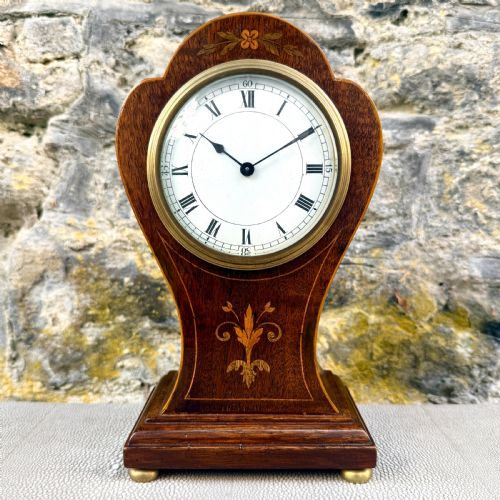
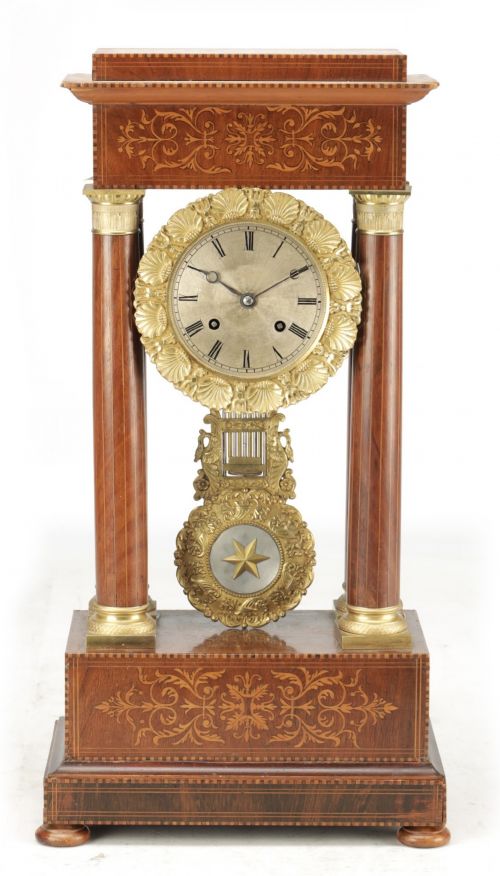
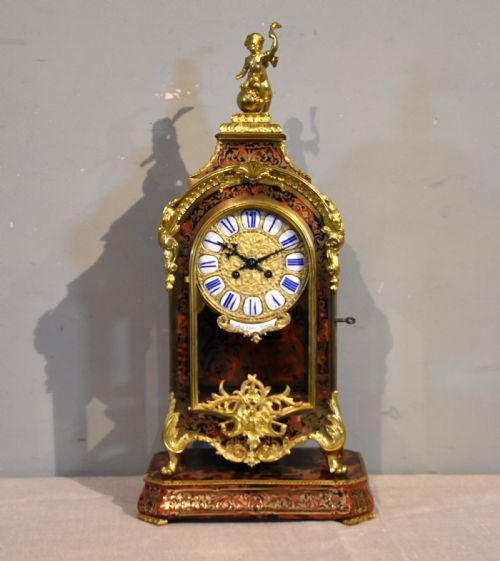
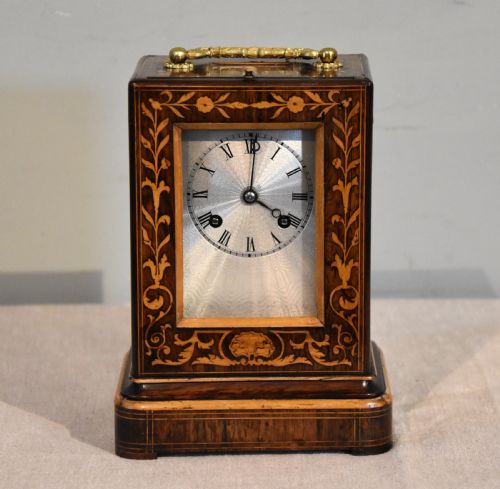
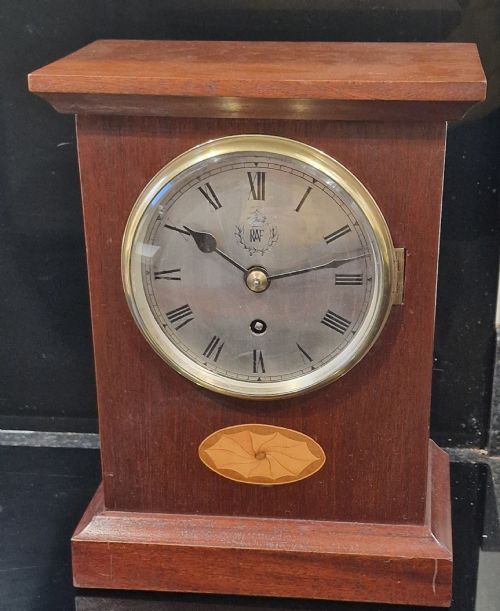


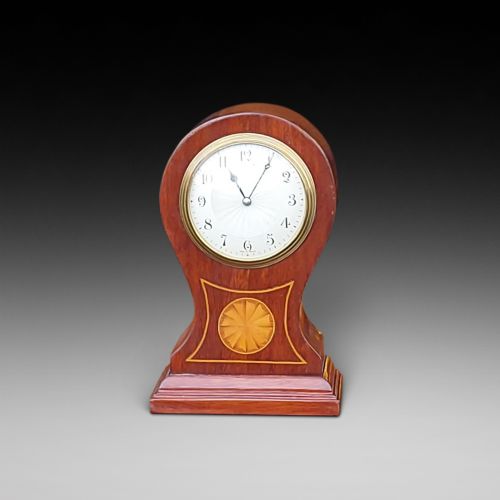


Brass Marquetry Timepiece
A brass marquetry timepiece brings together fine timber and precision metalwork, offering a decorative centrepiece for the mantel or shelf.
Brass Marquetry Timepiece
A brass marquetry timepiece is typically housed in rosewood, mahogany, or tortoiseshell, taking the form of mantel clocks, wall clocks, and portico clocks.
The examples gathered here span the nineteenth and twentieth centuries, taking in Victorian and Edwardian pieces alongside French revival styles.
Makers such as Henry Marc, Dumont, and Malecot appear amongst French nineteenth-century works, while Edwardian pieces favour inlaid mahogany and satinwood.
Materials and construction
Craftsmen built the carcasses from dense hardwoods like rosewood and mahogany, then applied delicate veneers of tortoiseshell, lemon wood, and boxwood.
Brass and ormolu were hand-cut and inlaid into the timber surfaces to create intricate Boullework patterns and floral motifs.
Enamel dials and protective glass bezels completed the housings, enclosing French and British mechanical movements designed for domestic interiors.
Distinctions in quality
The refinement of the brass inlay separates standard production from exceptional pieces, particularly where metal meets timber with absolute precision.
Complexity of case design also dictates standing, with architectural portico forms and tortoise-shell Boullework representing the more ambitious end of the craft.
Henry Marc·Dumont·Malecot of Paris
The Brass Marquetry Timepiece Glossary
- Boullework
- A form of marquetry employing brass and tortoiseshell inlaid in contrasting patterns, named after the famed cabinetmaker André-Charles Boulle.
- Portico clock
- A monumental clock design supported by four columns, often featuring architectural styling influenced by classical antiquity.
- Bracket clock
- A portable clock originally designed to sit on a wall bracket, though later examples stood directly on mantelpieces.
- Ormolu
- Gilt bronze applied to furniture and clock cases for decorative enrichment, providing metallic contrast to dark woods.
- Lancet clock
- A mantel clock featuring a pointed, arched top resembling a lancet window, popular during the Edwardian period.
Brass Marquetry Timepiece: Frequently Asked Questions
How do I wind a vintage timepiece?
Most mechanical clocks require a key to tension the mainspring through winding holes on the dial face. Care must be taken not to over-wind the movement.
Consulting a professional horologist for initial setup ensures the escapement and pendulum are correctly adjusted before regular use.
Where should I place a wooden mantel clock?
Select a stable, level surface away from direct sunlight and fluctuating heat sources like radiators. Timber cases and veneers react sensitively to rapid temperature changes.
Placing the clock on a solid mantel or shelf prevents vibrations that might interfere with the pendulum's beat.
What is the difference between a clock and a timepiece?
In horological terms, a timepiece is a clock that simply tells the time without striking hours or quarters on a bell or gong.
Many decorative bracket and portico models were constructed as pure timepieces to maintain a quiet domestic environment.
How do I identify a French nineteenth-century clock?
Look for signature engraving on the backplate of the movement, often accompanied by Parisian maker stamps and serial numbers. The casework frequently incorporates rosewood, ormolu mounts, or intricate Boulle brass inlay.
Stylistic cues such as Louis XV revival curves or portico architecture further point to French origin during the eighteen-hundreds.