
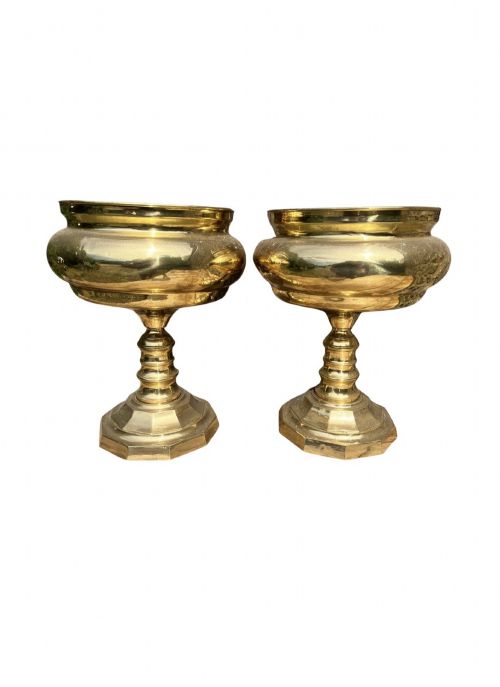
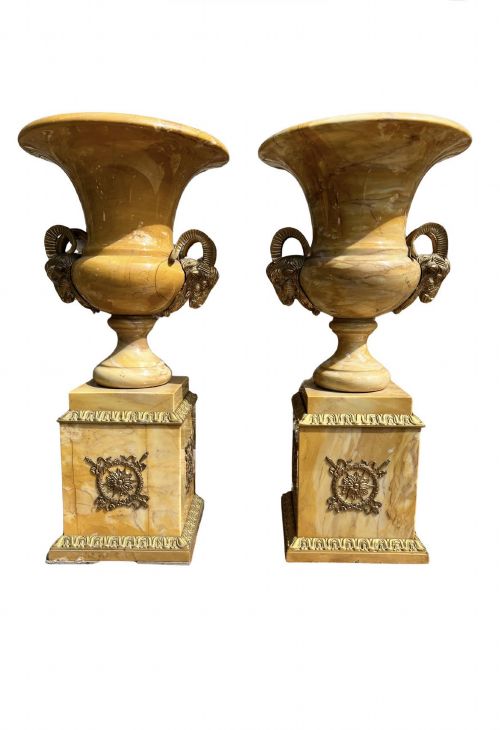


Brass Mantelpiece Urns
Brass mantelpiece urns are decorative metal vessels designed to sit atop fireplaces, bringing neoclassical symmetry and metallic warmth to a room.
Brass Mantelpiece Urns
Brass mantelpiece urns encompass decorative vessels, vases, goblets, and ewers intended for display on a fireplace surround. When searching for brass mantelpiece urns, buyers encounter matching pairs and garnitures that incorporate classical forms.
The pieces appearing on this page span the nineteenth century, including Victorian and late nineteenth-century examples alongside Italian Grand Tour productions and French Empire designs. They frequently appear alongside matching mantel clocks as part of larger garniture sets.
Origins range across British and continental workshops, with French influence visible through Louis XVI revival styles, ormolu finishes, and neoclassical details. Forms draw heavily on antiquity, utilising campana shapes and pierced brass bodies.
Materials and construction
Maker construction relies heavily on cast and turned brass, often combined with gilt bronze, ormolu, and bronze. Artisans paired these metals with contrasting materials like Sienna marble and glass to create visual weight and colour variation.
Surface ornamentation involved chasing, piercing, and gilding to catch the flickering light of a hearth. Many vessels incorporate applied mounts and classical detailing cast separately before being pinned or screwed to the main body.
Materials appearing across current selections include brass, gilt bronze, ormolu, bronze, Sienna marble, glass, and enamel.
Distinctions in quality
Quality rests in the crispness of the metal casting and the depth of the chasing work on the brass and bronze surfaces. Superior examples show sharp relief in floral and classical motifs rather than soft, rounded edges resulting from worn moulds.
The choice and integration of secondary materials separate standard production from high-end display pieces. Heavy marble bases, fire-gilded ormolu finishes, and substantial gauge brass indicate higher ambition from the maker.
The Brass Mantelpiece Urns Glossary
- Campana urn
- A bell-shaped vessel with a flared lip and a footed base, modelled after ancient Roman pottery and stone wine mixers.
- Garniture
- A set of matching decorative objects, typically comprising a central mantel clock flanked by a pair of urns or vases.
- Ormolu
- Finely ground high-carat gold applied to a bronze base using a mercury amalgamation technique, yielding a rich golden finish.
- Ewer
- A large jug with a wide spout and a sculpted handle, designed for pouring liquids but produced primarily as a decorative ornament.
- Grand Tour
- A cultural journey undertaken by wealthy young Europeans in the nineteenth century, acquiring classical antiquities and bronzes as souvenirs.
Brass Mantelpiece Urns: Frequently Asked Questions
Are these urns waterproof?
Most antique brass and bronze urns are decorative objects rather than functional vessels. Many feature pierced bodies, inner liners of different materials, or historical joins that are not watertight.
Utilising them for dried florals or displaying them empty preserves the material integrity of the antique metalwork.
How do I clean brass urns?
Dusting with a dry, soft microfiber cloth is the safest method for maintaining antique brass and gilt surfaces. Aggressive metal polishes strip away historical patina and can damage delicate gilding or applied ormolu.
Consult a conservator if deeper cleaning is required to remove stubborn residue without harming the underlying metal.
What is a clock garniture?
A clock garniture is a matched set designed to sit together on a mantelpiece, consisting of a central clock accompanied by two matching side pieces such as urns, vases, or candelabra.
This decorative arrangement creates symmetrical balance across the fireplace, a popular interior design convention throughout the nineteenth century.
How do I date these pieces?
Dating relies on stylistic clues, manufacturing techniques, and the combination of materials like Sienna marble and cast brass. Victorian and nineteenth-century pieces often reflect revivalist movements such as Louis XVI style or Neoclassicism.
Examining the construction of the base, screws, and casting seams helps establish the era of manufacture.