

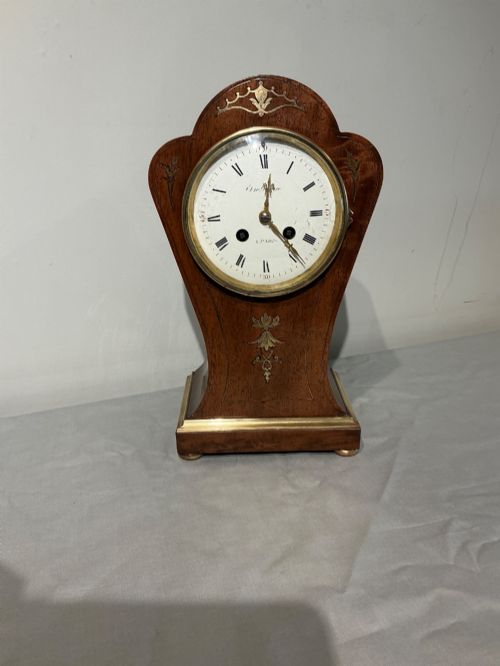
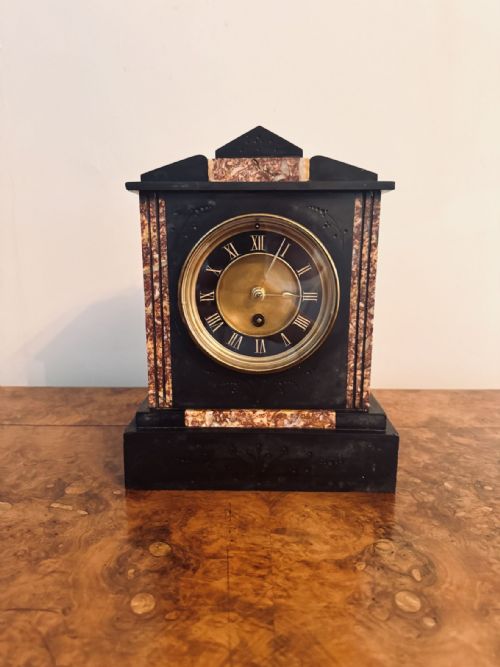
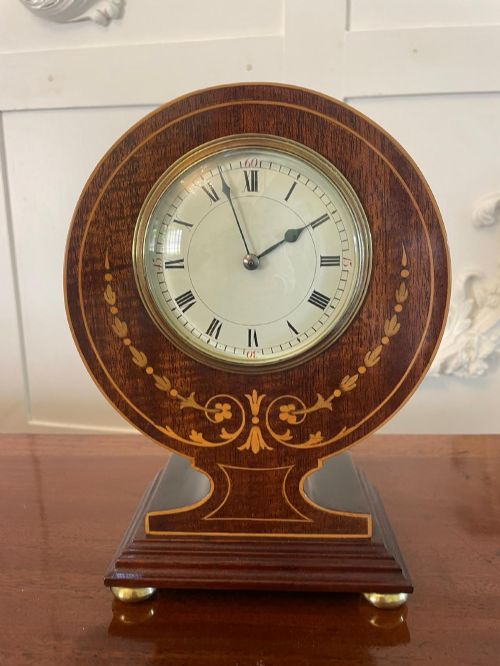
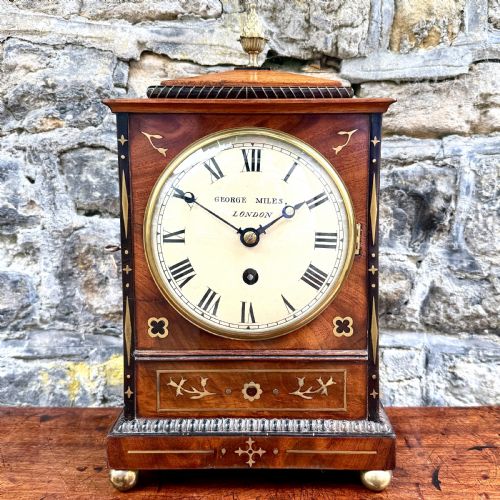

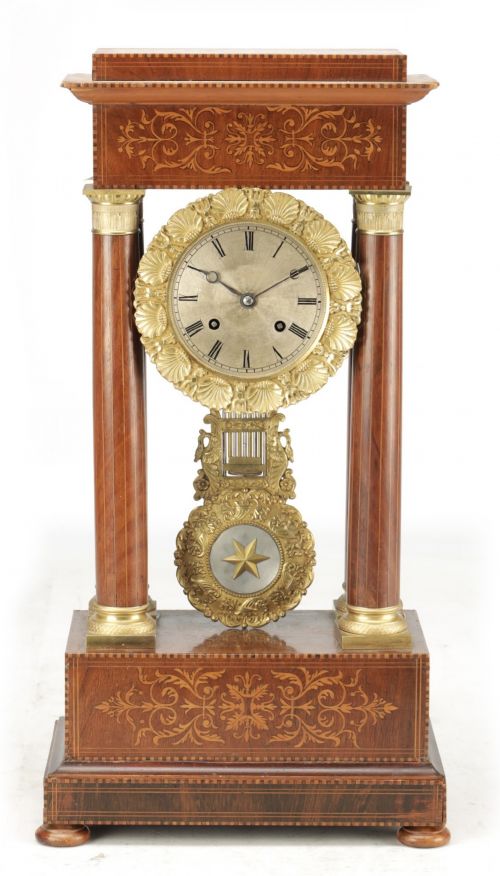


Brass Inlay Mantle Clock
A brass inlay mantle clock brings domestic timekeeping into the principal room with contrasting timber and metal work.
Brass Inlay Mantle Clock
When you examine a brass inlay mantle clock, you look at timepieces designed to sit upon a fireplace surround or bracket shelf in a principal room. The examples on this page span the Regency, Victorian, and Edwardian periods, stretching from the early nineteenth century into the twentieth.
Mahogany and rosewood form the main housing for the majority of these pieces, often enriched with satinwood or brass stringing. Forms vary from traditional bracket clocks and architectural wooden cases to French shaped and Boulle mantle models incorporating glass and enamel dials.
Materials and construction
Cabinet makers constructed these bodies from dense hardwoods like mahogany and rosewood, applying contrasting veneers and brass inlays to create geometric or floral motifs. Ormolu mounts and silvered metal dials frequently complement the timber framework.
Movements inside these wooden or marble housings utilise brass gear trains, often driven by springs with pendulum or balance wheel regulation. Glass panels protect the enamel or metal dials, allowing the escapement mechanism to remain visible in certain four-glass or regulator styles.
Brass Inlay Mantle Clock Retail Price Guide 2026
Typical asking prices for brass inlay mantle clock among the pieces listed under this phrase on Sellingantiques today, from the lower quarter to the upper quarter. They describe what is for sale here now, not the wider market.
Several pieces preserve the quiet ticking of a bygone era, long after the original owners misplaced their winding keys.
What separates the grades
The sophistication of the brass marquetry and the crispness of the timber carving dictate the visual standard of the piece. Finer examples display meticulous hand-cut inlay work that integrates seamlessly into the polished rosewood or mahogany surface.
Movement complexity also sets superior pieces apart, moving from basic timepieces to chiming eight-day mechanisms and double fusee systems created by notable makers. The weight of the marble, the clarity of the enamel dial, and the integrity of the original brass mounts further define the upper tier.
George Orpwood·L. Vick of Stroud·Thomas Moss·Cording of London·Thomas A Paris·Paul Garnier·Walker and Hall·Vulliamy·Seikosha
The Brass Inlay Mantle Clock Glossary
- Bracket clock
- A portable timekeeper originally designed to sit upon a wall bracket to aid movement between rooms. These spring-driven pieces typically feature sturdy wooden cases with brass carrying handles.
- Boulle
- An intricate marquetry technique employing brass and tortoiseshell or dark horn inlaid in elaborate scroll patterns. It gained popularity in French mantle pieces during the nineteenth century.
- Fusee
- A conical pulley used within clock movements to maintain an even pull on the gear train as the mainspring unwinds. This mechanism improves the timekeeping accuracy of the clock.
- Ormolu
- Gilded bronze applied to clock cases as decorative feet, bezels, or finials. The technique involves treating metal with a mixture of gold and mercury.
- Enamel dial
- A metal clock face covered with fused powdered glass to create a smooth, white background for painted numerals. These dials resist tarnishing and maintain their legibility over centuries.
Brass Inlay Mantle Clock: Frequently Asked Questions
How do I wind an eight day mantle clock?
Insert the appropriate key into the winding arbour on the enamel dial and turn it gently until you feel resistance. Take care not to overwind the spring, as this can damage the internal brass gear train.
Most eight-day movements require attention once a week. Keep the key in a safe location near the clock so it remains accessible whenever the timekeeper stops.
Where should I place a mahogany bracket clock?
Select a stable, level surface away from direct sunlight, central heating vents, and damp exterior walls. Sudden temperature shifts can cause the mahogany or rosewood timber to warp and affect the delicate brass mechanism inside.
A mantelpiece or a dedicated wall bracket offers an ideal display space. Ensure the surrounding area remains free from heavy vibrations that might disrupt the pendulum swing.
How do I date an antique French mantle clock?
Examine the style of the case, the materials used, and any signatures stamped upon the brass backplate of the movement. French pieces from the mid-nineteenth century often favour ornate Boulle work or black slate, while later Victorian versions incorporate varied marble.
Maker signatures or exhibition stamps provide further clues to the decade of production. Compare the dial construction and key escapement style with documented examples from the same period.
Why does my fusee clock lose time?
A clock that loses time often requires a professional clean and lubrication of its brass pivots and gears. Dust accumulation inside the wooden housing thickens the old oil, creating friction that slows the movement.
Check that the clock rests on a completely level surface, as a tilt alters the beat of the pendulum. Minor regulation can be achieved by adjusting the pendulum bob up or down on its threaded screw.