
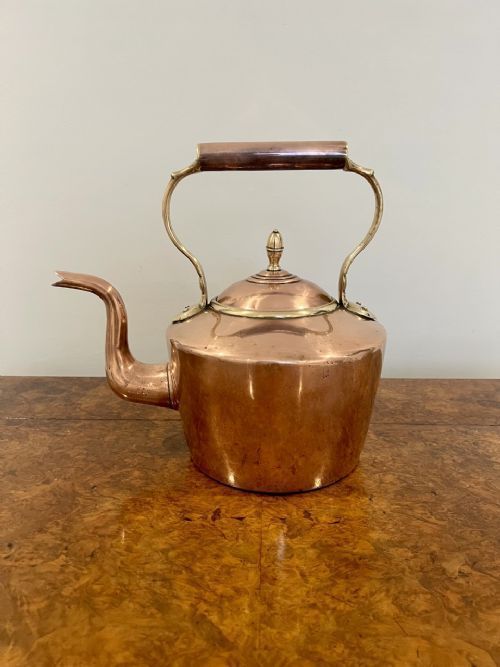
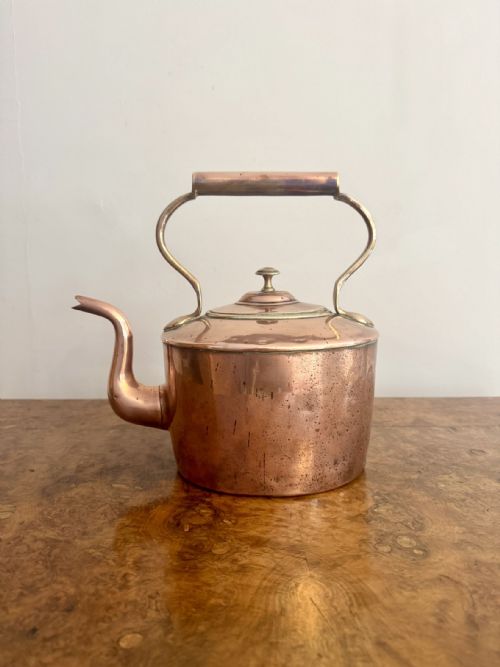
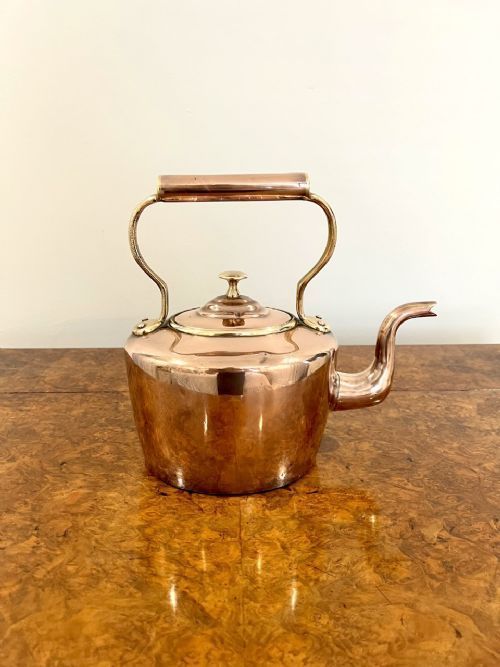


Brass Handle Tea Kettle
These brass handle tea kettle pieces combine warm metal and sturdy form, offering functional history for the hearth or table.
Brass Handle Tea Kettle
A brass handle tea kettle brings together domestic utility and period craftsmanship, centred on vessels designed for boiling water. When exploring brass handle tea kettle examples, buyers encounter forms spanning the Georgian and Victorian eras, alongside Edwardian and later pieces.
The selection here includes standard kettles, spirit kettles with stands, samovars, and water urns. These objects originate from the 18th, 19th, and early 20th centuries, reflecting the changing designs of British domestic interiors.
Materials and construction
Copper and brass form the primary body and handle materials of these vessels, often paired with iron, cane, glass, or ebonised wood for insulation and grip. Metalworkers shaped these components through hammering, casting, and joining techniques.
Handles incorporate brass, sometimes fitted with wood or cane elements to protect hands from heat. Stands and auxiliary parts add further structural complexity using iron and brass.
Some kettles arrived with spirit stands ready to boil water while guests waited patiently for tea.
Evaluating craftsmanship and design
Quality in these pieces rests upon the precision of the metalwork, the weight of the copper and brass, and the integrity of the joints. Finer examples display balanced proportions, whether formed in a traditional round shape or an unusual oval silhouette.
The presence of complete stands, spirit burners, and original wooden or ebonised fittings elevates certain items. Aesthetic Movement and Arts and Crafts examples show distinct stylistic flourishes that set them apart from standard utilitarian forms.
The Brass Handle Tea Kettle Glossary
- Spirit kettle
- A kettle mounted on a metal stand with an integrated spirit burner underneath for keeping water warm at the table.
- Samovar
- A large heated metal container traditionally used to boil and heat water for tea.
- Water urn
- A large vessel designed for storing and dispensing heated water, sometimes fitted with a hanging bracket or tap.
- Ebonised wood
- Timber treated with a dark finish to resemble ebony, frequently used for kettle handles and knobs.
- Aesthetic Movement
- A late 19th-century design style emphasising visual and compositional beauty over narrative content.
Brass Handle Tea Kettle: Frequently Asked Questions
How were these kettles used originally?
These vessels heated water over open hearths or dedicated spirit burners for tea service and domestic washing.
Larger urns and samovars provided continuous hot water for social gatherings and formal dining rooms.
How do I care for brass and copper?
Maintenance involves dusting with a dry cloth and occasionally using a gentle metal cleaner if polishing is desired.
Most owners prefer to preserve the natural patina accumulated over centuries rather than polishing the metal to a bright shine.
Are spirit kettles usable today?
Spirit kettles can still function for heating water if the internal chamber and burner remain intact and sound.
Many buyers choose to display them as decorative historical objects rather than connecting burners for active use.
How can I tell a Georgian kettle from a Victorian one?
Georgian kettles often feature simpler, robust copper construction with hand-hammered details typical of the late 18th and early 19th centuries.
Victorian and Edwardian versions frequently introduce varied silhouettes like oval shapes, decorative stands, and stylistic influences from the Aesthetic Movement.