
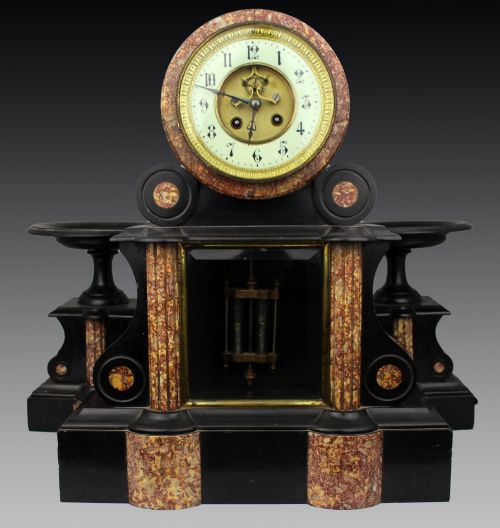
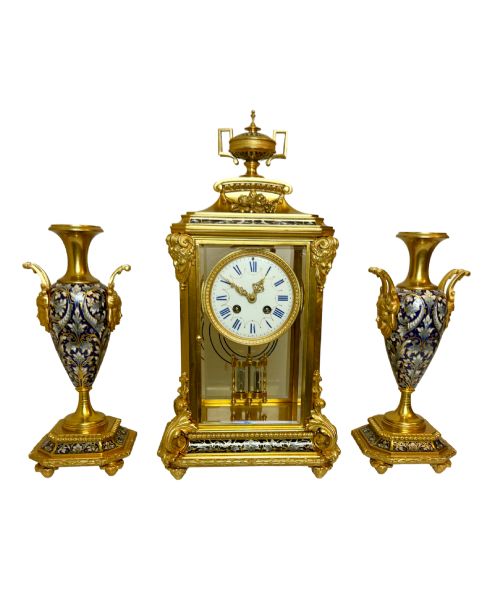
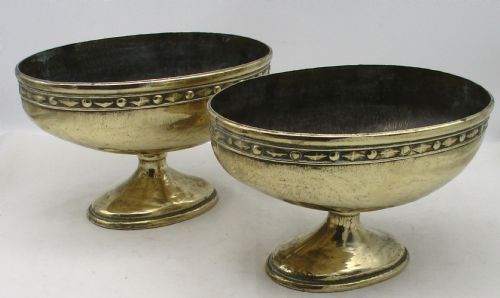
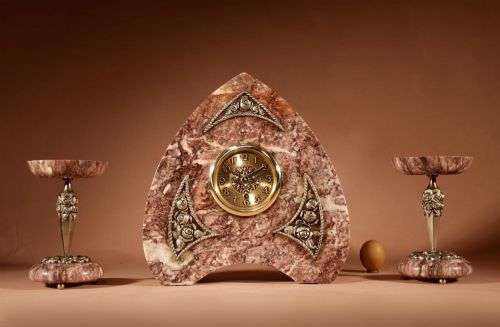


Brass Garniture Set
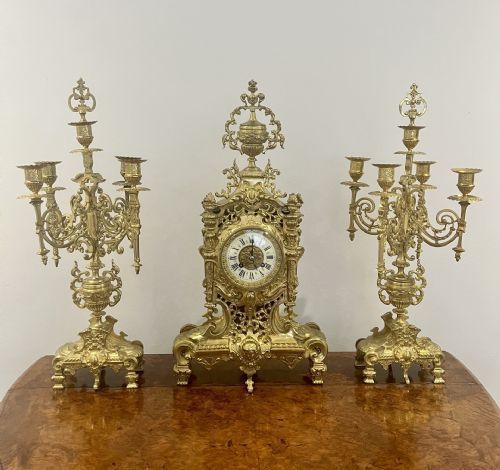
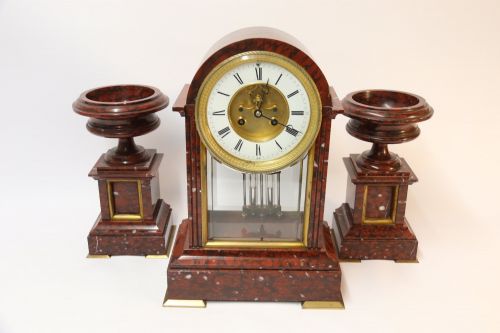
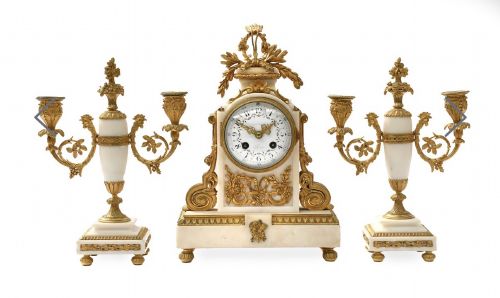
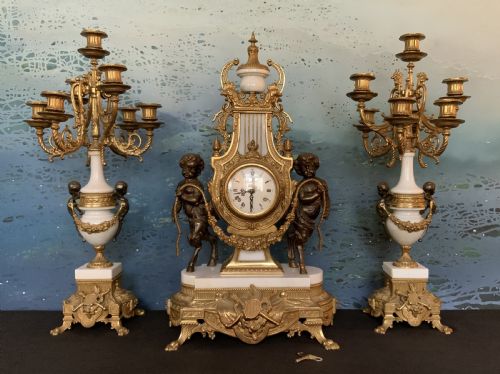
A brass garniture set brings coordinated symmetry to a mantelpiece, combining a central clock with matching vases or candelabras.
How they were made
Foundry workers cast brass, gilt bronze and ormolu into ornate Rococo, Neo-Classical and Art Deco frames using traditional metal-working techniques. Artisans then chased the metal surfaces by hand to sharpen the leaf scrolls, cherubs and architectural details before applying gilding.
The stone elements utilise heavy black, pink, green or Sienna marble, onyx and slate, shaped into portico columns, plinths and column cases to support the metal mountings. Enamel, porcelain and champlevé or cloisonné enamel decorate the clock dials and panels with coloured patterns.
What varies in quality
The weight and crispness of the cast metal mountings separate standard sets from exceptional examples. Finer sets display deep, sharp chasing on the ormolu and bronze, while simpler pieces rely on softer, shallower casting.
The choice of body material alters the character of a set, ranging from basic slate and plain brass to dense variegated marble, onyx and hand-painted porcelain panels. Named Parisian clockmakers and retailers also indicate the standard of the internal eight-day movement.
Listings include French and Italian sets spanning the nineteenth and twentieth centuries, incorporating materials like champlevé enamel, gilt bronze, marble, porcelain and slate.
Japy Frères·Samuel Marti·A.D Mougin·Finnigan Manchester·Vincenti of Paris·Deniere Paris
The Brass Garniture Set Glossary
- Garniture set
- A matched group of decorative objects designed to be displayed together, usually comprising a central clock and two matching side pieces such as candelabras or urns. They gained popularity in grand interiors to create symmetrical focal points.
- Ormolu
- Finely ground high-carat gold mercury-gilded onto a bronze or brass object. This technique produced a rich, warm metallic finish seen across nineteenth-century French decorative arts.
- Champlevé enamel
- A technique where troughs or cells are hollowed out of the metal surface and filled with vitreous enamel powder before firing. The resulting coloured designs sit flush with the surrounding brass or bronze framework.
- Portico clock
- A mantel clock built within an architectural framework supported by four columns, resembling a classical temple facade. They often form the central element of a marble or onyx garniture set.
- Candelabra
- A branched candlestick holding multiple candles, frequently produced as the matching side pieces in a garniture set to flank a central clock.
Brass Garniture Set: Frequently Asked Questions
How were garniture sets used?
Garniture sets served as both timekeeping devices and decorative centrepieces for drawing rooms, dining rooms and grand hallways. They were positioned centrally on mantelpieces above fireplaces or upon large consoles.
The side pieces balanced the visual weight of the clock and could hold candles or display decorative porcelain and bronze work.
How do I identify French nineteenth-century sets?
Nineteenth-century French sets often feature cast ormolu, gilt bronze or brass combined with coloured marble, slate or onyx. Look for markers' names stamped on the brass clock movements, such as Japy Frères or Samuel Marti.
Stylistic cues include Rococo scrolls, Louis XVI neoclassical columns, and champlevé enamel dials characteristic of the Victorian period and Second Empire.
How do I clean and care for them?
Care for the brass and gilt surfaces by dusting gently with a soft, dry cloth to prevent accumulation. Avoid chemical metal polishes, which can strip away the original ormolu or gilding.
Keep marble and onyx surfaces free of moisture, and have the mechanical clock movements serviced periodically by a professional horologist.