


Brass Footed Jardiniere
These brass footed jardiniere vessels bring heavy metal character to interior planting, offering period presence that modern pots lack entirely.
Brass Footed Jardiniere
A brass footed jardiniere is a decorative plant vessel designed to hold indoor greenery while elevating the container on integral feet. These pieces range from compact Victorian cylinders to substantial Georgian and 18th-century Dutch examples built for grand rooms.
The versions most commonly met on this page span the nineteenth century, including Victorian and Edwardian interpretations alongside Dutch traditional and French Empire pieces. Many double as wine coolers or plant stands, showing the flexible utility expected in period households.
How they were made
Makers utilised heavy sheet brass and copper, often forming cylindrical bodies through metal-spinning or hand-coopering. Several examples incorporate mahogany or walnut staves bound with metal hoops, marrying timber craftsmanship with brass mounts.
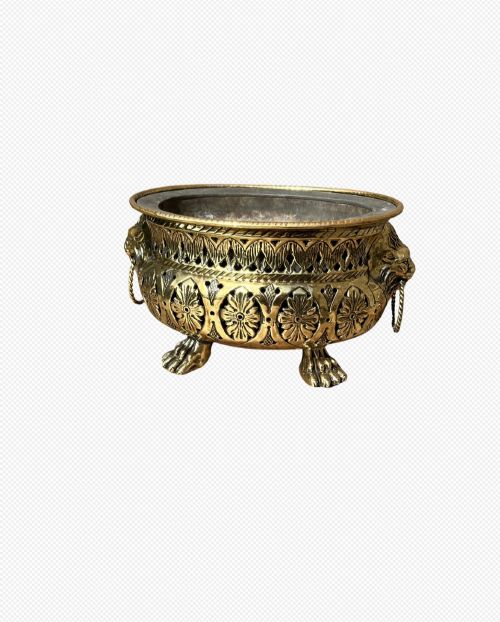
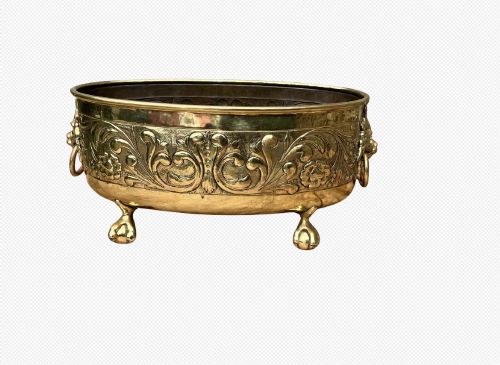
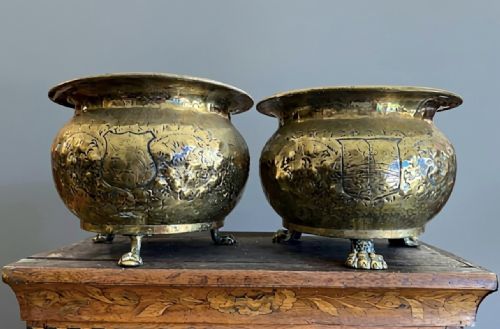
Surface ornamentation relied heavily on repoussé techniques, hammering designs from the reverse to create raised animal heads, lion mask handles, and botanical motifs. Pierced galleries and openwork fretwork appear frequently on nineteenth-century specimens.
Watch for ferocious lion masks keeping guard over ordinary ferns.
What varies in quality
Quality rests primarily on the gauge of the metal and the crispness of the hand-chased or repoussé detail. Heavy-gauge brass holds its structural integrity and supports weight without buckling at the rim or feet.
The distinction between standard production and finer work shows in the execution of cast mounts, such as lion mask handles and decorative feet, where sharp casting and secure attachment define the better pieces.
The Brass Footed Jardiniere Glossary
- Repoussé
- A metalworking technique where the artisan hammers a design from the reverse side to produce a raised relief on the front. This method creates the three-dimensional animal heads and botanical motifs seen on many planters.
- Coopered
- Constructed from vertical wooden staves fitted together and bound with metal bands, similar to barrel-making. This technique appears in mahogany and walnut planters.
- Jardiniere
- A large ornamental pot or stand designed to hold flowers or potted plants indoors. The term originates from the French word for gardener.
- Pierced
- Perforated or cut through to create an openwork pattern, often seen around the rim of nineteenth-century vessels. This decorative approach lightens the appearance of heavy metal.
Brass Footed Jardiniere: Frequently Asked Questions
What is a jardiniere used for?
These vessels house indoor potted plants or cut flowers, acting as an ornamental container that conceals standard nursery pots.
Historically, similar forms also functioned as wine coolers, holding ice and bottles during dining rooms service.
How do I clean antique brass?
Dust gently with a soft dry cloth and avoid harsh commercial metal polishes that strip away the aged patina.
Many collectors prefer to leave the dark oxidation undisturbed because it demonstrates age and handling over centuries.
Are these planters waterproof?
Many period metal planters lack sealed seams or liners, meaning direct planting can cause moisture leaks and active corrosion.
Placing a modern plastic saucer or liner inside protects the historic base from standing water.
How do I date a brass planter?
Dating relies on stylistic clues like Gothic Revival motifs, French Empire shapes, or Georgian proportions, alongside construction methods such as hand-hammering versus machine rolling.
Foot styles and handle attachments also shift across the eighteenth, nineteenth, and early twentieth centuries.