


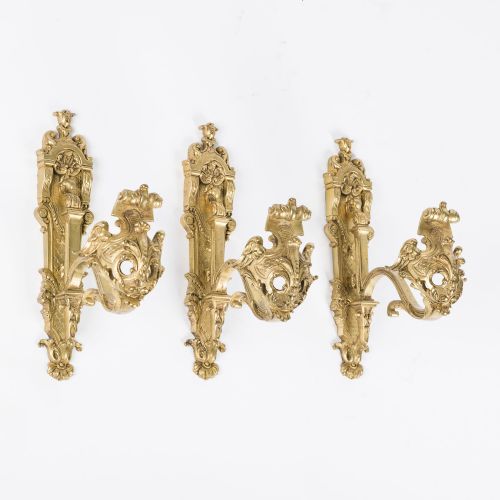


Brass Curtain Hooks
Brass curtain hooks are solid metal fasteners designed to hold drapery back gracefully against the wall.
Brass Curtain Hooks
Brass curtain hooks encompass decorative tie backs and wall hooks used to dress heavy window drapery. When searching for brass curtain hooks, collectors and decorators encounter matching pairs or sets designed to secure fabric panels on either side of a window.
The selections span functional Georgian items through ornate French Rococo Revival and Gothic Revival creations. Common forms include lion motifs, fleur-de-lys designs, and dragon figures, originating from the eighteenth and nineteenth centuries.
How they were made
These pieces rely heavily on cast brass, ormolu, and gilt bronze, utilising metalworking techniques typical of nineteenth-century French and British foundries. Artisans chased and gilded the surfaces to achieve a bright finish.
Some examples incorporate enamel elements to add colour and contrast to the metal structure. Workers secured the decorative faces to sturdy iron or brass stems intended for wall mounting.
Materials recorded across the inventory include ormolu, gilt bronze, enamel, and copper alongside standard brass.
What varies in quality
Quality rests in the crispness of the casting and the depth of the chasing work, particularly visible on facial details or botanical motifs. Finer pieces display sharper relief and careful hand-finishing that lesser castings lack.
The thickness of the gilt bronze or ormolu layer also dictates the calibre of the object. Heavier, more substantial brass cores paired with durable gilding represent the upper end of the production.
The Brass Curtain Hooks Glossary
- Ormolu
- Gilded bronze produced by applying a mercury and gold amalgam to a bronze object and heating it. This technique creates a rich, lasting metallic lustre.
- Gilt Brass
- Brass that has been coated with a thin layer of gold leaf or gold wash. It provides the appearance of solid gold at a lower material cost.
- Rococo Revival
- A nineteenth-century design style drawing on eighteenth-century French asymmetry, scrollwork, and natural motifs. It appears frequently in ornate curtain hardware.
- Curtain Tie Back
- A decorative fixture mounted to the wall to hold drapery open. These items serve both a practical support function and a decorative role.
Brass Curtain Hooks: Frequently Asked Questions
How do you install antique curtain hooks?
These pieces generally feature a threaded screw stem or mounting plate designed to secure directly into wooden window frames or wall anchors. Care is required during installation to avoid over-tightening and damaging the brass or ormolu surface.
Matching the screw gauge to existing holes prevents stripping the surrounding masonry or woodwork. A pilot hole ensures the stem seats firmly without twisting the decorative head.
Are these hooks sold in pairs?
Many examples appear as matched pairs intended to frame a single window symmetrically. Sets of four also occur for larger drapery installations.
Single items occasionally surface from dispersed collections. Checking the listing details confirms whether the hardware constitutes a matched set.
What periods do these hooks come from?
The available examples date primarily from the eighteenth and nineteenth centuries, including Georgian and Victorian eras. French styling heavily influences the nineteenth-century production.
Stylistic markers such as Gothic dragons or Rococo scrollwork help assign pieces to specific decades between seventeen-fifty and eighteen-eighty.
Can modern curtains use antique hooks?
These robust metal hooks support modern drapery fabrics provided the weight does not exceed the capacity of the mounting wall. The projection from the wall accommodates standard curtain thicknesses.
Heavier velvet or damask drapes sit securely within the curved arms of nineteenth-century tie backs. Ensuring sturdy wall fixings protects both the fabric and the antique metal.