
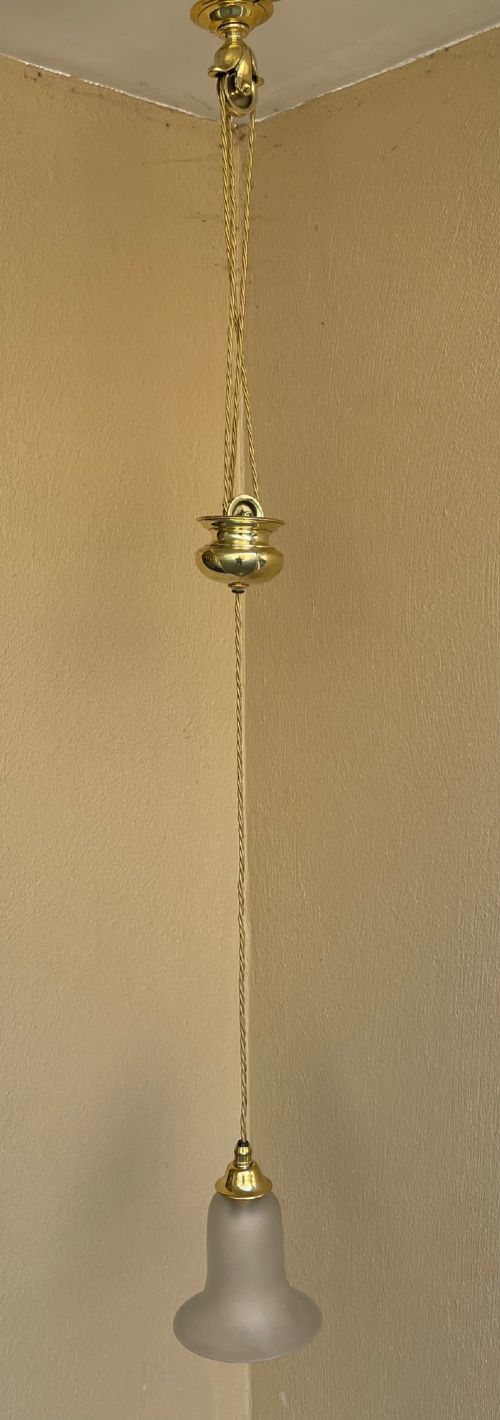
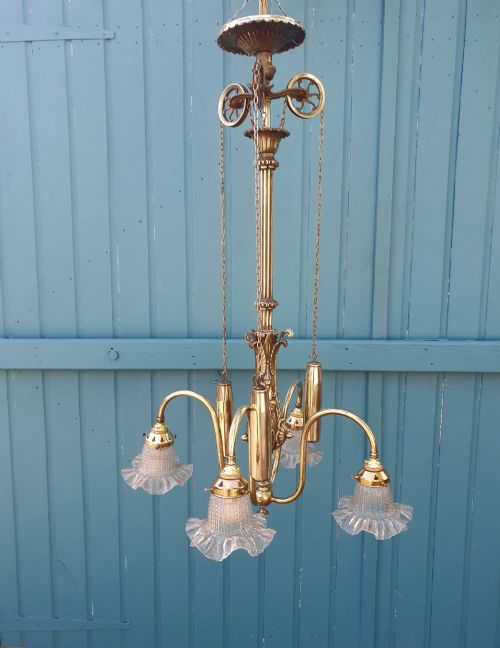


Brass Counterweights
Brass counterweights are heavy regulating devices used in adjustable lamps, scales, and balances, prized for their solid metal weight and mechanical utility.
Brass Counterweights
When you search for brass counterweights, you are looking at functional metal components that steady rise and fall lighting fixtures, desk lamps, and mechanical scales. These objects date from the Victorian, Edwardian, and Art Deco periods, encompassing working weights and counterbalanced hanging lamps.
The versions most likely to be met on this page are Edwardian rise and fall pendant lights, ceiling lights, and chandeliers utilising brass weights, alongside complete sets of standard imperial and avoirdupois weights. Such pieces originate from practical contexts like municipal offices, studies, and scientific workspaces.
Beyond lighting, the category includes specialised balancing equipment such as postal scales, stick balances, and student reading lamps. The materials associated with them extend to opaline glass shades, fabric flex cables, hardwood, and wrought iron.
How they were made
The construction of these pieces relies heavily on cast and turned brass, shaped to provide the precise mass required for hanging light mechanisms or balance scales. Makers combined this metalwork with structural elements in wrought iron and hardwood, particularly in larger balances and standard weight sets.
Lighting fixtures incorporate fabric cables, fabric cords, and fabric flex alongside opaline glass shades to house electrical components safely while maintaining a period appearance. Stamped markings and engravings identify standard weights produced for specific regional authorities and cities.
Listings feature brass counterweights integrated into Victorian and Edwardian desk lamps, pendant lights, standard weight sets, and scientific balances.
What varies in quality
Quality in these items is determined by the precision of the metal casting, the integrity of the mechanical action, and the crispness of any maker or municipal stamps. Pieces intended for scientific or official public use, such as standard weights for counties and cities, display higher standards of manufacture.
The retention of original components, from the specific brass hue to the matching hardware and glass elements, distinguishes finer examples. The proportional balance between the heavy metal weight and the associated fitting governs the overall execution of the object.
Osler·W&T Avery·De Grave·Wild & Wessel
The Brass Counterweights Glossary
- Rise and fall
- A mechanical lighting arrangement utilising a counterweight to allow the height of the pendant or lamp to be adjusted smoothly by hand.
- Avoir Standard
- A system of official weights conforming to avoirdupois standards, frequently stamped for specific cities or regional authorities.
- Swan neck
- A curved metal arm shape commonly found on desk lamps and reading lights of the Edwardian and later periods.
- Stick balance
- A traditional weighing apparatus constructed from hardwood, wrought iron, and brass for measuring loads.
- Opaline glass
- A milky, semi-translucent glass used extensively for shades on period pendant and desk lighting.
Brass Counterweights: Frequently Asked Questions
What are brass counterweights used for?
These brass weights and counterbalanced assemblies were primarily engineered to regulate the height of adjustable pendant lights and chandeliers, or to serve as precise standards in mechanical scales. Their weight allowed hanging lamps to remain stable at various heights without slipping.
In daily use, they combined utilitarian function with the polished aesthetic of Victorian and Edwardian interiors, making them essential for functional workspaces and formal rooms alike.
How do I date a rise and fall lamp?
Dating these lighting fixtures involves examining the manufacturing techniques, the style of the brass components, and associated materials like fabric flex or opaline glass shades. Edwardian and Victorian examples often feature distinct casting methods and maker's marks that anchor them to specific decades.
Looking closely at the patina of the brass and the wiring provisions can also indicate whether a piece belongs to the late nineteenth century or the early twentieth century.
Are standard weights collector items?
Complete sets of standard weights, particularly those stamped for specific regional authorities or cities by makers like W&T Avery or De Grave, are collected for their historical and industrial interest. They record official metrology and local governance from the Victorian and Edwardian eras.
These sets often retain their original fitted wooden boxes and precise stampings, which appeal to collectors of scientific and utilitarian antiques.
How do I care for antique brass?
Maintaining antique brass involves dusting gently with a soft cloth and avoiding harsh chemical polishes that can strip the historic patination accumulated over generations. Preserving the natural surface texture ensures the metal retains its character and age-appropriate appearance.
For wired items like desk lamps and pendant lights, routine checks of the electrical components by a qualified professional ensure safe daily use in a modern home.