


Antique Measuring Weights
Antique measuring weights are functional standards of mass and capacity that anchor domestic trade and official measurement.
Antique Measuring Weights
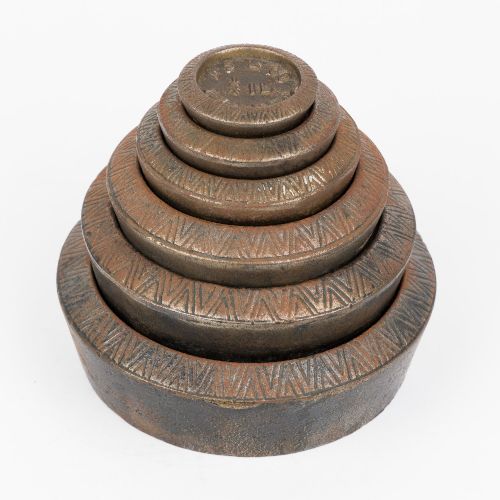
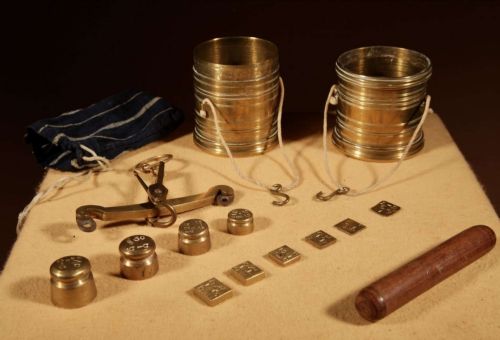
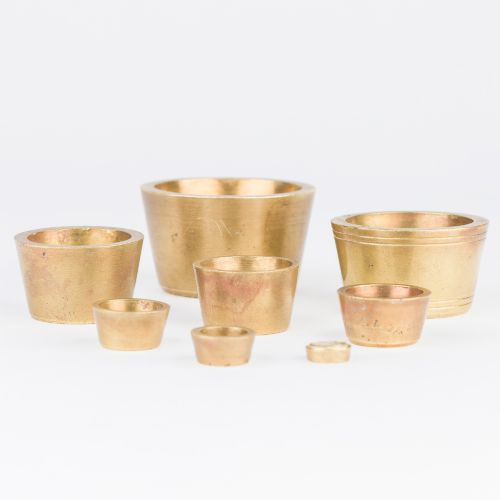
Antique measuring weights comprise sets of brass stacking weights, Troy ounce systems, and avoirdupois standards produced across the nineteenth and twentieth centuries. These objects served official verification purposes for counties and boroughs, alongside domestic commercial trade.
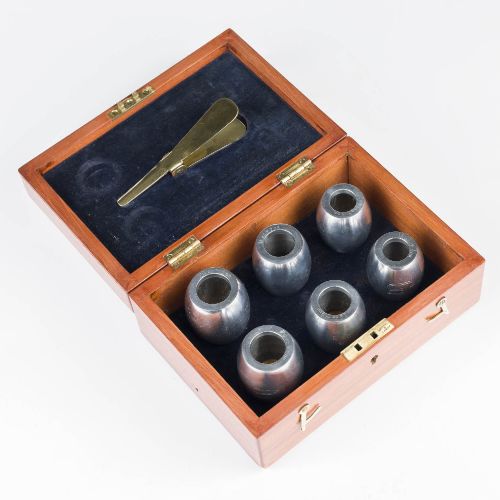
Buyers meet varied forms on this page, ranging from complete sets in mahogany cases to individual verification balances and imperial measures in brass, copper, and cast iron. Victorian examples dominate the selection, often associated with specific local authorities such as the City of Liverpool or the County of Essex.
The objects span scientific instruments and industrial calibration tools, reflecting rigorous governmental standardisation. Many items retain their original fitted boxes or wooden housings lined with velvet and textile.
How they were made
Makers utilised cast iron, brass, and copper to form the durable bodies required for accurate calibration and heavy handling. These metals were turned, cast, and polished to exact tolerances demanded by municipal inspectors.
Enclosing cabinetry relied on mahogany and other dense woods, often lined internally with velvet or textile to protect delicate balance components and standard weights. Metal elements frequently carry stamped verification marks and maker inscriptions.
Listings feature Victorian and Edwardian periods alongside mid-twentieth-century items, constructed from brass, mahogany, cast iron, and copper.
What varies in quality
Quality rests upon the completeness of a set and the clarity of official verification stamps denoting specific geographic jurisdictions. Comprehensive assemblages housed within their original fitted mahogany cases represent a higher standard than scattered individual pieces.
The precision of manufacture by established scale makers elevates certain pieces above standard utilitarian hardware. Surviving documentary association with named boroughs and verified inspection offices distinguishes superior survivals.
De Grave Short And Co·W And T Avery·De Grave And Co
The Antique Measuring Weights Glossary
- Troy ounce
- A system of units of mass used for precious metals. Sets of these weights appear in nineteenth-century scientific and commercial contexts.
- Avoirdupois
- A system of weights based on a pound of sixteen ounces. Standard sets served everyday trade and municipal inspection.
- Chondrometer
- An instrument used to determine the density or weight of grain. These scientific devices were typically housed in mahogany cases.
- Bushel balance
- A specific apparatus designed for measuring dry volume or capacity. Dutch examples demonstrate distinct regional nineteenth-century styling.
- Verification balance
- A precision scale utilised by inspectors to check commercial weights. These scientific instruments were built by specialist makers for city authorities.
Antique Measuring Weights: Frequently Asked Questions
What are antique measuring weights?
These pieces are verified standards of mass and capacity used in trade and municipal administration. They include brass stacking sets, Troy ounce collections, and heavy standard weights.
Many were commissioned by specific counties and boroughs, bearing official stamps and maker details. They reflect the strict regulatory systems of the nineteenth and twentieth centuries.
How were these weights used?
Weights served to calibrate commercial scales and verify measures used in markets and shops. Inspectors utilised them to ensure fair trade across cities and towns.
Some pieces functioned as standard lengths or bushel measures for testing bulk commodities. Others served in governmental offices and verification stations.
How do I date these objects?
Dating relies on stamped verification marks, reigning monarchs' ciphers, and maker inscriptions on the metal or wood. Stylistic cues in the mahogany cases also help establish the period.
Many pieces carry specific dates of manufacture or municipal issue stamped directly into the brass or cast iron surfaces.
How should I display them?
Complete sets sit well displayed inside their original mahogany cases alongside beam scales or scientific instruments. Individual stacking weights can be arranged together on flat surfaces.
Keep them away from excessive moisture to preserve the polished brass and textile linings. Regular dusting maintains the finish of the metal and wood.