
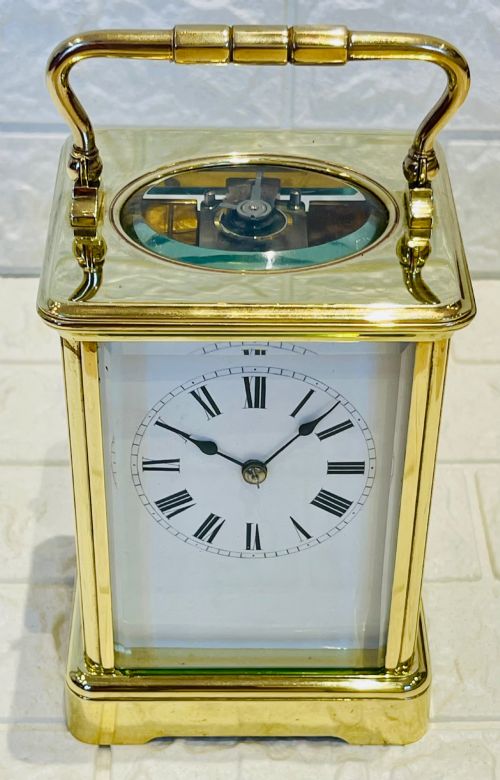


Brass Corniche Carriage Clock
A brass corniche carriage clock offers precision portable timekeeping encased in polished metal and glass, appealing to collectors who prize mechanical ingenuity.
Brass Corniche Carriage Clock
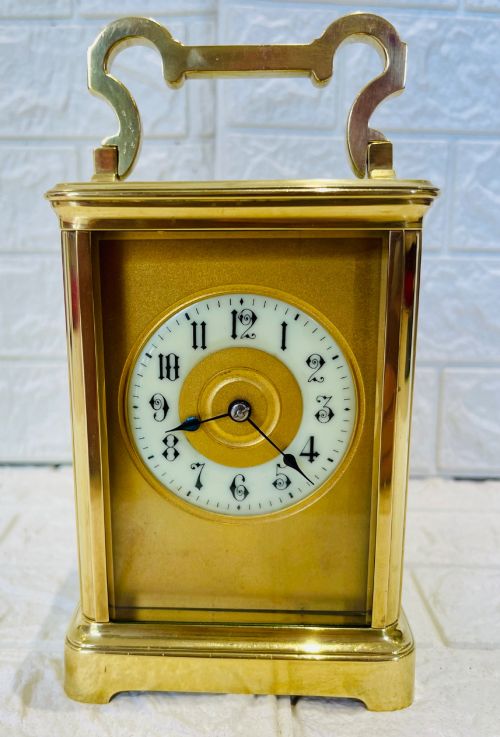
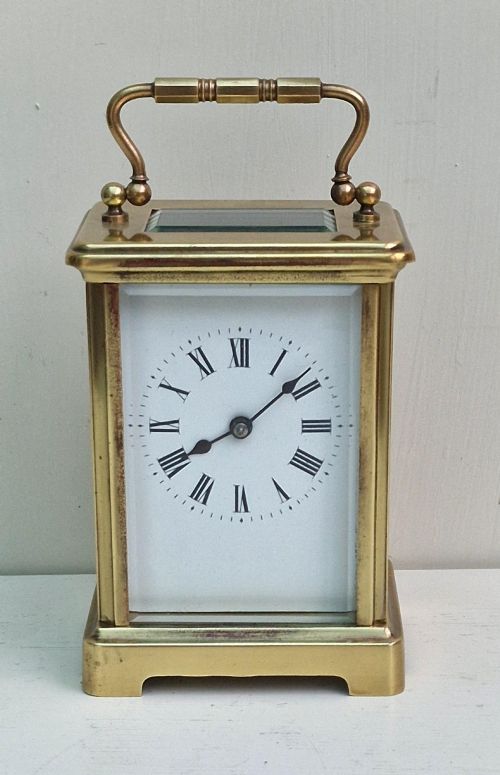
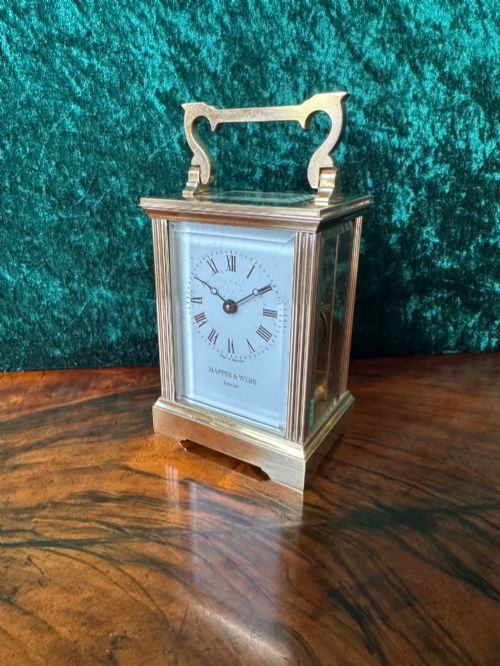
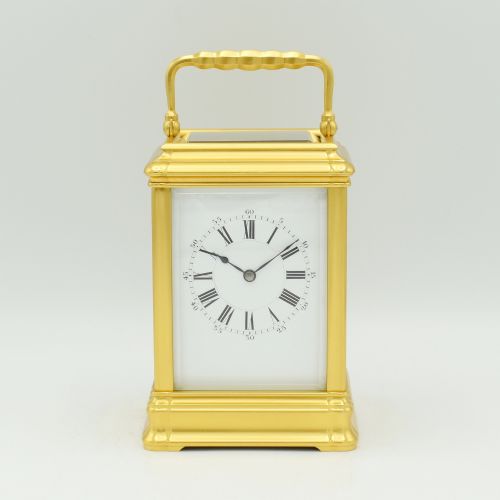
When you search for a brass corniche carriage clock, you are looking at portable timepieces housed in distinct architectural cases featuring flat top glasses and pillared corners. The examples on this page span the nineteenth century and the early twentieth century, dominated by French Victorian designs.
Most pieces you meet here originate from French workshops and retail establishments, often constructed with eight-day movements. These clocks range from standard timepieces to complex mechanisms including striking, repeating, alarm and petite-sonnerie functions.
You will also find variations in size, from miniature and subminiature formats to substantial striking examples. The defining corniche framework remains consistent across these iterations, providing clear visibility of the internal escapement through bevelled glass panels.
What varies in quality
The sophistication of the internal movement separates standard timepieces from high-end examples. Clocks featuring repeating mechanisms, alarms or multiple gongs require greater horological skill than a simple time-only movement.
The crispness of the gilt brass casting and the weight of the corniche case indicate the tier of production. Finer pieces bear the signatures of esteemed makers on their backplates and retain original leather travelling cases.
The listings show French carriage clocks produced across the nineteenth and twentieth centuries, utilising gilt brass, enamel, and glass.
Henri Jacot·Drocourt·Paul Garnier·Mappin and Webb·T. Martin and Co·J.W. Benson·James Grohe·Latshea and Sons
The Brass Corniche Carriage Clock Glossary
- Corniche case
- A traditional carriage clock case design characterised by a flat top, rounded or pillared corners, and a handle above. This style provides an unhindered view of the dial and interior mechanics through bevelled glass panels.
- Repeating mechanism
- A complication activated by pushing a button on top of the case, causing the clock to strike the last hour and quarters audibly. This function allowed owners to check the time in darkness.
- Petite-sonnerie
- A quarter-striking system that automatically sounds the hours and quarters as they pass without requiring manual intervention. It represents a higher standard of horological complexity.
- Escapement
- The internal mechanism that controls the release of gear train energy to maintain the pendulum or balance wheel motion. Platform escapements are standard in carriage clocks for portability.
- Breguet hands
- Delicately pierced moon-tipped hands often found on fine nineteenth-century clock dials. They contribute to the refined aesthetic of the timepiece.
Brass Corniche Carriage Clock: Frequently Asked Questions
How do I wind a carriage clock?
Use the designated key on the backplate to turn the arbours clockwise until you feel resistance. Ensure you do not overwind the mainspring.
Most eight-day movements require winding approximately once a week to maintain accurate timekeeping.
Why does my clock gain or lose time?
Carriage clocks rely on a balance wheel regulated by a small index pointer visible on the platform escapement. Moving this regulator towards the fast or slow direction corrects minor discrepancies.
Environmental temperature changes and older lubricants can also influence the rate at which the movement operates.
What is a corniche case?
A corniche case is a specific architectural housing style defined by its flat top, swinging handle, and pillared corners. It frames the bevelled glass panels neatly.
This design emerged during the nineteenth century and became a standard format for French carriage clocks.
Did these clocks travel in carriages?
Original nineteenth-century carriage clocks were built for travellers to carry in horse-drawn carriages or trains. Their robust brass frames and heavy glass protected the delicate internal gears.
Many high-end pieces were sold alongside fitted leather travelling cases for added protection during transit.
How do I identify the maker?
Makers frequently engraved their trademarks, names, or serial numbers onto the brass backplate of the movement. Opening the back door or viewing through the glass often reveals these inscriptions.
Retailers who sold the clocks also sometimes stamped their business names onto the enamel dial face.