



Brass Column Carriage Clock
These brass column carriage clock pieces combine polished metal and bevelled glass, offering a reliable timepiece for desk or mantel display.
Brass Column Carriage Clock
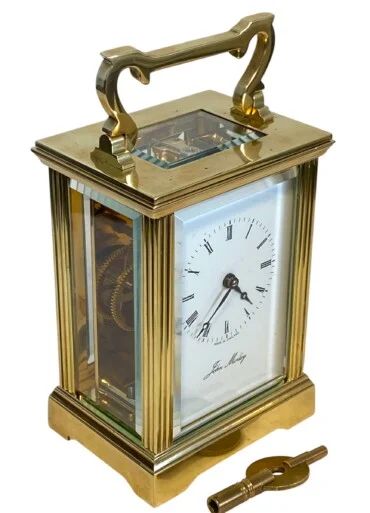
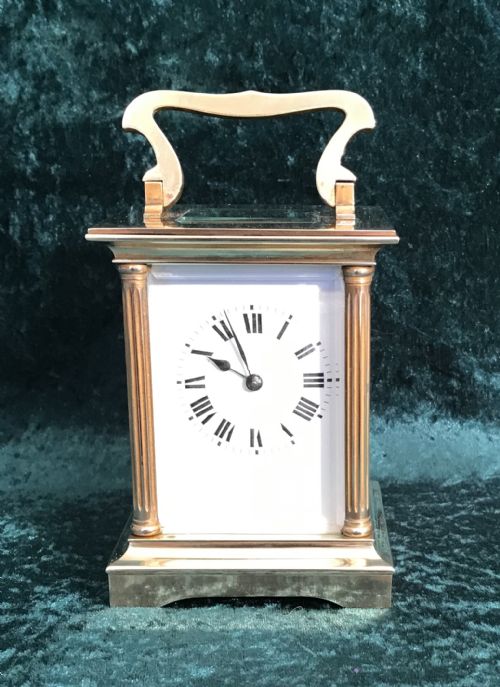
When you search for a brass column carriage clock, you encounter portable timepieces designed for travel and domestic use during the nineteenth and twentieth centuries. These clocks typically feature structural columns, often Corinthian capped, supporting a glazed brass case that houses the movement.
The versions most common on this page hail from French and English workshops across the Victorian, Edwardian, and later periods. Makers produced these items in various styles including Classical Revival and Neoclassical, incorporating striking mechanisms and repeating functions alongside standard timekeeping.
How they were made
The construction relies heavily on brass, gilt brass, and gilt bronze for the structural frames and decorative mounts, complemented by steel internal components. Bevelled glass panels fit into the sides and top, allowing a clear view of the escapement and gear train within.
The selection includes architectural column designs alongside simpler brass cases equipped with striking and repeating complications.
What varies in quality
Quality differences emerge in the complexity of the internal movement, distinguishing simple timepieces from those with grand sonnerie striking capabilities, date work, or moon-phase complications. The precision of the case fabrication, particularly the crispness of Corinthian column caps and the weight of the gilt brass or bronze, also sets higher tiers apart.
John Morley·Mappin and Webb·Clerke Royal Exchange London·A Delépine
The Brass Column Carriage Clock Glossary
- Carriage clock
- A small, portable spring-driven clock designed for travellers in the nineteenth century. These items typically feature a handle on top and glass panels on all sides.
- Bevelled glass
- Glass with edges cut at an angle to create a framed appearance. This material is fitted into the sides of the clock case to protect the movement.
- Grande sonnerie
- A complex striking mechanism that chimes the hours and quarters automatically on the passage of time. It represents a higher grade of horological engineering.
- Engine turned
- A decorative technique involving intricate geometric patterns engraved mechanically onto metal surfaces. Clockmakers applied this finish to dial masks for visual depth.
- Corinthian capped
- A decorative architectural style applied to the top of column supports on the clock case. It mimics classical column design popular in revival periods.
Brass Column Carriage Clock: Frequently Asked Questions
How do I wind a carriage clock?
Wind the mainspring using a dedicated key inserted into the arbours located on the backplate of the movement. Turn carefully until resistance indicates the spring is fully tensioned.
Ensure you do not overwind the mechanism, as this can damage the internal components and disrupt the timekeeping accuracy.
What is a repeating carriage clock?
A repeating carriage clock includes an extra mechanism that sounds the last hour or quarter-hour when a button or lever on the top of the case is pressed.
This function allowed owners to check the time in the dark without needing to strike a match or view the dial.
Where should I place a carriage clock?
Position your clock on a stable, level surface such as a mantelpiece, desk, or shelf away from direct sunlight and damp environments. A steady foundation ensures the pendulum or balance wheel maintains an even beat.
Avoid high-traffic areas where the portable case might be easily knocked or dislodged from its resting spot.