



Brass Castor Magazine Stand
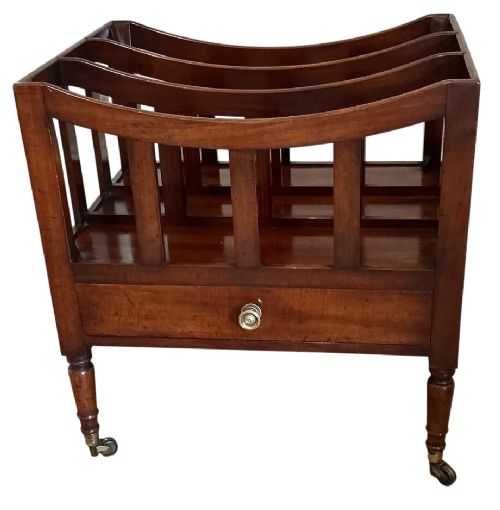
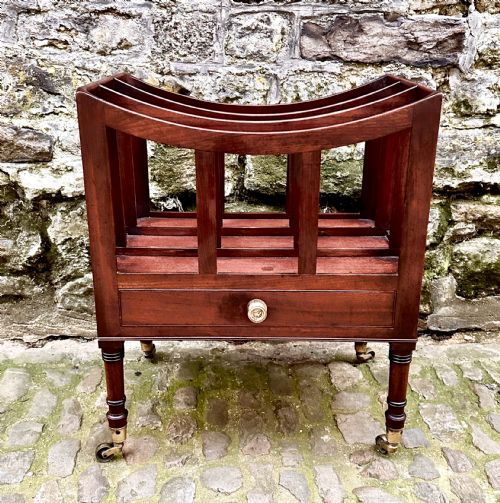
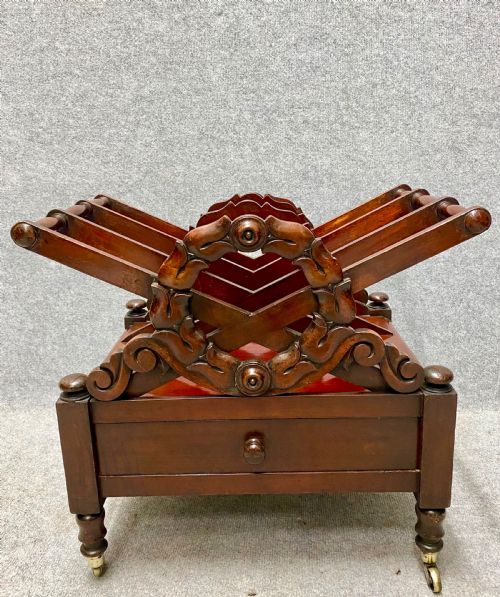
These brass castor magazine stand pieces are refined newspaper racks and music holders on small wheels, offering elegant storage for papers and folios.
Brass Castor Magazine Stand
A brass castor magazine stand typically takes the form of a Canterbury, music rack, or folio stand, serving as a designated holder for periodicals and papers. These pieces bring functional utility alongside traditional cabinet-making craftsmanship into a room.
The selections available here span the Regency, George III, and Victorian periods, with pieces originating from the nineteenth century. Buyers will most commonly encounter mahogany and rosewood constructions, occasionally featuring ebonised finishes.
Forms vary from boat-shaped designs to four-division configurations and oversized country house proportions. Many incorporate lower drawers or divided sections specifically designed to keep journals and music sheets organised.
Materials and construction methods
Cabinet makers utilised dense hardwoods such as mahogany and rosewood for the structural frames and slatted divisions. These timbers provided the necessary strength to support heavy books and folios without warping.
Metalworking played a crucial role in mobility, with cast brass castors fitted to the base of the legs to allow smooth movement across carpets and wooden floors. Woodturning and careful joinery formed the characteristic upright slats and carrying handles.
Listings feature mahogany, rosewood, and ebonised mahogany spanning the Georgian, Regency, and Victorian periods.
Assessing quality in period pieces
The refinement of the timber grain and the crispness of the turned spindle work distinguish finer examples from standard workshop production. Superior pieces often exhibit thoughtful proportions, such as oversized country house dimensions or sophisticated boat-shaped outlines.
Original brass fittings and integrated drawers demonstrate a higher grade of manufacture. Pieces attributed to notable makers carry an added level of cabinet-making distinction visible in the joinery and detailing.
Gillows of Lancaster·J.C. Loudon
The Brass Castor Magazine Stand Glossary
- Castor
- A small wheel attached to the base of a furniture leg to facilitate movement. These are typically cast from brass on period stands.
- Folio stand
- A larger rack designed for holding oversized books, prints, or maps. Examples often share characteristics with large canterburys.
- Ebonised
- Wood treated with a finish to imitate ebony. This technique was favoured during the Victorian era for a dramatic appearance.
Brass Castor Magazine Stand: Frequently Asked Questions
What is a Canterbury furniture piece?
A Canterbury is a traditional stand featuring upright divisions used for storing newspapers, magazines, and music sheets. They usually include a low drawer and sit on small wheels.
First appearing in the late eighteenth century, these items allowed people to keep reading materials tidy beside a chair or desk in the parlour.
How do I care for rosewood and mahogany?
Maintain these hardwoods by keeping them away from direct sunlight and sudden temperature shifts. Dust regularly with a soft cloth to protect the polished surface.
Applying a traditional wax occasionally helps nourish the timber and preserves the natural grain without building up heavy residue.
Where should I place a magazine stand?
These stands suit placement beside a sofa, desk, or armchair in a living room or study. Their compact footprint allows them to sit neatly against walls or beside seating.
The brass castors make it simple to reposition the stand across the room when clearing space or cleaning.
How do I identify a Regency period stand?
Regency pieces often display classical lines, boat-shaped frames, and refined mahogany or rosewood timbers. They date from the early nineteenth century and reflect classical design influences.
Details such as finely turned spindles and original brass castors point toward this specific era of British furniture making.