

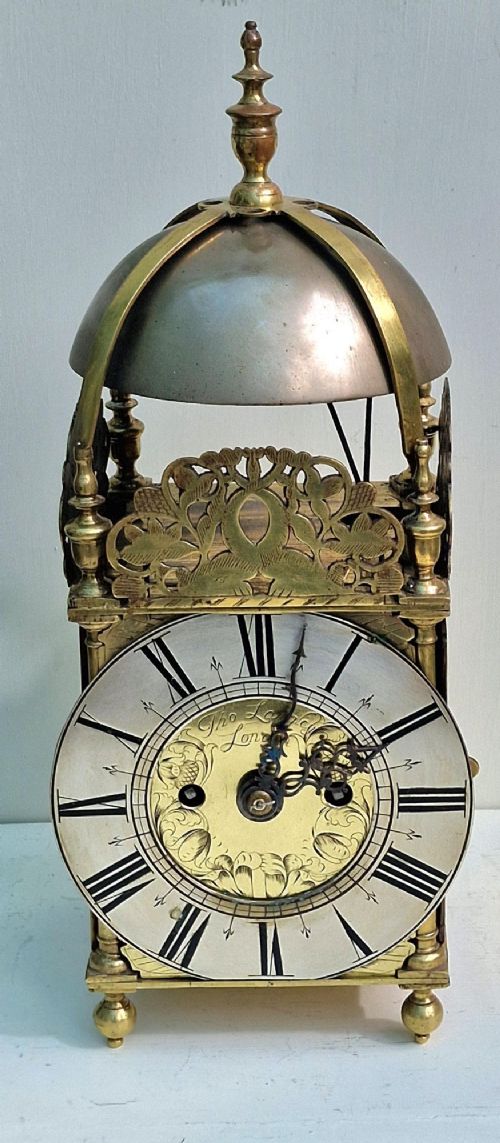
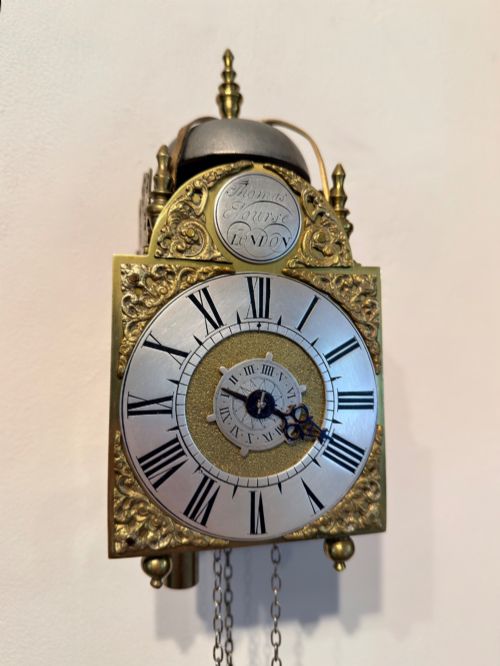


Brass Bell Wall Clock
These brass bell wall clocks bring mechanical timekeeping and resonant sound into a room, offering both heavy metal structure and traditional striking.
Brass Bell Wall Clock
A brass bell wall clock combines a wall-mounted timepiece with an exposed or internal bell mechanism that sounds the hours or quarters. Buyers search this phrase to find functional horological pieces that serve as striking visual focal points in a room.
The selections range from early 17th Century English lantern clocks and Georgian miniature hook and spike styles to 18th Century verge escapement examples by notable London makers. Later Victorian drop-dial variants and mid-century maritime pieces also appear.
Victorian drop-dial wall clocks with twin fusee movements and golden oak cases represent the forms most frequently encountered on this page. Earlier brass lantern clocks and German ships clocks provide alternative traditional aesthetics.
Materials and construction
These clocks rely heavily on brass for dials, bezels, plates, and bells, often paired with steel and iron internal components. Cases incorporate timber frames made from mahogany, walnut, oak, and golden oak.
Dial faces frequently utilise silvered metal for engraved chapters and numerals, protected behind glass covers. Movements employ mechanical systems such as twin fusee trains and verge escapements to drive the striking mechanisms.
Brass Bell Wall Clock Retail Price Guide 2026
Typical asking prices for brass bell wall clock among the pieces listed under this phrase on Sellingantiques today, from the lower quarter to the upper quarter. They describe what is for sale here now, not the wider market.
The listings span multiple centuries, ranging from seventeenth-century English lantern clocks to mid-century maritime timepieces.
Assessing quality
Quality rests in the precision of the mechanical movement, from early verge escapements to twin fusee gear trains. Finer examples display meticulous hand-engraving on brass dial plates and signature engraving from recognised makers.
Case construction differentiates standard production from superior craftsmanship, seen in the selection of solid mahogany, walnut, or oak timber. The acoustic resonance and finishing of the brass bell further distinguish higher grade pieces.
Thomas Langley·Windmills and Bennet·Samuel Tinham·Schatz of Germany
The Brass Bell Wall Clock Glossary
- Lantern clock
- An early type of brass weight-driven or spring-driven wall clock with open sides and a top-mounted bell. This form dates back to the seventeenth century and typically hangs from a wall bracket.
- Fusee
- A conical pulley used in mechanical clocks to maintain an even pull on the movement as the mainspring unwinds. This mechanism improves timekeeping accuracy across the power reserve.
- Verge escapement
- An early type of mechanical escapement that regulates the speed of a clock using a balance wheel or pendulum. It represents traditional seventeenth and eighteenth-century horological engineering.
- Drop-dial
- A wall clock design featuring an extended wooden case below the circular dial to accommodate a longer pendulum. This style gained popularity during the Victorian period.
- Twin fusee
- A movement incorporating two separate fusee cones, usually dividing the timekeeping train from the striking train. This setup ensures consistent power delivery to both functions.
Brass Bell Wall Clock: Frequently Asked Questions
How do I wind a brass bell wall clock?
Wind the clock using the designated winding key inserted into the dial holes, turning gently until resistance is met. Avoid over-winding to protect the internal springs and fusee chains.
Ensure you support the pendulum or case securely during the process if required by the specific mechanism type.
What is a fusee movement?
A fusee movement uses a conical pulley connected to the mainspring via a cord or chain to equalise power delivery. As the spring loses tension, the chain rides higher on the cone to maintain consistent torque.
This traditional method helps mechanical clocks maintain steady timekeeping accuracy between windings.
How do I date a lantern clock?
Dating relies on examining construction methods, signature engravings, and stylistic elements like frets and dial proportions. Seventeenth-century examples often feature brass strap frames and hook-and-spike wall fixings.
Later reproductions and Georgian variants adopt refined components while retaining the traditional top-mounted bell silhouette.
Where should I hang a heavy brass wall clock?
Mount the clock directly into a solid wall stud or masonry using heavy-duty fixings suited to the combined weight of brass, timber, and movement. Secure hanging prevents vibration and ensures the pendulum swings evenly.
Position the timepiece away from damp areas and direct sunlight to protect the wood case and metal surfaces.