

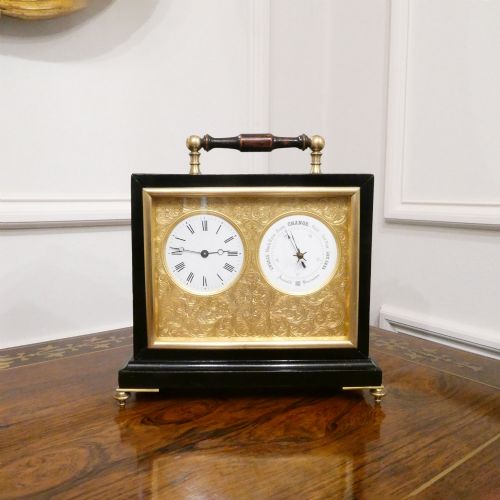


Brass Barometer Clock
A brass barometer clock combines timekeeping and meteorological measurement in a single brass housing, offering utility and decorative presence.
Brass Barometer Clock
A brass barometer clock is an instrument that pairs a timepiece with a barometer to record atmospheric pressure alongside the hour. Buyers searching this phrase will find a variety of domestic weather and time instruments.
The versions most commonly met on this page span the nineteenth and early twentieth centuries, taking forms such as mantel pieces, desk compendiums, and banjo styles. They draw on Victorian, Edwardian, and Regency traditions.
Origins include domestic mantle and desk settings, featuring architectural oak, mahogany cases, and gilt bronze. Their survival reflects a Victorian and Edwardian preoccupation with domestic scientific measurement.
How they were made
These instruments rely on brass as a primary structural and housing metal, often combined with mahogany, oak, walnut, and ebonised wood for cases. Glass protects the dials, while silvered metal and enamel provide the contrasting faces for readings.
Manufacturing methods involve precision metalworking for the movements and aneroid mechanisms, alongside cabinetmaking for the wood surrounds. Stylistic flourishes include Chinoiserie details and cast bronze shapes like the caduceus.
Brass Barometer Clock Retail Price Guide 2026
Typical asking prices for brass barometer clock among the pieces listed under this phrase on Sellingantiques today, from the lower quarter to the upper quarter. They describe what is for sale here now, not the wider market.
Some nineteenth-century makers cast their weather instruments into unusual shapes, including the winged staff of the caduceus.
What varies in quality
Quality rests in the precision of the mechanics and the integrity of the materials, separating standard production from pieces bearing named makers. Heavier brass castings and finer dial engraving indicate superior execution.
The sophistication of the case timber, such as figured mahogany or carved oak, alongside the complexity of combined functions like barographs and thermometers, distinguishes the more ambitious examples.
Ganthony of London·H Marks
The Brass Barometer Clock Glossary
- Aneroid barometer
- An instrument measuring atmospheric pressure by the flexion of a sealed metal box without liquid. It allows for compact desk and mantel formats.
- Barograph
- A barometer that records pressure readings continuously onto a revolving drum of paper. This mechanical device provides a historical trace of weather patterns.
- Desk compendium
- A multi-functional desk accessory housing several instruments together. It typically includes a clock, barometer, and thermometer in one housing.
- Silvered metal
- A brass or copper dial treated to give a matte silver finish. It provides a readable surface for engraved numerals and markings.
Brass Barometer Clock: Frequently Asked Questions
What is a brass barometer clock?
It is a combined domestic instrument that houses both a clock movement and a barometer mechanism within a single brass frame or wooden case. These pieces were designed for desks, mantelpieces, and walls.
They allowed nineteenth and early twentieth-century households to check the time and local weather pressure simultaneously without needing separate wall instruments.
How do I date a brass barometer clock?
Dating relies on examining the case style, wood type, dial materials, and the sophistication of the internal aneroid or barometer mechanisms. Regency and Georgian examples tend to use banjo formats.
Victorian and Edwardian pieces often present as architectural desk clocks, skeletonised movements, or substantial oak and mahogany weather stations.
Where were these instruments placed?
These instruments were principally made for domestic interior spaces, particularly libraries, studies, and drawing rooms where gentlemen and families monitored the weather.
Desk compendiums and mantel clocks sat upon writing tables and fireplace surrounds, while larger banjo barometers hung upon parlour walls.
Are barometer dials usually silvered?
Many barometer and clock dials on these pieces are constructed from silvered metal to provide a clear, non-reflective surface for the engraved numbers and weather terminology.
Enamel was also utilised for white-faced clock dials, contrasting with the warm tones of the surrounding brass cases and wooden frames.