

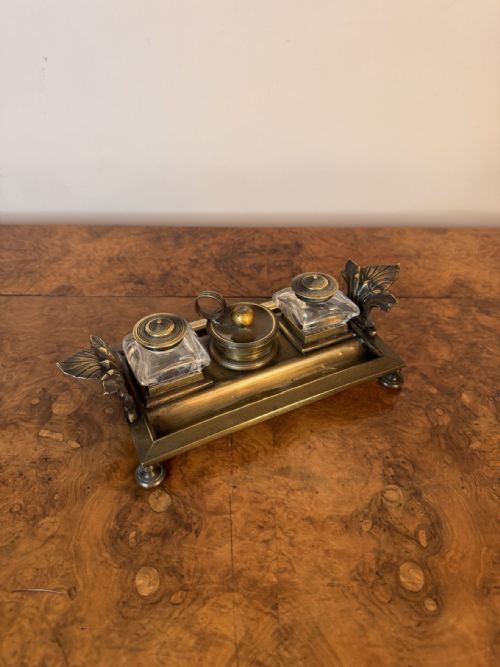


Brass and Bronze Inkwell
A brass and bronze inkwell brings tactile weight to a desk, combining cast metalwork and glass ink bottles into a functional centrepiece.
Brass and Bronze Inkwell
A brass and bronze inkwell is a desk accessory designed to hold liquid ink for writing, appearing here in forms ranging from simple lidded vessels to elaborate desk stands with pen rests and integrated clocks. Buyers searching for a brass and bronze inkwell encounter pieces primarily from the nineteenth century, including Victorian examples and French Empire or Art Nouveau designs.
The objects span individual inkwells, figural novelties featuring animals or portrait busts, and multi-piece desk sets mounted on marble bases. French examples often pair gilt bronze and ormolu with marble, while English pieces introduce timber bases or figural subjects like ostriches and stags.
How they were made
These pieces rely on metal casting in brass, bronze, and ormolu, often utilising fire-gilding or mercury gilding to achieve a lustrous gold surface. Artisans combined these metals with carved marble bases, cut crystal or glass bottles, and occasionally champleve enamel or ceramic elements.
Figural and decorative elements display detailed hand-finishing, such as the engraved plumage on bird subjects or the application of glass eyes to animal castings. Mounts and hinges were engineered to secure glass inserts within heavy metal frames.
Brass and Bronze Inkwell Retail Price Guide 2026
Typical asking prices for brass and bronze inkwell among the pieces listed under this phrase on Sellingantiques today, from the lower quarter to the upper quarter. They describe what is for sale here now, not the wider market.
Listings feature brass, bronze, gilt bronze, and ormolu combined with marble, cut crystal, enamel, and coromandel-wood across nineteenth-century and early twentieth-century forms.
What varies in quality
Quality rests in the crispness of the metal casting and the depth of the chasing, where finer pieces exhibit sharp anatomical details on figural subjects like lions, birds, and cats. The integration of materials also defines the tier, seen in the choice of dense vert or Sienna marble bases rather than simpler supports.
The presence of original glass ink bottles and matching lids elevates a piece, as does the sophistication of the associated desk accessories, such as integrated pen trays or clock movements.
The Brass and Bronze Inkwell Glossary
- Ormolu
- Gilt bronze, typically produced by applying a mercury and gold amalgam to a bronze base and heating it to drive off the mercury.
- Champleve
- An enamelling technique where troughs or cells are hollowed out of the metal surface and filled with vitreous enamel before firing.
- Desk stand
- A larger platform or tray designed to hold one or more inkwells alongside pens, stamps, or other writing implements.
- Vert marble
- A rich green decorative stone frequently used as a heavy, contrasting base for French gilt bronze mounts.
Brass and Bronze Inkwell: Frequently Asked Questions
What periods do these inkwells come from?
The selection spans the nineteenth and early twentieth centuries, featuring Victorian pieces alongside French Empire and Art Nouveau designs.
Dates range across the 1850s, 1880s, and into the 1920s, showing shifting tastes from classical mounts to naturalistic organic curves.
How were brass and bronze inkwells used?
They sat upon writing desks to hold liquid ink safely within a removable glass or crystal insert, preventing spills while keeping nibs wet.
Many included integrated pen rests or larger trays to accommodate writing slopes and correspondence materials in a study or office.
Are the glass ink bottles usually original?
Some pieces retain their original cut crystal or glass bottles and matched lids, which is noted in specific descriptions.
Because glass inserts were fragile and prone to replacement over decades of use, survivals with original bottles hold particular interest.
How do I identify French Empire versus Art Nouveau styles?
French Empire pieces favour formal symmetry, classical architectural motifs, and bright ormolu mounts set against dark marble bases.
Art Nouveau examples introduce asymmetrical, flowing lines, botanical motifs, and stylized animal or figural casts typical of the turn of the twentieth century.