
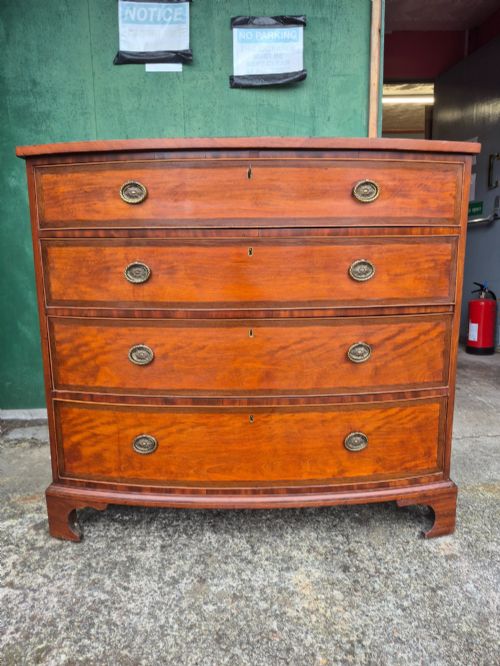
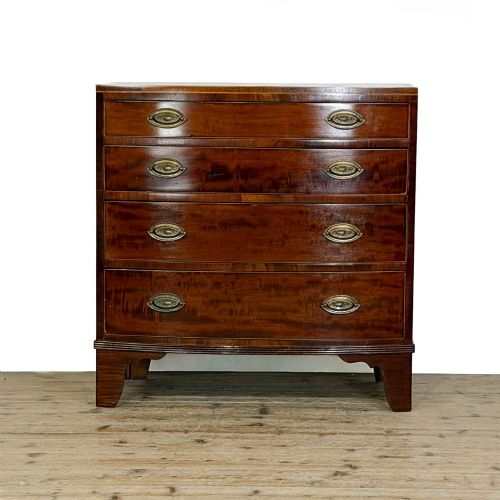
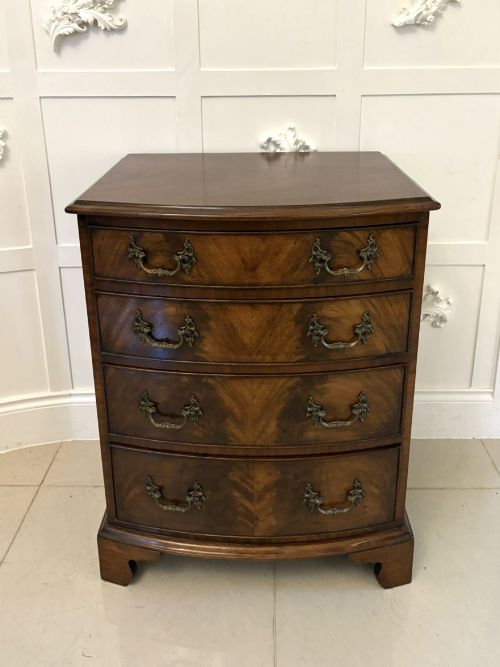
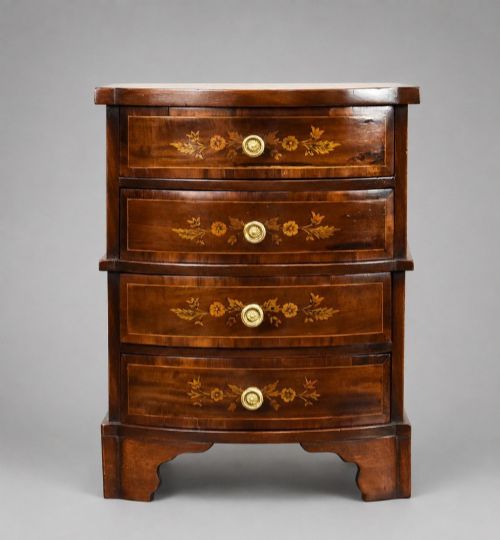


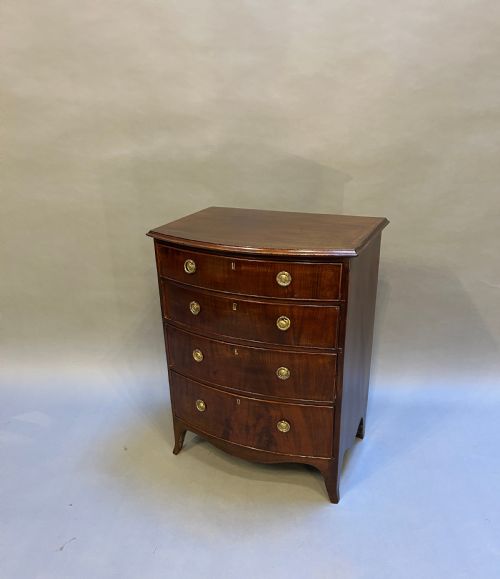


Bowfront Four Drawer Chest
A bowfront four drawer chest brings the curved elegance of the Georgian and Regency eras directly into the bedroom.
Bowfront Four Drawer Chest
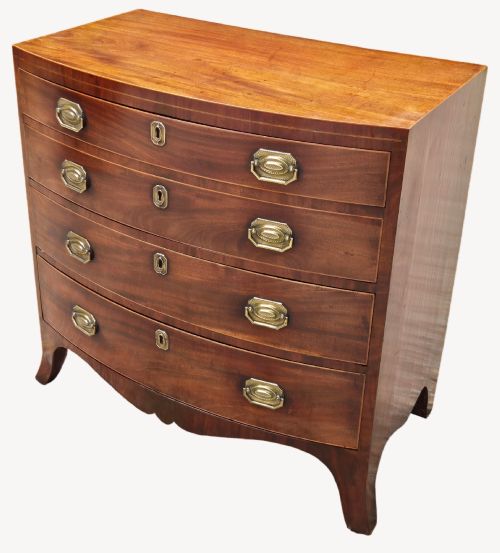
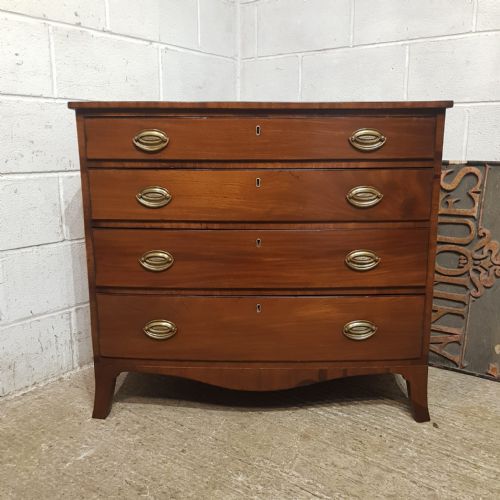
When you search for a bowfront four drawer chest, you are looking at case furniture defined by its convex projecting front and stacked horizontal storage. The pieces meeting this description span the eighteenth, nineteenth, and early twentieth centuries, capturing Georgian, Regency, and Edwardian design traditions.
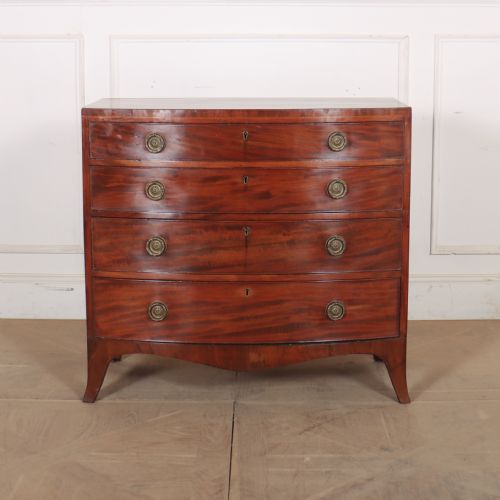
The most common version you will encounter on this page is constructed from mahogany, often displaying flame veneer or inlay, standing on bracket feet or short turned legs. These chests provide practical drawer capacity while softening the rigid corners typically found in standard bedroom furniture.
How they were made
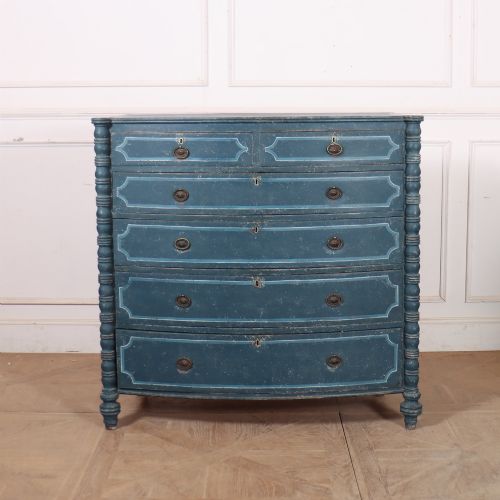
Cabinetmakers constructed these carcases primarily using solid wood and veneers, applying mahogany, flame mahogany, and satinwood across the curved drawer fronts. Decorative details frequently incorporate contrasting wood inlays, painted finishes, and cast brass hardware.
The curved front required skilled joinery to shape the solid timber framing and bend veneers smoothly across the drawer tiers. Drawers were built with traditional joints to ensure stability and smooth operation within the arched framework.
Listings span multiple centuries, ranging from eighteenth-century Georgian and Sheraton designs to nineteenth-century Regency and Victorian interpretations.
What varies in quality
The distinction between standard examples and superior pieces rests on the choice of timber and the crispness of the cabinetwork. Finer chests utilise highly figured flame mahogany or delicate satinwood marquetry that elevates the visual depth of the curved facade.
Proportion and the handling of secondary woods also separate workshops, with better pieces exhibiting seamless drawer graduation and refined edge mouldings. The integrity of the original brasses and the warmth of the polished surface contribute significantly to the overall standing of an individual chest.
Gillows
The Bowfront Four Drawer Chest Glossary
- Bowfront
- A convex curved front profile that swells outward from the centre. This design softens the room presence of heavy bedroom furniture.
- Flame mahogany
- Timber veneer cut from the branch junction where the grain creates a distinctive flickering flame pattern. It appears frequently on decorative Regency and Georgian drawer fronts.
- Graduated drawers
- A series of drawers that decrease in depth from bottom to top. This arrangement creates a balanced visual perspective on tall case pieces.
- Inlaid wood
- Pieces of contrasting timber or shell fitted flush into the surface to form decorative patterns. Sheraton and Edwardian examples often employ this technique.
- Bracket feet
- Small, foot supports that extend outward from the bottom corners of a chest. They provide a stable base while lifting the carcase slightly off the floor.
Bowfront Four Drawer Chest: Frequently Asked Questions
How do I date a bowfront chest?
Dating relies on observing construction methods, timber choices, and overall stylistic details like foot shape and hardware. Earlier Georgian pieces often show hand-cut joinery and dense mahogany, while Edwardian versions may incorporate lighter satinwood.
Changes in proportion and veneer selection across the eighteenth and nineteenth centuries help distinguish a George III chest from a later Victorian or Edwardian interpretation.
Where should I place a bowfront chest?
These chests function traditionally as bedroom storage for clothing, utilising their four drawers to hold bulky garments or linens. Their finished proportions also suit hallways, landings, or living rooms as statement side pieces.
Because the front curves outward, positioning requires enough clearance for the protruding centre not to crowd narrow walkways.
Did these chests always have four drawers?
While four drawers form a standard configuration for this group, heights and drawer counts vary across different periods and overall scales. Some compact or miniature versions adapt the design into smaller formats.
Graduated drawer arrangements often accompany the four-tier layout to maintain balanced proportions from the top to the base.