


Bowfront Bedside Cabinets
Bowfront bedside cabinets bring rounded mahogany and satinwood forms to the bedroom, offering concealed storage with a curved silhouette.
Bowfront Bedside Cabinets
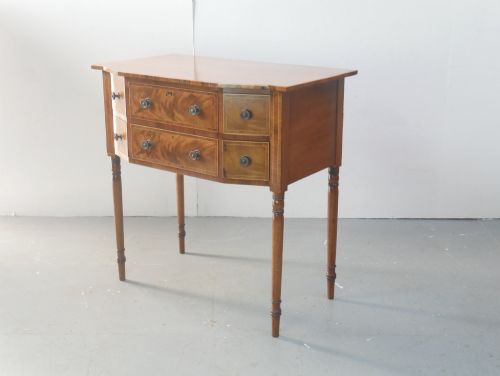
Bowfront bedside cabinets are small storage pieces designed for the bedroom, characterised by a convex curved front that projects outward. When searching for bowfront bedside cabinets, buyers encounter forms ranging from Georgian and Regency cupboards to Victorian lockers and Edwardian inlaid chests.
The selection includes single cabinets alongside matched pairs in mahogany, satinwood, and walnut. These pieces function as bedside tables while providing enclosed space behind doors or within drawers.
Origins span the nineteenth and early twentieth centuries, encompassing George III, Sheraton Revival, and Queen Anne styles. Mahogany remains the dominant timber across the periods represented.
Materials and construction
Cabinet makers constructed these pieces primarily using solid mahogany, flame mahogany, and burr walnut veneers applied to secondary timbers. Selected examples incorporate satinwood, ebony inlay, and marquetry detailing across the curved drawer fronts and cabinet doors.
Hardware such as brass handles and pulls complement the timber grains and polished surfaces. The curved bowfront shape requires precise carpentry to bend and shape the woodwork for the doors and drawers.
Early nightstands doubled as discreet indoor plumbing solutions before plumbing moved indoors.
Assessing quality and craftsmanship
Quality in these cabinets rests upon the choice of timber figure, such as flame mahogany or burr walnut, and the precision of the curved drawer construction. Finer examples display meticulous marquetry and ebony inlay work rather than plain surfaces.
Maker attribution elevates certain pieces, particularly items bearing signatures or distinct workshop characteristics associated with firms like Edwards and Roberts or Gillows. Matched pairs also command greater interest among collectors than individual cabinets.
Edwards and Roberts·Gillows
The Bowfront Bedside Cabinets Glossary
- Bowfront
- A convex curved front profile that projects outward from the corners of the cabinet. This shape requires specialised joinery to match the doors and drawers to the curved frame.
- Marquetry
- Decorative patterns formed by fitting together small pieces of veneer of different woods. It appears on select Edwardian and later twentieth-century cabinet doors.
- Satinwood
- A pale, lustrous hardwood used extensively during the Sheraton Revival and Edwardian periods for cabinet surfaces and banding. It provides a distinct contrast to darker timbers like mahogany.
- Commode chest
- A low chest of drawers or cabinet with doors, often used as a bedside commode in earlier periods before adapting into standard bedside storage.
- Nightstand
- An alternative term for a bedside cabinet or cupboard, providing surface space and enclosed storage next to the bed.
Bowfront Bedside Cabinets: Frequently Asked Questions
What is a bowfront bedside cabinet?
A bowfront bedside cabinet is a small piece of bedroom furniture featuring a rounded, convex front facade. It typically provides enclosed storage behind a door or drawers beneath a flat top surface.
These cabinets date from the Georgian era through to the early twentieth century, utilising timbers such as mahogany, walnut, and satinwood.
Are pairs difficult to find?
Matched pairs of bedside cabinets occur less frequently than single pieces because many were made or acquired individually. When pairs do appear, they often originate from the Victorian and Edwardian periods.
Collectors prize pairs for symmetry in bedroom placement, particularly when the grain and proportions match precisely.
How do I identify the period?
Dating relies on timber selection, construction methods, and stylistic details such as inlay work and hardware. Georgian and Regency pieces show simpler or classical proportions, while Edwardian examples often feature satinwood and delicate stringing.
Makers' stamps or labels, when present, offer definitive attribution to firms active during the nineteenth century.
How do I care for mahogany and walnut?
Maintenance involves keeping the timber away from direct sunlight and maintaining stable room humidity to prevent veneer cracking. Regular dusting with a soft, dry cloth preserves the polished finish.
Application of appropriate beeswax feeds the wood without building up heavy chemical residues over time.