


Bow Front Writing Desk
A bow front writing desk brings a distinct curved silhouette to a room, offering practical workspace framed in traditional timber.
Bow Front Writing Desk
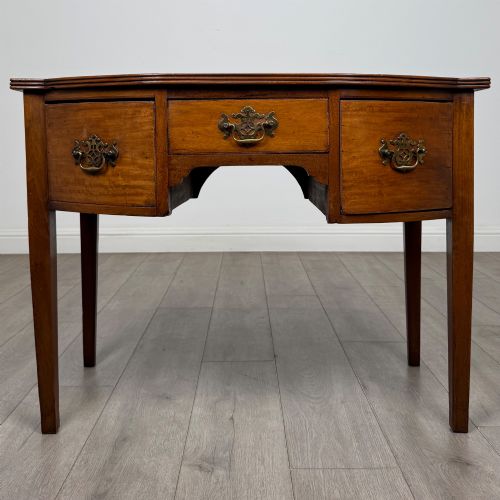
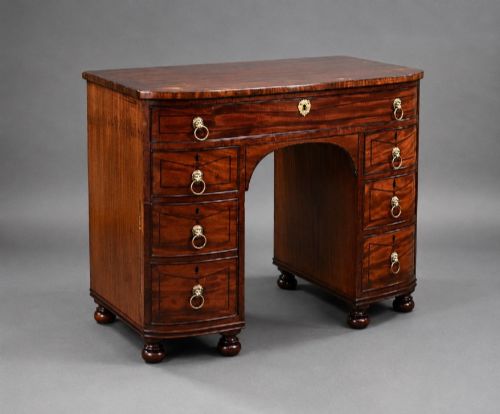
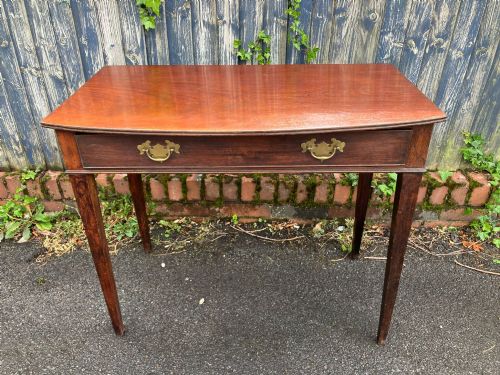
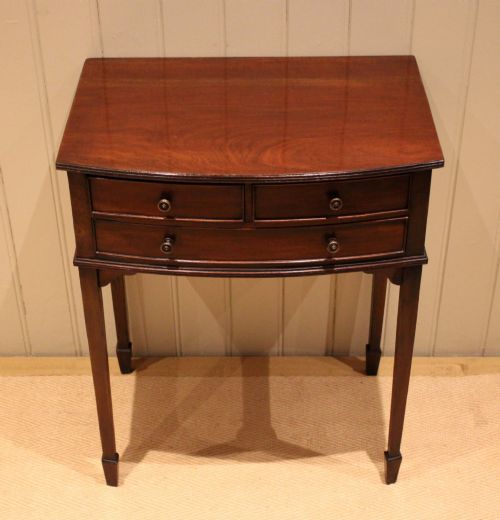
A bow front writing desk appears in several guises across the Georgian, Regency, Victorian, and Edwardian periods. Pieces range from compact side tables and dressing chests to twin pedestal desks and secretaire bookcases, all united by a curved frontal sweep.
Makers adapted the form for writing, dressing, and general study, utilising mahogany, flame mahogany veneer, and walnut. The Edwardian era and the Sheraton Revival period also produced lighter inlaid examples designed for domestic sitting rooms and boudoirs.
Most surviving examples date from the nineteenth and early twentieth centuries, retaining the drawer configurations and brass handles typical of their original domestic settings.
Materials and Technique
Cabinetmakers constructed these desks primarily using solid mahogany and flame mahogany veneers, often incorporating boxwood and satinwood for fine stringing and delicate inlay work. Leather inserts appear frequently on writing surfaces, whilst brass provides hardware handles and key escutcheons.
Curving the timber for the signature front required skilled joining and steam bending techniques to maintain structural integrity across the drawer fronts. Secondary timbers line the interior drawers, and occasional pieces incorporate marble tops for specific utility.
Listings demonstrate that mahogany remains the dominant timber, accompanied by brass hardware, leather writing surfaces, and boxwood inlay.
Craftsmanship and Proportion
Quality rests in the precision of the curved drawer fronts and the alignment of the grain across the timber surfaces. Superior examples demonstrate careful selection of flame mahogany veneer and refined execution of boxwood and satinwood inlay.
The choice of secondary woods, the weight of the brass fittings, and the stability of the writing surface distinguish workshop production from standard commercial output. Proportion and restraint in decoration mark the work of notable makers.
S and H Jewell of London·Maples·JAS Shoolbred
The Bow Front Writing Desk Glossary
- Bow front
- A convex curved front projecting outward in a gentle arc. This shape softens the corners of a room and defines the profile of the desk.
- Flame mahogany
- Timber cut from the fork of the mahogany tree to create a distinctive flickering flame pattern. Cabinetmakers reserved this veneer for primary surfaces.
- Stringing
- Thin lines of contrasting wood inlay used to outline drawers and borders. It adds linear definition to mahogany surfaces.
- Secretaire
- A desk form featuring a drop-front drawer that conceals small compartments and pigeonholes. It combines cabinet storage with a writing surface.
- Pedestal desk
- A heavy desk comprising two banks of drawers supporting a single top. Twin pedestal versions offer substantial workspace.
Bow Front Writing Desk: Frequently Asked Questions
What periods do these desks cover?
The evidence records pieces spanning the Georgian and Regency eras through to Victorian, Edwardian, and later revival periods. Edwardian interpretations frequently incorporate Sheraton Revival design motifs.
Construction dates extend from the late eighteenth century into the early decades of the twentieth century.
Were they used only for writing?
Many examples served multiple domestic functions, operating interchangeably as dressing tables, side tables, or console tables. Writing surfaces often integrated leather inserts or fold-down compartments.
Compact dimensions allowed these tables to function effectively in both principal rooms and private chambers.
How do I identify a revival piece?
Revival items from the Edwardian period or the 1920s often display lighter framing, specific inlay patterns, and machine-cut dovetails. They emulate earlier Georgian and Regency aesthetics while reflecting the manufacturing methods of their actual date of production.
Timber selection and hardware style assist in separating eighteenth-century originals from later interpretations.
What woods are used in construction?
Mahogany dominates the selection, appearing as both solid timber and decorative veneer. Boxwood and satinwood provide contrasting stringing and inlay.
Secondary materials include walnut, marble tops on selected tables, and brass for handles and keyplates.