



Boulle Clock
When you choose a boulle clock, you bring home a nineteenth-century French centrepiece of tortoiseshell and brass marquetry designed to command a room.
Boulle Clock
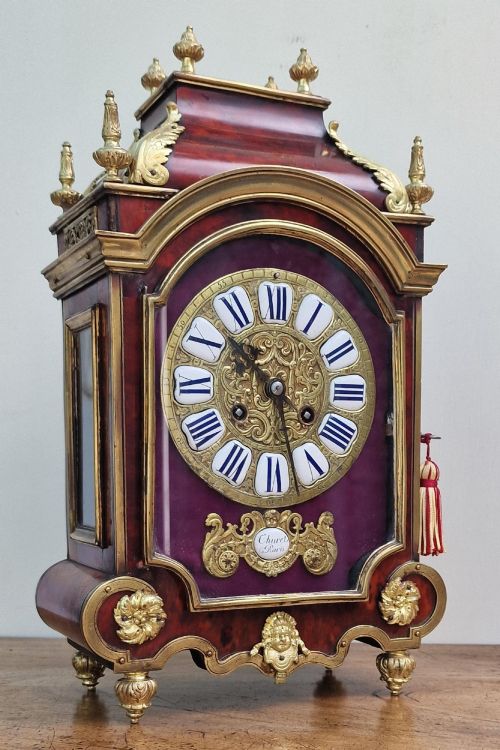
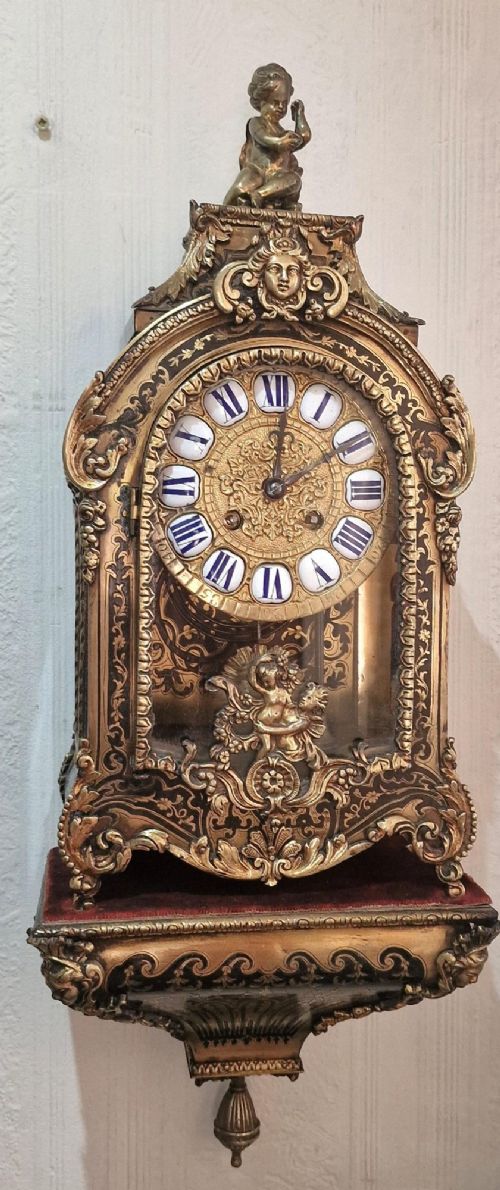
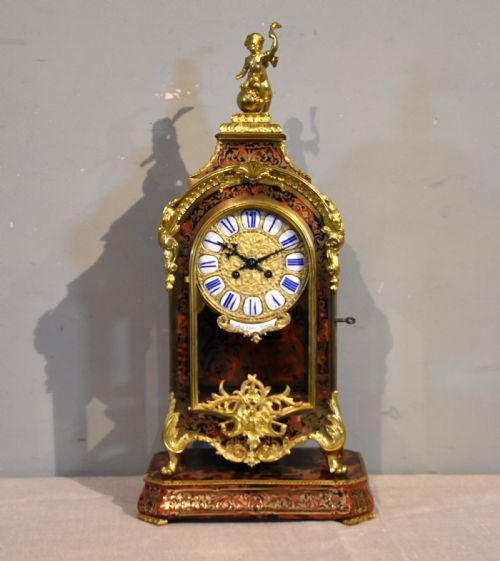
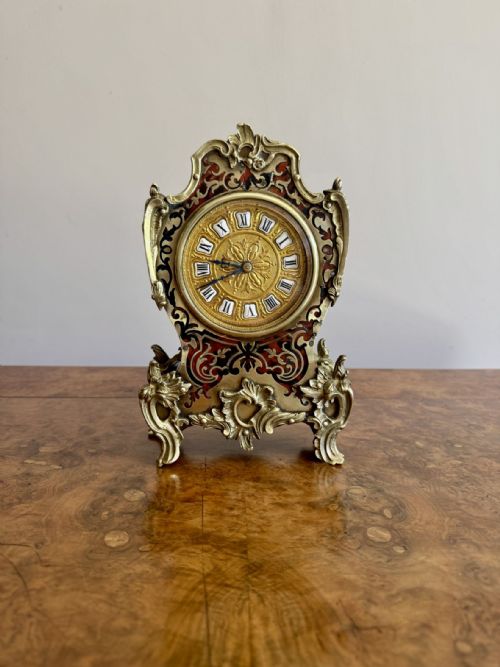
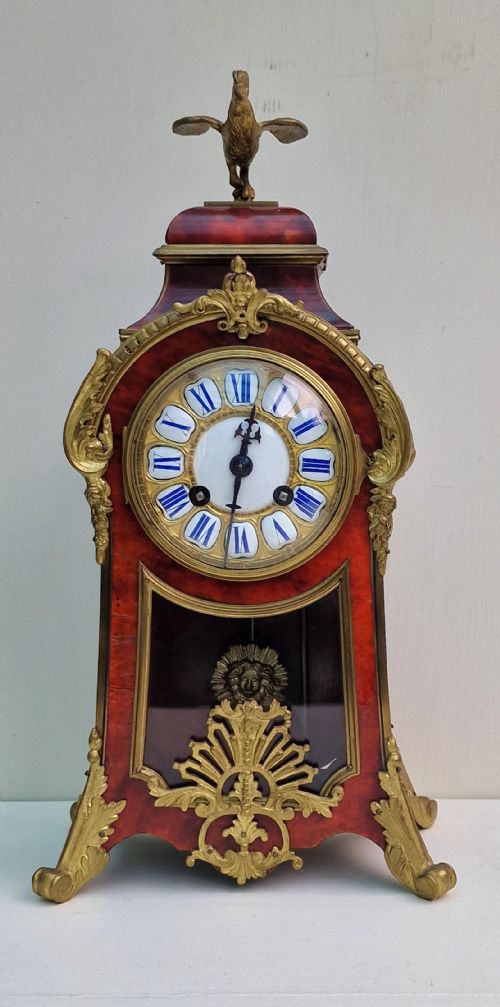
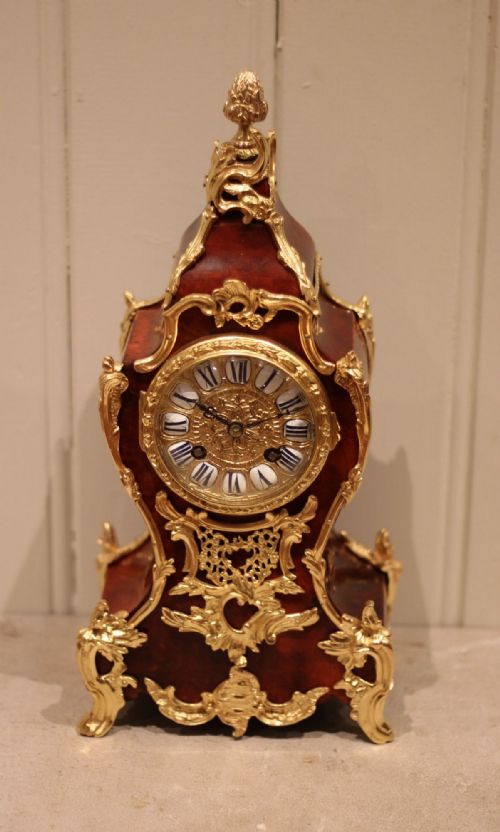
A boulle clock is an elaborate timepiece encased in tortoiseshell veneer and inlaid metal marquetry, originating from seventeenth-century French court traditions. On this page, you will primarily encounter nineteenth-century interpretations of these designs, predominantly taking the form of mantel clocks, bracket clocks with matching wall brackets, and occasional larger longcase or wall clocks.
The aesthetic draws heavily on French Rococo Revival, Louis XIV, and Louis XV styles, characterised by symmetric or sweeping asymmetrical wooden carcases covered in intricate patterns. These pieces span Victorian and Napoleon III periods, reflecting a sustained nineteenth-century fascination with opulent continental craftsmanship.
Most examples function as shelf or mantel ornaments, while bracket versions come equipped with their own suspended wall supports to create a commanding architectural presence. Collectors seek them for their dramatic silhouette and the rich interplay of reflective tortoiseshell and polished metal.
Materials and Technique
The defining technique relies on première-partie and contre-partie marquetry, where brass and tortoiseshell are cut together in stacked sheets to create interlocking patterns of bright metal against dark organic shell. Craftsmen laid these delicate veneers over robust timber carcases, often utilising ebonised or stained wood to frame the marquetry panels.
Gilt bronze, known as ormolu, mounts cast in elaborate scrolls, masks, and floral motifs were then applied to the corners, feet, and crests of the clock cases to accent the tortoiseshell body. Enamel numerals, frequently set into individual cartouches, face the dial behind protective glass plates, completing the complex assembly.
Listings feature mantel clocks, wall clocks, and bracket clocks with matching wall brackets executed in brass, tortoiseshell, and ormolu across Victorian and nineteenth-century periods.
Evaluating Quality
Quality in a boulle clock rests on the precision of the brass and tortoiseshell cutting and the crispness of the cast ormolu mounts. Finer pieces display tight, seamless marquetry without excessive filler in the joints, whereas lesser examples show wider gaps between the metal and shell elements.
The depth and clarity of the fire gilding on the bronze mounts distinguish superior makers from mass-produced workshops, along with the complexity of the internal eight-day movement signed by known Parisian clockmakers.
Thuret·Henri Marc·Samuel Marti·A.D. Mougin·Payne London·Leroy·Japy Freres·Vincenti·Arsandaux·Glading·R Fage
The Boulle Clock Glossary
- Boulle
- A style of marquetry using brass and tortoiseshell, named after André-Charles Boulle, cabinetmaker to Louis XIV.
- Ormolu
- Gilded bronze used for decorative mounts and feet on furniture and clock cases. It provides a bright golden contrast to the dark tortoiseshell.
- Bracket clock
- A portable clock designed to sit on a matching wall bracket rather than directly on a mantelpiece.
- Marquetry
- The art of applying pieces of veneer to a structure to form decorative patterns and pictorial designs.
- Cartouche
- A small enamel plaque bearing a single numeral on the clock dial, common in nineteenth-century French timepieces.
Boulle Clock: Frequently Asked Questions
What is a boulle clock?
A boulle clock is a decorative timepiece featuring elaborate tortoiseshell veneer and inlaid brass marquetry, developed in the French baroque and revived during the nineteenth century.
These clocks serve as ornate decorative objects for mantels and walls, combining fine woodworking with precision French clockmaking.
How do I wind my boulle clock?
Most nineteenth-century boulle clocks utilise an eight-day mechanical movement wound via key holes on the enamel dial. You insert the winding key and turn it gently until resistance stops the barrel.
Care must be taken not to overwind the mainspring, and consulting a professional horologist for initial setup ensures the pendulum beats in correct rhythm.
Are boulle clocks fragile?
Tortoiseshell and brass veneer require stable environmental conditions to prevent the organic shell from drying or lifting away from the wooden carcase. Keeping the clock away from direct sunlight and sudden temperature shifts preserves the delicate marquetry.
Regular professional servicing keeps the mechanical movement operating smoothly without placing undue stress on the historic gear train.
How do I identify the period of a boulle clock?
Makers' marks stamped on the back plates of the brass movements, alongside stylistic cues from Louis XIV, Louis XV, or Napoleon III revivals, help date these pieces. The presence of nineteenth-century French foundry stamps often points to production between eighteen-fifty and nineteen-hundred.
Examining the construction methods of the wooden carcase and the composition of the tortoiseshell veneer also aids in confirming nineteenth-century manufacture.