



Bombee Marquetry Cabinet
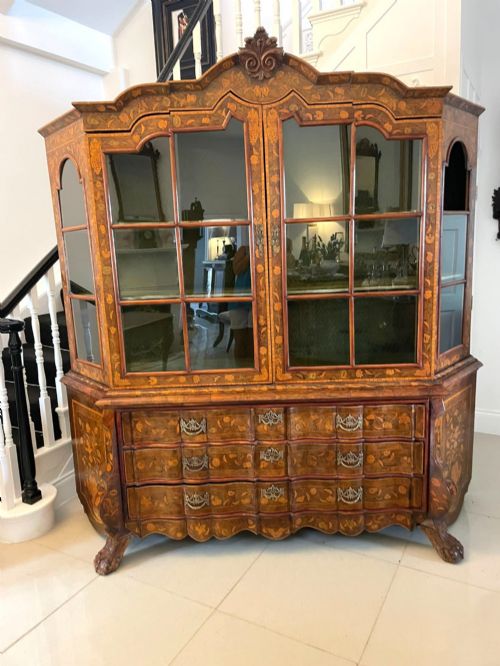
A bombee marquetry cabinet brings sweeping walnut curves and intricate floral inlay together into a striking piece of period furniture.
Bombee Marquetry Cabinet
When you search for a bombee marquetry cabinet, you are looking at substantial storage furniture defined by its swelling, bulbous profiles and detailed wood inlay. The pieces seen here span the eighteenth, nineteenth, and twentieth centuries, originating from Dutch and French workshops influenced by Rococo and Baroque tastes.
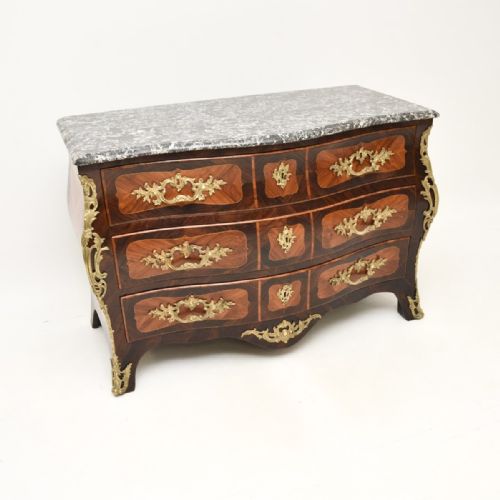
The most common form you will meet on this page is the commode or chest of drawers, alongside bedside tables, display cabinets, and miniature apprentice pieces. These items utilise distinctive curved drawer fronts and sides that sweep outward before tapering down to short feet.
Makers often drew inspiration from Louis XV and Dutch Rococo design principles, applying floral marquetry across walnut, burr walnut, and kingwood surfaces. Each piece balances sculptural timber shaping with elaborate decorative veneers to create a commanding presence in a room.
How they were made
Cabinetmakers constructed the underlying carcase using solid timbers such as walnut or fruitwood, shaping the curved bombe contours by hand before applying decorative veneers. Thin sheets of kingwood and burr walnut were meticulously sawn and arranged to cover the undulating surfaces.
Floral marquetry designs were created by cutting contrasting wood veneers into intricate petal and leaf motifs, which were then fitted flush into the background timber. Master artisans finished these complex wooden facades with hand-rubbed polishes to highlight the natural grain variations.
Mounts made from cast or gilt ormolu and brass were frequently added to accent the corners, handles, and apron curves of the cabinets. Heavy marble slabs, often in shades of white or variegated tones, were shaped to fit precisely atop the commodes and tables.
Bombee Marquetry Cabinet Retail Price Guide 2026
Typical asking prices for bombee marquetry cabinet among the pieces listed under this phrase on Sellingantiques today, from the lower quarter to the upper quarter. They describe what is for sale here now, not the wider market.
Listings feature items from the eighteenth, nineteenth, and twentieth centuries, spanning Dutch Baroque and French Louis XV styles.
What varies in quality
Quality in a bombee marquetry cabinet rests on the precision of the veneer work and the fluidity of the timber shaping. Finer examples display seamless alignment of floral marquetry across opening doors and intersecting drawer fronts, showing rigorous discipline in the workshop.
The sophistication of the bronze or ormolu mounts also signals grade, with superior pieces featuring crisply chased metalwork that follows the contours of the wood precisely. Additionally, the selection of highly figured burr walnut and rich kingwood distinguishes top-tier commissions from simpler regional pieces.
Jacques Bircklé
The Bombee Marquetry Cabinet Glossary
- Bombe
- A swelling, outward-curving contour found on the sides and fronts of furniture. This sculptural profile requires skilled joinery to shape the timber accurately.
- Marquetry
- A decorative technique where small pieces of coloured wood veneer are assembled into pictorial or floral patterns. Artisans inlay these patterns directly into the furniture surface.
- Ormolu
- Gilded bronze used for decorative mounts, handles, and feet on eighteenth and nineteenth-century furniture. It provides a bright metallic contrast to dark wood veneers.
- Kingwood
- A dense, heavy exotic timber featuring rich dark brown colouring with lighter golden streaks. It was frequently utilised by period cabinetmakers for contrasting banding and borders.
- Burr walnut
- Timber taken from a tree growth featuring intricate, swirling grain patterns. It creates a highly decorative surface prized for fine cabinet facades.
Bombee Marquetry Cabinet: Frequently Asked Questions
What is a bombee cabinet?
A bombee cabinet is a piece of furniture characterised by its swelling, rounded sides and fronts that curve outward. These items often feature decorative wood veneer patterns and elaborate mounts.
They serve as storage chests, bedside tables, or display units that bring a strong sculptural silhouette to an interior space.
How do I identify Dutch marquetry?
Dutch marquetry is typically recognised by dense, highly detailed floral and foliage inlaid patterns spread across walnut or fruitwood surfaces. The floral arrangements often incorporate tulips and other garden flowers.
These designs cover the entire visible facade of the cabinet, including the curved drawer fronts and sides.
Are these cabinets French or Dutch?
The pieces originate from both French and Dutch traditions, each bringing distinct regional characteristics to the design. French examples frequently lean towards Louis XV Rococo styling with marble tops.
Dutch interpretations often emphasise darker walnut timbers and more exuberant floral marquetry panels across the swelling carcase.
How do I care for marble tops?
Marble top commodes and tables require gentle cleaning with mild, pH-neutral soap and warm water to protect the polished stone surface. Avoid acidic cleaners, vinegar, or harsh chemicals that can etch the marble.
Using coasters and placemats helps prevent staining from liquids and moisture rings over time.
Where should I place a commode?
A commode works well as a focal point in a hallway, bedroom, or living room where its curved profile can be appreciated from multiple angles. Pairing the surface with a lamp or decorative objects enhances its visual presence.
Keep the piece away from direct heat sources and strong sunlight to protect the aged wood veneer.