
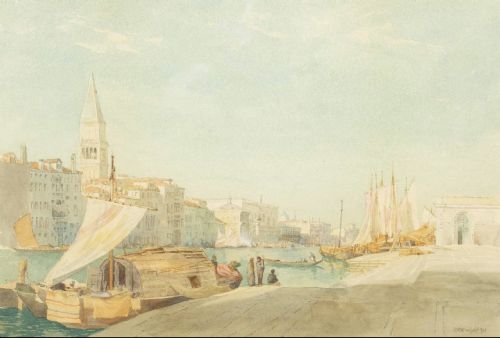


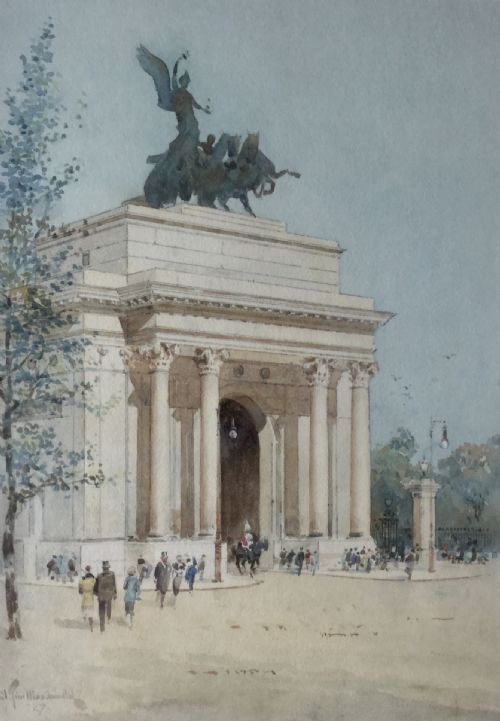

Blue Watercolour Cityscape
These blue watercolour cityscape works capture urban scenes in pigment on paper across several centuries.
Blue Watercolour Cityscape
A blue watercolour cityscape captures urban architecture, famous waterways, and notable landmarks rendered primarily in blue pigment and watercolour paint upon paper. These works document city views from Venice, London, Paris, Rome, and Lincoln.
The selections span from the Victorian era and the late nineteenth century through to the Edwardian period and the twentieth century. Common subjects include the canals of Venice, the Thames in London, and historic European streets.
Buyers encounter fine art paintings executed by British and Italian hands, ranging from detailed architectural studies to atmospheric river views. Each piece records a specific urban moment using paper and watercolour.
How they were made
Artists apply watercolour pigments directly to paper sheets, utilising the transparency of the medium to build atmospheric washes and architectural details. Selected works incorporate gold leaf alongside watercolour paint to add tonal highlights to the composition.
The technique relies on fluid brushwork to delineate cityscapes, rivers, and historical buildings. Paper serves as the universal support across all periods represented in the collection.
Listings feature paper, watercolour pigment, and gold leaf across Victorian, Edwardian, and twentieth-century British and Italian fine art paintings.
What varies in quality
The success of a blue watercolour cityscape rests on the handling of light, shadow, and architectural perspective within the wash. Stronger examples demonstrate confident brush control that defines complex structures such as bridges, canals, and cathedrals without heavy reworking.
Condition also separates examples, particularly regarding the preservation of the paper support and the vibrancy of the blue watercolour pigment against environmental exposure over time.
Richard Henry Wright·Fred Lawson·A. G. Hayward·Vittore Zanetti Zilla·David Small·David Law·Noel Harry Leaver·Ettore Ascenzi·Henry Wimbush·Rowland Henry Hill·J. Tim Macdonald·John D. Walker
The Blue Watercolour Cityscape Glossary
- Watercolour pigment
- The finely ground colour substance mixed with a binder to create watercolour paint. It provides the blue tones essential to these cityscapes.
- Gold leaf
- Extremely thin beaten gold applied to decorative areas of a painting. It appears in select works to catch the light on architectural details.
- Paper
- The flat cellulose sheet material used as the base for watercolour paintings. Its weight and texture influence how the pigment settles.
- Fine art
- Creative work valued primarily for its aesthetic appeal and execution. These cityscape paintings belong to this broad artistic category.
- Victorian
- The period spanning the reign of Queen Victoria. It denotes works produced during the nineteenth century.
Blue Watercolour Cityscape: Frequently Asked Questions
What periods do these watercolours cover?
The works span from the nineteenth century, including Victorian and late nineteenth-century Italian pieces, through Edwardian times and into the mid-twentieth century.
Specific dates recorded in the listings include eighteen-ninety, nineteen-ten, nineteen-thirty, and nineteen-sixty.
Where do the cityscape views come from?
The scenes depict prominent locations across Europe, with a strong focus on Venetian canals and London landmarks.
Other represented cities include Paris, Rome, and Lincoln.
What materials are used in these works?
Every piece is executed on paper using watercolour paint and pigment.
Selected works additionally incorporate gold leaf into the design.
How should I frame a watercolour?
Watercolours on paper require framing behind glass to protect the pigment and support from atmospheric dust and moisture.
Mounting the paper with acid-free board prevents direct contact with the glass.
How do I identify the artist?
Artists typically signed their work directly on the surface of the paper, often within the lower corners of the composition.
Listing titles also record attribution based on these signatures and historical records.