
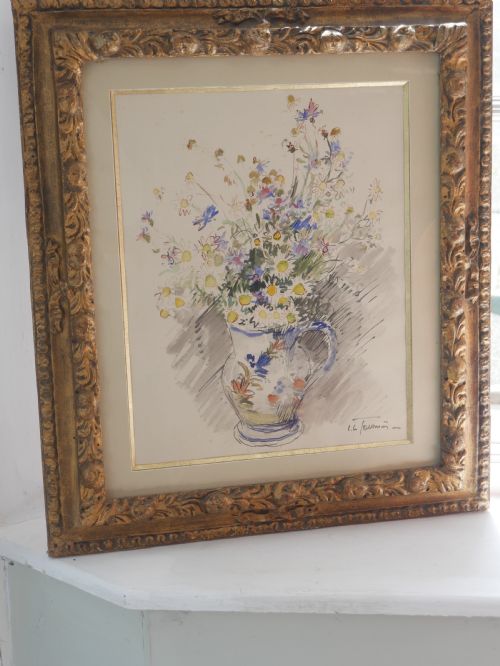


Blue Vase Still Life Painting
A blue vase still life painting brings domestic floral arrangements and ceramics onto canvas or paper through the distinct lenses of twentieth-century artists.
Blue Vase Still Life Painting
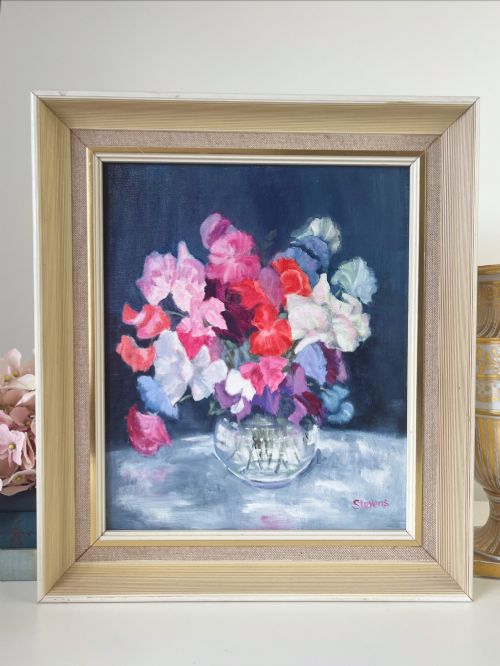
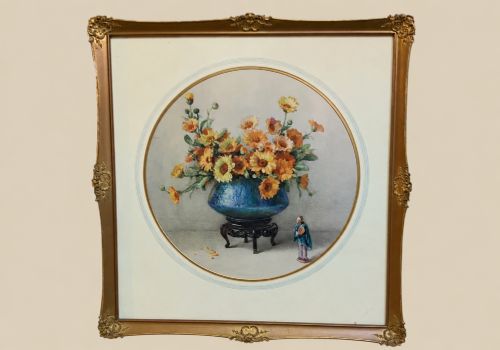
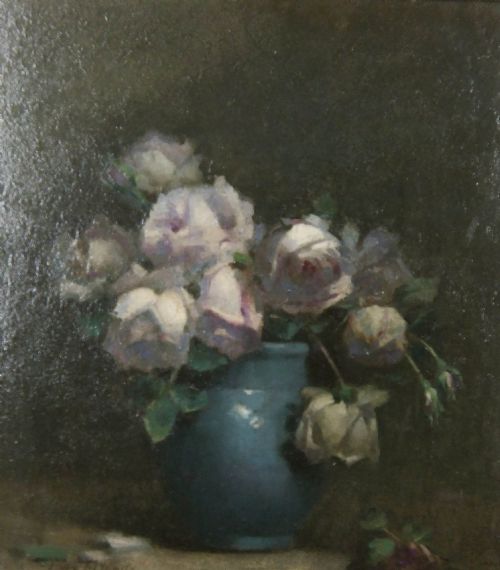
When you examine a blue vase still life painting, you find floral arrangements depicted across the twentieth century, with watercolours and oils dominating the works. Artists from the 1900s through the 1960s captured roses, marigolds, and summer blooms paired with ceramics in various domestic interiors.
The version you are most likely to meet on this page is a mid-twentieth-century study on canvas or paper, often bearing a signature from British painters working in impressionist or post-war traditional styles. These compositions range from delicate watercolour studies of wallflowers and delphiniums to textured oil paintings of summer arrangements.
The evidence shows a strong representation of works from the 1930s and 1950s, utilising traditional formats alongside mid-century modern interpretations. Whether rendered as a detailed watercolour or a pointillist oil, the central subject remains the interplay between the blue ceramic vessel and the botanical specimens it holds.
How they were made
The materials recorded in these works rely primarily on oil paint applied to canvas or board, alongside watercolour pigment on paper. Artists utilised these standard painterly mediums to capture the reflective surface of ceramics and the soft textures of floral petals.
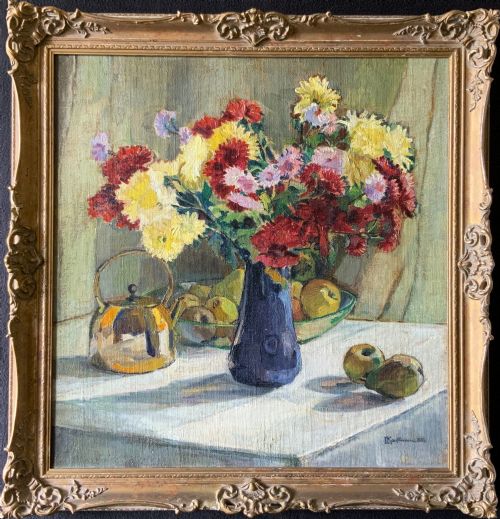
Gilt frames frequently accompany the oil paintings, providing a traditional presentation for the canvas supports. The application ranges from thin watercolour washes to thick, textured oil layers that define the still life arrangement.
Listings feature works created across six distinct decades, spanning from 1900 through 1960.
What varies in quality
The standard of a painting rests upon the artist's handling of light, colour harmony, and the structural integrity of the composition. Works by recognised regional painters or Royal Academicians demonstrate a higher degree of technical precision in rendering form and depth.
Material support and framing also differentiate the pieces, with original canvas works and period gilt frames indicating more substantial studio output. The vibrancy of surviving pigments in both the watercolours and oils determines the visual impact of each floral study.
William Thomas Wood·Owen Bowen·Stuart Armfield·Phyllis I Hibbert·Amy Reeve-Fowkes·Olive Higginbottom·W R E Goodrich
The Blue Vase Still Life Painting Glossary
- Watercolour pigment
- A water-based paint medium utilising finely ground colorants. It produces translucent washes on paper, frequently seen in early twentieth-century floral studies.
- Oil on canvas
- Pigment suspended in drying oil applied to a woven fabric stretched across a wooden frame. This durable medium allowed artists to build rich, textured surfaces.
- British Impressionism
- A painting style focused on natural light and spontaneous brushwork. Practitioners in this tradition sought to capture the immediate visual impression of domestic interiors.
- Pointillism
- A technique of painting where small, distinct dots of colour are applied in patterns to form an image. This method enhances the luminous quality of light on the subject.
- Tempera
- A permanent, fast-drying painting medium consisting of coloured pigment mixed with a water-soluble binder. It produces a flat, matte surface distinct from oil.
Blue Vase Still Life Painting: Frequently Asked Questions
What periods do these paintings come from?
The available works span the early to mid-twentieth century, with dates concentrated around the 1930s and 1950s. Artists working during these decades produced both traditional watercolours and modernist interpretations.
Earlier pieces from the 1900s appear alongside post-war creations from the 1960s, reflecting changing aesthetic movements across the decades.
Are these works signed by the artists?
Many of the listed pieces bear signatures or attributions to named painters, providing a clear record of their authorship. Signatures often appear in the corners of the canvas or paper.
Unsigned works are typically attributed to regional schools or contemporaneous makers based on style and technique.
How should I frame and display them?
Works on paper require conservation mounting and framing behind glass to protect the pigment from light damage and atmospheric moisture. Oil paintings on canvas are generally housed in traditional wood or gilt frames.
Display these pieces away from direct sunlight to preserve the original vibrancy of the oil and watercolour pigments.
What subjects accompany the blue vase?
The primary focus centres on floral arrangements, including roses, marigolds, delphiniums, and wallflowers placed inside the ceramic vessel. Some compositions incorporate broader interior elements or Chinese objects.
Occasional variations introduce fruit or seated figures into the still life arrangement alongside the central flowers.