
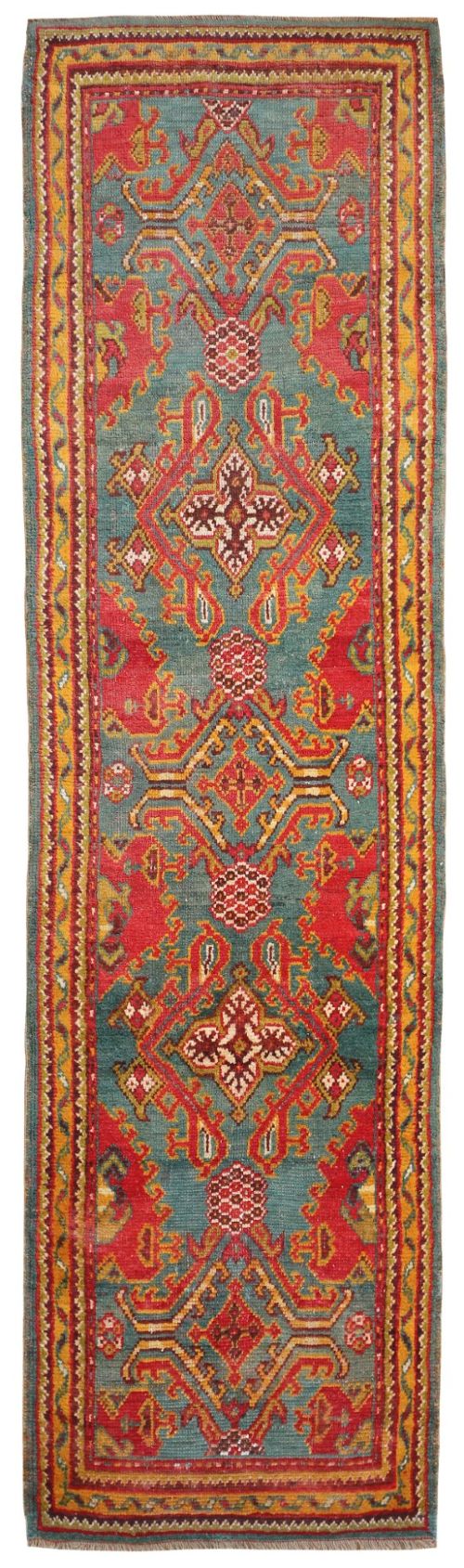



Blue Ushak Runner
A blue ushak runner brings soft Anatolian warmth to a hallway, woven in wool and cotton with gentle historic dye work.
Blue Ushak Runner
When you search for a blue ushak runner, you are looking at hand-knotted floor coverings originating from Turkey during the late nineteenth and early twentieth centuries. These pieces display distinct Anatolian motifs interpreted through traditional Ottoman aesthetics, tailored in long, narrow runner formats suited for corridors.
The versions you are most likely to meet on this page date from the Victorian era up to the nineteen-twenties. They combine muted wool piles with cotton foundations, showing the characteristic large-scale geometric or floral designs typical of the region.
Makers utilised durable construction methods suited for heavy domestic traffic, resulting in practical furnishings that retain their decorative appeal. Each runner demonstrates the regional weaving traditions of Anatolia, adapted over decades for Western homes.
How they were made
These runners are constructed with hand-knotted wool piles secured onto sturdy cotton warps and wefts. Certain examples incorporate angora wool, which yields a softer handle and a subtle sheen across the surface.
The weavers employed traditional Turkish knots, tying each strand by hand to create dense, hard-wearing foundations that withstand generational use. Natural dyes provided the characteristic soft blue ground colours that define this specific palette.
Listings span the late Victorian period to the nineteen-twenties, utilising wool, cotton, and angora wool across traditional Anatolian runner formats.
What varies in quality
Quality rests upon the fineness of the knotting and the clarity of the Anatolian design. Finer knots allow for sharper definition within the large-scale medallions and border patterns.
The handling of the wool also distinguishes finer examples, particularly where soft angora wool is utilised to create a more tactile pile. The consistency of the natural blue dye saturation across the long field dictates visual harmony.
The Blue Ushak Runner Glossary
- Ushak
- A term designating rugs and carpets produced in and around the town of Uşak in western Turkey. These textiles are renowned for their distinctive motifs and warm palette.
- Runner
- A long, narrow carpet format specifically designed for hallways, staircases and narrow passageways. They protect wooden floors while adding pattern to transitional spaces.
- Angora Wool
- The hair of the Angora goat, sometimes incorporated into pile weaving to impart a softer texture and a reflective quality to the surface. It handles dyes with particular brilliance.
- Warp
- The vertical foundation threads stretched lengthwise on the loom before knotting begins. Cotton is standard for these structural elements in later Anatolian weaving.
Blue Ushak Runner: Frequently Asked Questions
Where should I place a blue ushak runner?
These long carpets suit narrow corridors, grand hallways and transitional spaces where floor coverage softens footsteps and adds historic character.
Their elongated proportions ensure they fit comfortably in rooms requiring linear definition without overwhelming the surrounding architecture.
How do I care for an antique wool runner?
Regular gentle vacuuming without a rotating brush bar keeps the wool pile free from abrasive grit and dust.
Professional specialist cleaning is recommended to maintain the integrity of the natural dyes and the cotton foundation over time.
What period do these runners come from?
The examples on this page primarily date from the late nineteenth century through to the early twentieth century, spanning the Victorian and Edwardian eras.
Production methods during this timeframe relied entirely on traditional hand-knotting techniques passed down through generations in Anatolian workshops.
Are these runners durable enough for daily use?
Constructed with dense wool knots and sturdy cotton foundations, these textiles were originally built for heavy household traffic.
With appropriate underlay to prevent sliding, they withstand everyday walking while preserving their historic aesthetic.