

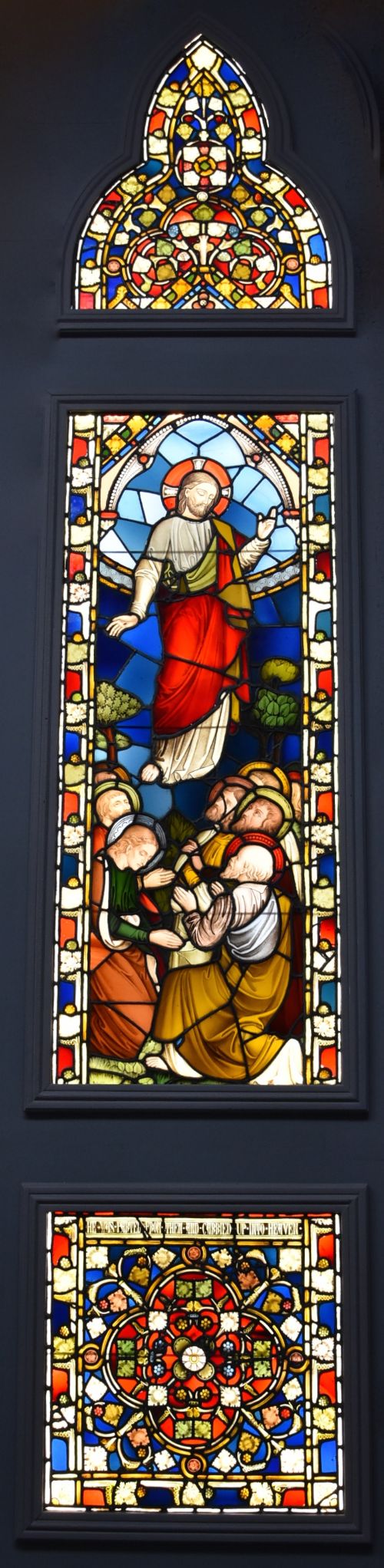


Blue Leaded Glass Panel
A blue leaded glass panel brings rich colour and historic character to any room, filtering natural light through intricate coloured glass sections held within lead cames.
Blue Leaded Glass Panel
A blue leaded glass panel is a decorative architectural window or hanging panel composed of individual pieces of coloured and clear glass joined by flexible lead strips. When searching for a blue leaded glass panel, buyers encounter examples spanning from the mid nineteenth century through to the nineteen thirties, encompassing Victorian, Edwardian, and Arts and Crafts periods.
The selections available here showcase diverse decorative motifs, ranging from Gothic Revival religious scenes and Pre-Raphaelite figures to hand-painted countryside landscapes, knights, and Dutch folk art designs. Most pieces take the form of vertical windows or triptychs framed in wood or timber, designed to be fitted into architectural openings or displayed against a light source.
How they were made
The structural framework often relies on timber surrounds or wood frames, while the internal matrix depends on the durability of the lead work and solder to maintain rigidity across large decorative compositions.
Blue Leaded Glass Panel Retail Price Guide 2026
Typical asking prices for blue leaded glass panel among the pieces listed under this phrase on Sellingantiques today, from the lower quarter to the upper quarter. They describe what is for sale here now, not the wider market.
Several panels feature cheerful Dutch children and armoured knights keeping watch over domestic interiors.
What varies in quality
Quality in these panels is determined by the artistry of the hand-painting, the depth of the glass colour, and the complexity of the compositional design. Finer examples display meticulous brushwork in figurative scenes, such as medieval knights or religious iconography, alongside harmonious glass selection that catches shifting daylight effectively.
The integrity of the lead cames and the condition of the painted surface dictate the overall durability and visual coherence of the panel. Superior pieces maintain crisp detail in both the glass painting and the lead matrix, whereas simpler utilitarian items rely on basic geometric patterns and minimal surface decoration.
Sir Edward Burne-Jones
The Blue Leaded Glass Panel Glossary
- Came
- The grooved lead strip used to hold individual pieces of glass together in a window. These flexible strips form the structural grid of the panel.
- Stained glass
- Glass that has been coloured during its manufacture or painted with metallic oxides and fired in a kiln. This technique allows for permanent decorative imagery.
- Triptych
- A picture or relief carving on three panels, often hinged together or displayed as a set. In glasswork, this format creates a large tripartite window composition.
- Vitreous enamel
- A material made by fusing powdered glass to a substrate by firing, used here to paint permanent details onto glass. It bonds securely under high heat.
- Gothic Revival
- An architectural and decorative style drawing inspiration from medieval design. It frequently appears in religious windows and pointed arch formats.
Blue Leaded Glass Panel: Frequently Asked Questions
How do I hang a glass panel?
These panels are generally heavy and require secure fixing within a window frame or dedicated hanging brackets that support the timber surround.
Using proper architectural fixings ensures the weight distributes evenly without straining the lead cames.
Can these panels be used outside?
Most antique panels were built for interior partition walls or protected exterior window settings where they avoid harsh weather.
Placing them directly outside exposes the historical lead work and hand-painted glass to environmental degradation.
How do I date a panel?
Dating relies on stylistic clues, such as the Gothic Revival motifs of the mid nineteenth century or the folk art designs of the nineteen thirties.
The specific painting techniques and framing materials also provide strong indicators of the period of manufacture.
Are the painted details original?
Hand-painted scenes on these windows typically feature fired vitreous enamel that becomes permanent part of the glass during creation.
Close inspection reveals whether the shading and brushwork align with Victorian or Arts and Crafts artistic conventions.