

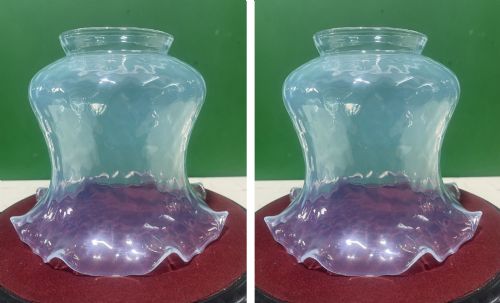
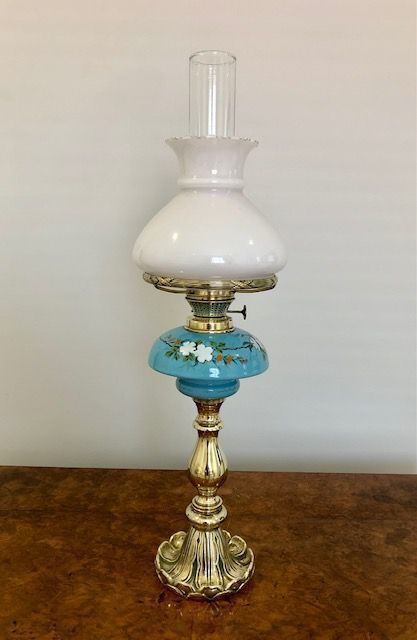


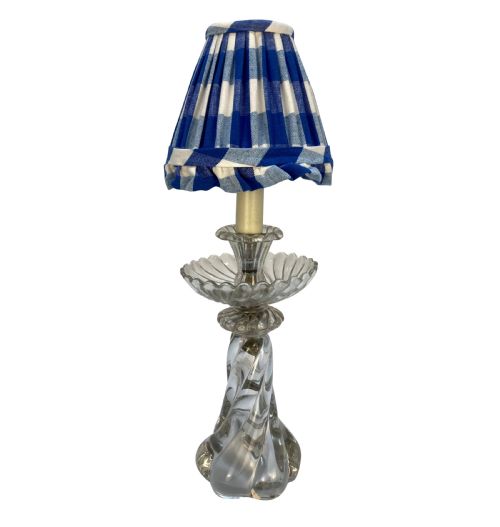


Blue Glass Light Shade
A blue glass light shade brings an immediate, rich wash of colour into a room, filtering illumination through Victorian opalescence or Art Deco geometry.
Blue Glass Light Shade
When you search for a blue glass light shade, you are looking at functional glassware designed to temper and colour electric or oil illumination. These pieces span from the late Victorian period through the Edwardian era into Art Deco, encompassing everything from Stourbridge globes to French plafonniers.
The version you are most likely to meet on this page is a nineteenth-century or early twentieth-century oil lamp shade or pendant light. They appear mounted on brass brackets, paired as wall sconces, or suspended as individual ceiling fixtures.
The forms range from simple globes and terrestrial shades to elaborate leaded panels and moulded figures. Makers utilised specialised cooling and tinting techniques to achieve deep cobalt hues and subtle opaline gradients.
How they were made
Glassmakers produced these shades using free-blown, mould-blown, or leaded construction methods. Opalescent and frosted effects relied on chemical additives to the molten batch, creating uneven light diffusion.
Many shades integrate metal components such as brass galleries, bronze mounts, and patinated fittings. Ceramic and fabric elements occasionally support the glass bodies on table and oil lamps.
Blue Glass Light Shade Retail Price Guide 2026
Typical asking prices for blue glass light shade among the pieces listed under this phrase on Sellingantiques today, from the lower quarter to the upper quarter. They describe what is for sale here now, not the wider market.
Some early oil lamps include tiny blue prisms that scatter stray gleams across the wallpaper when the evening lamps are lit.
What varies in quality
The distinction between ordinary and exceptional pieces lies in the depth of the glass colour and the precision of the moulding or leadwork. Heavy, hand-blown Stourbridge or Baccarat examples display rich chromatic variation rather than a flat, sprayed-on tint.
Integration with the original mounting hardware dictates the overall integrity of the piece. Fine examples retain matching brass galleries, original beaded prisms, or signed bronze bases that complement the glass.
Tiffany Studios NYC·Baccarat
The Blue Glass Light Shade Glossary
- Opalescent glass
- Glass containing ingredients that cause it to diffuse light with a milky or iridescent appearance, often showing blue tones by reflected light and amber by transmitted light. This technique was popular in Victorian and Art Nouveau lighting.
- Plafonnier
- A shallow bowl-shaped ceiling light mounted close to the fixture, common in the Art Deco period. These fixtures direct light downward through patterned or frosted glass.
- Stourbridge glass
- Glassware produced in the English West Midlands town known for fine Victorian coloured and cameo glass. Pieces from this region often exhibit complex layered colours.
- Font
- The oil reservoir of a lamp, frequently fashioned from blue glass to match the corresponding shade. It sits above the base and below the burner.
- Terrrestrial globe shade
- A spherical glass shade painted or moulded to resemble a map or globe. These typically enclose the flame of nineteenth-century oil lamps.
Blue Glass Light Shade: Frequently Asked Questions
How do I clean an antique glass shade?
Wash the glass gently in lukewarm water with mild soap, avoiding harsh abrasives that might damage the surface texture or historic tint. Dry thoroughly with a soft cloth before rehanging.
Take care around any painted or frosted areas, as old pigments can be sensitive to prolonged soaking or strong cleaning agents.
Are these shades compatible with modern wiring?
Most antique shades can be adapted to modern electrical fittings using standard brass galleries or shade rings. Ensure the fitter size matches the gallery of your chosen pendant or wall sconce.
Consult a qualified electrician to check that older brass or bronze lamp bodies meet current safety standards for domestic lighting.
How do I tell Victorian shades from later pieces?
Victorian examples often feature heavy opalescent or Stourbridge glass with hand-finished rims and fitted oil lamp galleries. They tend to have softer, more tactile surfaces.
Later pieces from the nineteen-thirties lean toward geometric Art Deco moulding and streamlined plafonnier shapes designed specifically for electrical ceiling fixtures.
Can I use these with modern LED bulbs?
Low-heat LED bulbs work well inside antique glass shades, preserving the material from thermal stress caused by older incandescent lamps. Choose a warm colour temperature to replicate historic light output.
Check the physical dimensions of the bulb to ensure it fits comfortably within spherical or closed globe shades without touching the glass.