
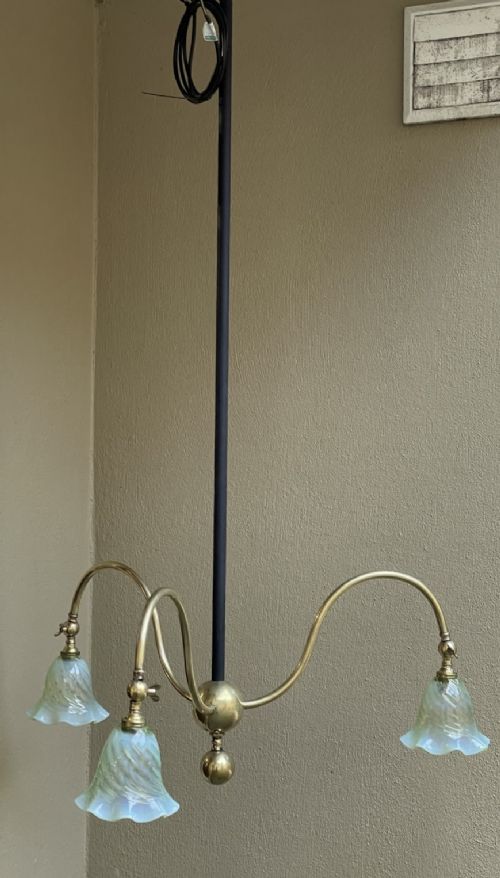


Opalescent Glass Shade Lamp
These opalescent glass shade lamp examples range from Victorian oil variants to Edwardian rise and fall ceiling fittings.
Opalescent Glass Shade Lamp
An opalescent glass shade lamp combines translucent glassware with mounts in brass, copper, wrought iron or chrome. The selections span ceiling lights, wall oil lamps and table lamps across Victorian, Edwardian and Art Deco periods.
The Arts and Crafts and Art Nouveau styles dominate the grouping, alongside industrial Art Deco items. Collectors encounter everything from large ceiling pendant bowls to functional wall brackets and pendant lights.
How they were made
Maker workshops utilised glass blowing techniques to create the opalescent shades, pairing them with heavy metalwork in brass, copper and iron. Components were assembled using standard period fixings, fabric cords and structural brackets.
Surface treatments on the metal frames include polished brass and patinated copper, whilst the glass displays milk and opalescent qualities achieved through chemical additives during the melting process.
Even town halls required good lighting, as proven by surviving municipal ceiling fixtures.
What varies in quality
Quality rests upon the weight of the metal mountings and the subtlety of the opalescent glass fire. Heavier brass and copper castings indicate superior production compared to lighter metal forms.
Artistic execution in the Art Nouveau and Arts and Crafts styles separates standard utility lighting from more ambitious decorative commissions, particularly in architectural ceiling pendants and town hall fittings.
The Opalescent Glass Shade Lamp Glossary
- Opalescent glass
- Glass containing ingredients that cause a milky, pearlescent appearance with subtle colour shifts under light. It diffuses illumination evenly across pendant bowls and shades.
- Rise and fall
- A mechanical ceiling fitting mechanism using pulleys and weights to adjust the height of the lamp. This system was popular during the Edwardian period for dining tables.
- Art Nouveau
- A design style characterised by organic, flowing lines inspired by natural plant forms. It appears frequently in brass and copper light fittings from the turn of the twentieth century.
- Arts and Crafts
- A movement prioritising traditional craftsmanship and honest materials like hammered copper and brass. Pieces from this era often display visible construction details.
- Duplex burner
- A double-wick oil lamp burner mechanism used on Victorian and Edwardian reservoirs. It provided a brighter flame than single-wick predecessors.
Opalescent Glass Shade Lamp: Frequently Asked Questions
What is an opalescent glass shade lamp?
These fixtures combine milk or opalescent glass shades with metal bases or hanging mounts. They date from the nineteenth century through the Art Deco period.
The category includes ceiling pendants, wall-mounted oil lamps, and table lamps styled in Arts and Crafts and Art Nouveau traditions.
How do I date an antique lamp?
Dating relies on identifying material combinations, manufacturing techniques, and stylistic markers such as Art Nouveau curves or Arts and Crafts hand-working. Hardware types and cord styles also offer clues.
Period references range from Victorian oil reservoirs to nineteen-thirties chrome table lamps.
Were these originally for oil or electricity?
Many early pieces began as oil or paraffin burners, such as Messenger or Hinks models. Others were manufactured as gas or early electric ceiling lights.
Conversions to electricity are common amongst older wall brackets and pendant bowls to suit modern interiors.
What metals were used in these lamps?
Makers employed brass, copper, wrought iron, and later chrome. Brass and copper dominate the Arts and Crafts and Art Nouveau selections.
Metal choice often reflects the period and the specific workshop aesthetic, ranging from polished finishes to darker patinas.