





Blue Geometric Wall Art
These pieces sold as blue geometric wall art span mid-century abstracts and tribal textiles, bringing structured colour and strong pattern to an interior.
Blue Geometric Wall Art
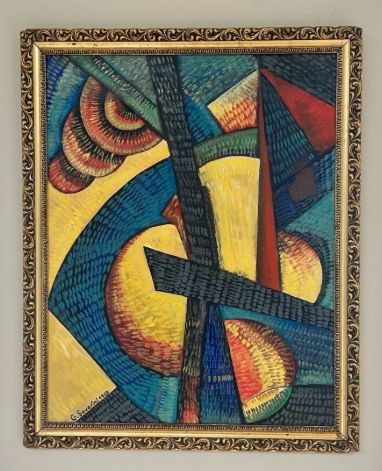
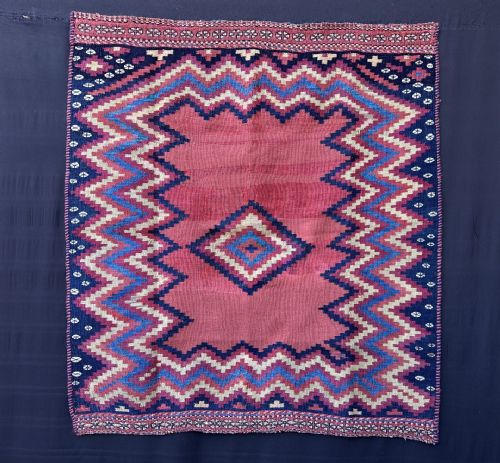
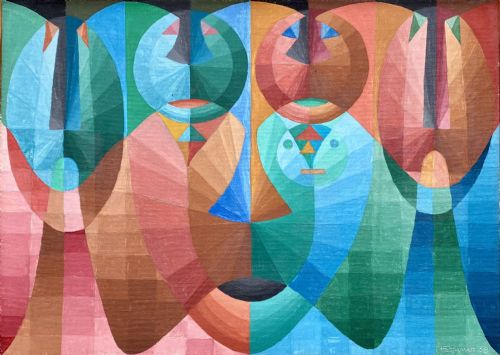
When you search for blue geometric wall art, you encounter a mix of mid-century abstract paintings and tribal textiles from various origins. The selection on this page ranges from mid-century modernist canvases and oil paintings on board to Persian tribal bags and flatwoven bread sofrehs.
The mid-century works often reflect styles such as op art and brutalist abstraction, while the older textile pieces display Persian tribal and Turkmen designs. These objects serve as striking visual focal points, combining utilitarian craft origins with distinct artistic expression.
Materials and construction
The paintings in this group utilise oil paint applied to canvas or hardboard, sometimes housed within gilded wood frames. Artists employ techniques typical of mid-century abstraction and op art to create structured, patterned compositions.
The textile pieces are constructed from wool using flatweave and Soumak techniques. These woven works rely on traditional tribal methods native to regions such as Kerman Province and Central Asia.
The listings span periods from the late nineteenth century to the late twentieth century, covering canvas, oil paint, wool, and wood.
Assessing quality
Quality in these works rests upon the precision of the composition and the integrity of the materials used. Paintings show distinction through confident brushwork and balanced colour relationships.
For the woven textiles, excellence is found in the tightness of the weave, the clarity of the tribal motifs, and the preservation of the wool over time.
Gino Severini·Rowland Fade·Sonia Delaunay·William Ernst Burwell
The Blue Geometric Wall Art Glossary
- Soumak
- A flatweaving technique that wraps the weft threads around the warp to produce a durable fabric with a braided texture on the face. This method allows for intricate geometric patterns.
- Op art
- A style of visual art that uses optical illusions, employing repeating patterns and precise geometric shapes in contrasting colours. It emerged prominently during the mid-twentieth century.
- Sofreh
- A type of woven spread or cloth traditionally used in Persian households for meals or bread making. These textiles often feature geometric tribal designs.
- Hardboard
- A type of high-density fibreboard used as a rigid support for paintings. It provides a smooth, stable surface for oil paint.
- Brutalist
- An artistic style characterised by a rugged, textured appearance and heavy geometric forms. In painting, this translates to thick application and stark structural compositions.
Blue Geometric Wall Art: Frequently Asked Questions
What is blue geometric wall art?
This category encompasses mid-century abstract paintings and antique tribal textiles featuring structured patterns and blue tones. The pieces range from oil paintings on canvas to woven wool bags from Persia and Central Asia.
Buyers choose these items to introduce bold colour and graphic design into modern or traditional spaces.
How do I hang a textile piece?
Textiles such as tribal bags and bread sofrehs require careful mounting to distribute their weight evenly. A professional framer can stitch the textile to a padded backing support.
Alternatively, a concealed sleeve can be sewn to the reverse to slide onto a rod for wall display.
How do I date mid-century paintings?
Mid-century paintings are typically dated through signatures, exhibition labels, or stylistic markers characteristic of the nineteen-fifties and sixties. Artists working during this era often experimented with op art and abstract forms.
Materials such as hardboard supports also provide chronological indicators for works from this period.
How are tribal pieces authenticated?
Tribal pieces are evaluated by examining the weave structure, natural dye characteristics, and regional motifs specific to groups such as the Afshar or Yomut tribes. The materials and construction methods reflect traditional practices of their origin.
Documentation or provenance from previous collections further supports the attribution of these textiles.