
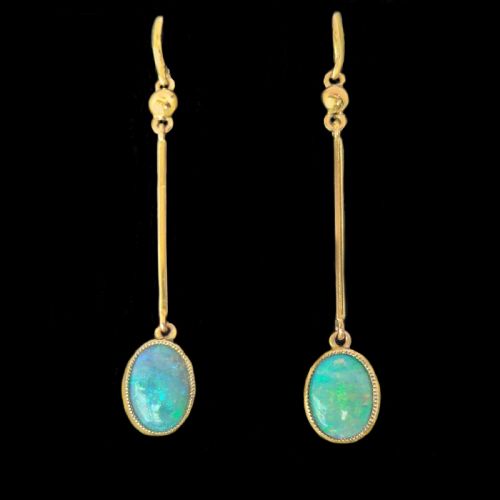
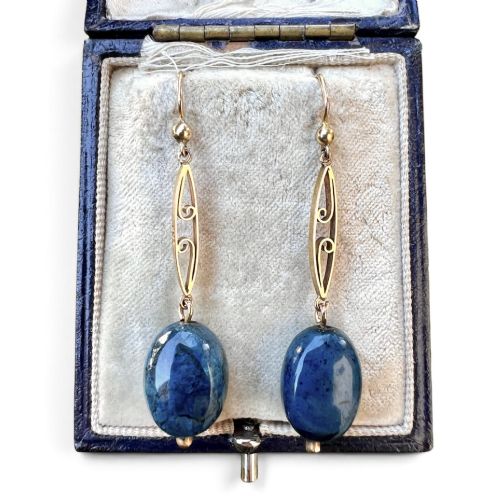


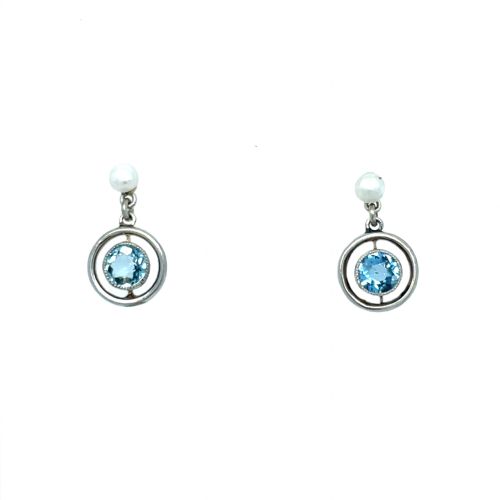


Blue Gemstone Drop Earrings
Blue gemstone drop earrings bring together centuries of fine metalwork and cool stones, offering a graceful line that flatters the wearer.
Blue Gemstone Drop Earrings
Blue gemstone drop earrings are defined by their pendant movement and cool-toned stones, suspended to catch the light with every turn of the head. When searching for blue gemstone drop earrings, buyers encounter diverse forms ranging from simple bezel settings to intricate clustered designs.
The selections span from the ornate detailing of the Edwardian era and the geometric precision of the 1920s and 1930s Art Deco period to the clean lines of mid-century modernism and the later twentieth century. Aquamarine dominates the selection, accompanied by sapphire, opal, blue topaz, apatite, and blue zircon.
Mountings vary widely in scale and construction, pairing stones with accompanying diamonds or pearls. Metal choices range across platinum, white gold, eighteen carat gold, and nine carat yellow or white gold.
Materials and Construction
Metals such as platinum, eighteen carat gold, and nine carat gold provide the structural backbone for these drop earrings, often chosen to complement the pale or vibrant hues of the central stones. Platinum and white gold frequently support Edwardian and Art Deco pieces, offering strength for delicate claw and cluster settings.
Gems are shaped into pear cuts, square cuts, and standard facets to maximise brilliance, then secured alongside small accent diamonds or pearls. Techniques evolved from hand-worked Edwardian filigree and platinum settings to the structured mountings of the nineteen-fifties.
Blue Gemstone Drop Earrings Retail Price Guide 2026
Typical asking prices for blue gemstone drop earrings among the pieces listed under this phrase on Sellingantiques today, from the lower quarter to the upper quarter. They describe what is for sale here now, not the wider market.
The selection includes Edwardian, Art Deco, and mid-century designs utilising both yellow and white gold alloys.
Assessing Quality and Craftsmanship
Quality rests in the harmony between the gemstone's clarity and the precision of the metal setting. Finer examples display clean stone facets and secure, balanced drop mechanics that allow natural movement without rigidity.
The integration of supporting diamonds and the weight of the gold or platinum chassis distinguish standard production from exceptional pieces. Superior design ensures the drop hangs correctly, maintaining balance and comfort during wear.
The Blue Gemstone Drop Earrings Glossary
- Aquamarine
- A pale blue variety of beryl that forms the primary gemstone across many Edwardian, Art Deco, and mid-century designs.
- Drop Earrings
- Earrings designed to suspend below the earlobe rather than sit directly against it, creating gentle movement.
- Art Deco
- A design style from the nineteen-twenties and nineteen-thirties characterised by geometric symmetry and platinum or white gold settings.
- Platinum
- A dense, durable white metal utilised in antique and vintage jewellery to hold fine stone settings securely.
- Cluster Earrings
- A style where a central gemstone is surrounded by a border of smaller stones, such as diamonds.
Blue Gemstone Drop Earrings: Frequently Asked Questions
How do I care for antique drop earrings?
Store them individually in soft pouches to protect the metal settings and prevent stone-on-stone contact.
Clean them gently with a soft cloth, avoiding harsh chemical dips that might damage softer gems like opals.
What is the difference between Edwardian and Art Deco styles?
Edwardian pieces often feature delicate lace-like platinum work, pearls, and romantic motifs popular in the early twentieth century.
Art Deco designs lean towards sharp geometric lines, bold stone cuts, and streamlined platinum frameworks.
Are these earrings suitable for daily wear?
Robust mountings in eighteen carat gold or platinum handle regular use well, provided the stone settings remain secure.
More delicate Edwardian or high-carat pieces benefit from reserved wear on special occasions to preserve their antique structure.
How are different gold purities used?
Nine carat gold offers a sturdy, durable alloy suited to mid-century and later mounting styles.
Eighteen carat gold provides a richer yellow hue and greater malleability, often found in finer vintage constructions.