


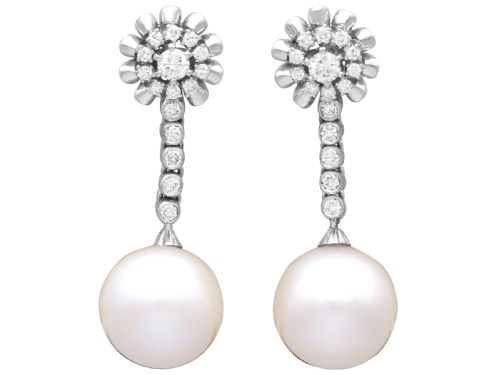


1950s Diamond Earrings
These 1950s diamond earrings combine mid-century glamour with platinum and white gold settings, offering a sophisticated look for collectors.
1950s Diamond Earrings
When you search for 1950s diamond earrings, you find pairs shaped by mid-century design, featuring floral clusters, daisy motifs, and fan shapes. These pieces capture the optimism of the post-war decades through structured geometric forms and organic arrangements.
You are most likely to meet white gold and platinum settings on this page, often paired with cultured pearls, aquamarines, sapphires, or turquoises alongside the diamonds. Drop earrings and clip-ons dominate the current selection, reflecting the fastening preferences of the era.
How they were made
Goldsmiths utilised 18ct white gold, 14ct white gold, and platinum to build secure claw and bezel settings for single cut, brilliant cut, and baguette cut stones. These durable metals allowed for delicate floral clusters and starburst designs without adding excessive weight to the earlobe.
Many pairs incorporate clip-on mechanisms or lever-backs to accommodate the changing fashion for heavier, larger drop and pendant forms. Gemstones such as aquamarine and pearl are integrated directly into the metal framework to create balanced mid-century compositions.
Listings feature 18ct white gold, platinum, and 14ct white gold alongside diamonds, pearls, aquamarines, and sapphires.
What varies in quality
The distinction between average and exceptional pairs rests upon the clarity and cut of the diamonds, alongside the weight of the precious metal used in the mount. Heavier platinum and 18ct white gold constructions provide structural integrity that lighter alloys simply cannot match.
Execution of design details, such as hand-formed fan or comet motifs and matched gemstone saturation in sapphires or aquamarines, elevates the piece. Superior craftsmanship shows in the seamless integration of secondary stones like pearls and turquoises within the primary diamond layout.
The 1950s Diamond Earrings Glossary
- Single cut
- A simple diamond cut with seventeen facets, typical of smaller stones in vintage cluster designs. This cut produces a sharp, distinct sparkle quite different from modern brilliant cuts.
- Platinum
- A dense, strong white metal favoured for mid-century fine jewellery. It holds small claw settings securely without tarnishing.
- Drop earrings
- Earrings that hang below the earlobe, popular in mid-century styles. They often incorporate swinging pendant sections with pearls or aquamarines.
- Clip-ons
- A fastening mechanism attached to the reverse of non-pierced earrings. This closure style became widespread during the 1950s for heavier cluster designs.
- Baguette cut
- A rectangular, step-cut diamond shape utilised for linear accents. These stones provide cool, geometric contrast to brilliant cut clusters.
1950s Diamond Earrings: Frequently Asked Questions
How do I identify a 1950s diamond earring?
Look for characteristic mid-century motifs like floral clusters, starbursts, and fan shapes set in white gold or platinum. The use of single cut diamonds and clip-on backings also points directly to this period.
Proportions tend to be bold yet refined, frequently combining diamonds with coloured gems such as aquamarine or sapphire.
Did women pierce their ears in the 1950s?
Ear piercing declined in popularity during the mid-century decades, leading manufacturers to design most earrings with sturdy clip-on mechanisms. These fasteners distributed the weight of larger diamond clusters comfortably across the earlobe.
Converted pairs or original pierced variations do exist on the market, but clip-ons remain the standard find for this decade.
What metals were used in 1950s earrings?
Platinum and 18ct white gold served as the primary metals for high-end diamond pieces during this era. Some designs also incorporate yellow gold for contrast or utilise 14ct white gold alloys.
These metals provided the necessary strength to support intricate arrangements of multiple diamonds and coloured stones.