
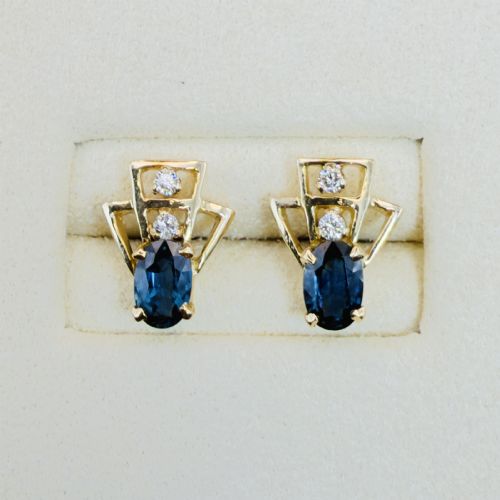


Vintage Diamond Ear Clips
These vintage diamond ear clips span the Edwardian era through the mid-century, offering secure fasteners set with diamonds in platinum and gold.
Vintage Diamond Ear Clips
Vintage diamond ear clips comprise earrings designed with clip-on, screw, or stud mechanisms, removing the need for pierced lobes. They appear in styles ranging from Edwardian and Art Deco to Retro and Mid-Century designs.
The selection includes platinum and gold mountings paired with white and yellow metals. Gemstone combinations feature diamonds alongside sapphires, rubies, and pearls in various carat weights.
How they were made
Master jewellers mounted old cut diamonds into platinum and various grades of gold, including 18ct white gold, 18k white gold, 14ct white gold, and 9ct white gold. Metalwork incorporates swirl and twist forms executed during the 1920s, 1930s, 1940s, 1950s, and 1960s.
Earrings utilise specialised mechanical backs, such as clip-on and screw fittings, secured to the main setting. Construction frequently combines diamonds with sapphires, rubies, and pearls.
Vintage Diamond Ear Clips Retail Price Guide 2026
Typical asking prices for vintage diamond ear clips among the pieces listed under this phrase on Sellingantiques today, from the lower quarter to the upper quarter. They describe what is for sale here now, not the wider market.
Screw-back mechanisms allowed grandmothers to secure over six carats of diamonds without committing to a piercing needle.
What varies in quality
Quality differences rest in the precision of the metalwork and the integration of the stones within the platinum or gold settings. Heavier carat weights and intricate Edwardian or Art Deco geometric layouts distinguish finer examples.
The robustness of the fastening mechanisms, whether clip-on or screw back, dictates the reliability of the piece during wear. Harmony between the primary diamonds and secondary gems like sapphires or pearls influences the overall composition.
The Vintage Diamond Ear Clips Glossary
- Ear clips
- Non-pierced earrings secured to the earlobe via a hinged clip mechanism. They provide a snug fit without requiring pierced ears.
- Old cut
- A diamond cutting style prevalent in antique and vintage jewellery before modern brilliant cuts were standardised. These stones feature smaller tables and higher crowns.
- Platinum
- A dense, durable, and naturally white precious metal frequently utilised in Edwardian and Art Deco mountings. It holds small pavé-set stones securely.
- Art Deco
- A design style spanning the 1920s and 1930s characterised by geometric symmetry, clean lines, and stylised motifs. Pieces from this era often pair diamonds with platinum.
- Mid-Century
- A period covering the 1940s and 1950s known for organic forms, bold shapes, and mixed gold tones. Designs from this time reflect post-war modernist aesthetics.
Vintage Diamond Ear Clips: Frequently Asked Questions
How do vintage ear clips stay on?
Vintage ear clips use a hinged lever mechanism on the reverse that applies gentle pressure to hold the lobe. Some examples utilise screw mechanisms to adjust the tension manually.
This design allowed people to wear substantial gemstone earrings without needing pierced ears.
Can clip earrings be converted to posts?
Jewellers can convert clip-on earrings to posts, though altering antique or vintage mountings often changes the original structure. Collectors generally prefer preserving the historic fastening system intact.
Professional evaluation helps determine if the conversion is possible without damaging the setting.
What periods do these earrings cover?
The available pieces span from the Edwardian era through the 1920s, 1930s, 1940s, 1950s, and 1960s. Each decade brings distinct stylistic traits, such as Art Deco geometric lines or Mid-Century organic curves.
Platinum dominates the earlier decades, while various gold purities appear more frequently in mid-century items.
Are pearls common in these designs?
Pearls occasionally accompany diamonds in mid-century and retro clip-on earrings. They serve as central accents or contrasting elements against white gold settings.
These combinations reflect the decorative preferences of the 1950s and 1960s.