
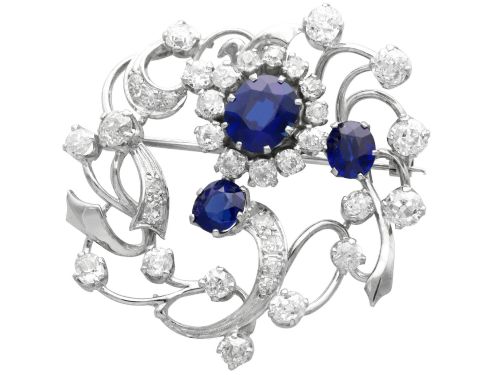
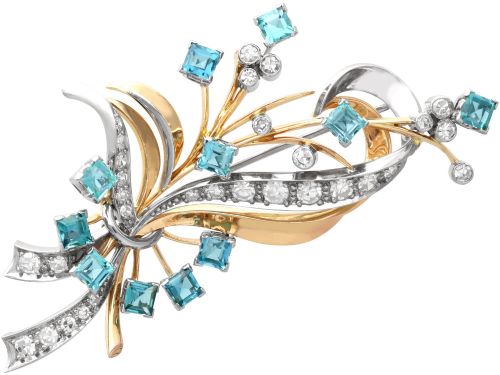


Blue Gemstone Brooch
A blue gemstone brooch brings cool colour and enduring metalwork together, prized for its versatile elegance.
Blue Gemstone Brooch
A blue gemstone brooch spans multiple eras, offering designs from the Victorian period through to the mid twentieth century. Buyers seeking a blue gemstone brooch find varied forms including crescent shapes, bar pins, and convertible pendant designs.
The materials range from deep blue sapphires and aquramarines to zircon, chalcedony, and amethyst, set against yellow gold, white gold, silver, or platinum. These ornaments reflect distinct periods such as Art Deco, Edwardian, and Renaissance Revival.
Victorian examples often incorporate foliate motifs and pearls alongside gold or silver settings, while later twentieth-century pieces favour geometric platinum arrangements. Each piece displays the characteristic craftsmanship of its specific decade.
How they were made
Goldsmiths and silversmiths utilised durable metals including nine carat gold, fifteen carat gold, eighteen carat yellow gold, fourteen carat white gold, silver gilt, and platinum to mount the stones securely. Metalwork often incorporates detailed wirework or cast frames suited to the period.
Gemstones such as sapphires, aquamarines, and zircons are paired with accents of diamonds and pearls, held in collet or claw settings. Artisans balanced substantial central stones with delicate surrounding gem clusters to create structured pins and brooches.
Listings feature periods spanning the Victorian era through to nineteen sixty, utilising sapphire, aquamarine, zircon, and platinum.
What varies in quality
The distinction between tiers rests upon the scale of the central stones, the weight of the precious metal, and the intricacy of the surrounding work. Larger carat weights in aquramarines or sapphires paired with substantial diamond accents elevate the character of a piece.
Artisanal execution distinguishes standard production from finer examples, seen in the harmony of stone proportions, the precision of metal settings, and the preservation of original enamel or delicate foliate details.
The Blue Gemstone Brooch Glossary
- Sapphire
- A precious gemstone of the corundum family, prized for its deep blue coloration in antique jewellery. It appears frequently in Victorian and later settings.
- Aquamarine
- A pale blue variety of beryl utilised extensively in twentieth-century designs. It offers significant stone weight and clarity in brooch settings.
- Platinum
- A dense, durable white metal favoured during the Art Deco period for intricate settings. It allows for fine claw work without bulk.
- Foliate motif
- A decorative pattern inspired by leaves and foliage. It is common in nineteenth-century metalwork and brooch designs.
- Silver gilt
- Silver that has been coated with a thin layer of gold. This technique provides the appearance of gold while utilising a silver base.
Blue Gemstone Brooch: Frequently Asked Questions
How do I wear a blue gemstone brooch?
Pin the piece securely to heavy fabrics such as wool coats, structured lapels, or thick knit scarves where the weight is well supported.
Heavier designs featuring large aquramarines or multiple diamonds sit best on sturdy garments to prevent the fabric from sagging.
What periods do these brooches come from?
The pieces span the nineteenth and twentieth centuries, encompassing Victorian, Edwardian, and Art Deco styles.
Maker choices range from mid-Victorian gold work to platinum settings from the nineteen-thirties and nineteen-forties.
Are these brooches also pendants?
Certain examples feature integrated loops or mechanisms that allow the piece to be worn on a chain as well as pinned to clothing.
Convertible designs provide flexibility in how the ornament is displayed.
What metals are used in these settings?
Jewellers utilised nine carat gold, fifteen carat gold, eighteen carat yellow gold, fourteen carat white gold, silver, silver gilt, and platinum.
White metals became particularly prominent during the Art Deco era alongside platinum and diamond clusters.