


Blue Floral Watercolour
Blue floral watercolour paintings capture gardens and still-lifes on paper through delicate pigment and brushwork.
Blue Floral Watercolour
When you search for blue floral watercolour, you are looking at works on paper spanning the Victorian era to the mid-twentieth century. The selection centres on still-life studies of flowers alongside garden landscapes and architectural views.
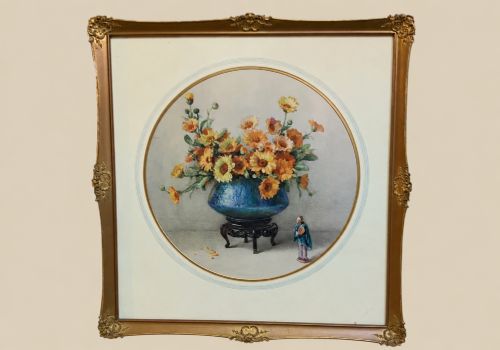
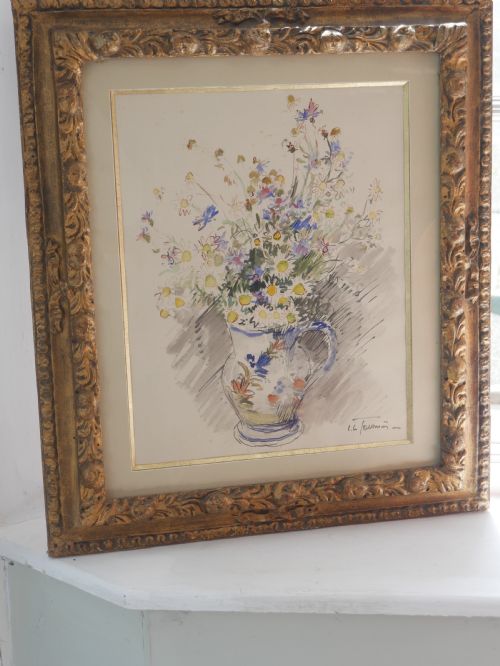
You are most likely to meet traditional still-lifes depicting blooms such as pansies, azaleas, and wallflowers arranged in vases, baskets, or jugs. These paintings capture botanical subjects using watercolour paint and pigment across various decades from the Victorian period through to nineteen fifty.
How they were made
These works utilise watercolour paint and pigment applied directly onto paper surfaces to achieve transparent washes and fine botanical detail. Artists build up the floral subjects using traditional brush techniques.
Many of the surviving pieces feature framing materials such as wood, glass, and giltwood with gold leaf accents. These frames complement the works on paper while protecting the delicate watercolour pigment from environmental damage.
Pansies and wallflowers sit quietly in their jugs, outlasting the gardeners who first planted them.
What varies in quality
The standard of execution separates simple decorative flower studies from accomplished works by named artists. Stronger pieces display confident brushwork and harmonious composition within the floral arrangement or garden scene.
Framing and material preservation also influence the overall character of the piece. Works retaining their original giltwood or wood frames demonstrate greater integrity than those re-framed at later dates.
Edith Barrow·Grace Hastie·Phyllis I Hibbert·Marion Broom·Beatrice Parsons·Theresa Sylvester Stannard·George Frederick Nicholls·Amy Reeve-Fowkes
The Blue Floral Watercolour Glossary
- Watercolour pigment
- The finely ground colour substance mixed with a binder to create watercolour paint. It provides the hues seen in floral and garden paintings.
- Giltwood
- Wood carved and covered with a thin layer of gold leaf. This material appears frequently on period frames enclosing works on paper.
- Impressionism
- An artistic style focusing on light and spontaneous brushstrokes. This approach appears in works from the Edwardian period.
- Botanical
- Pertaining to the scientific or artistic study of plants. These works focus closely on specific flower species like pansies and azaleas.
Blue Floral Watercolour: Frequently Asked Questions
What periods do these watercolours cover?
The available pieces span from the Victorian era through the nineteen twenties, nineteen thirties, and nineteen forties up to nineteen fifty. They reflect changing artistic styles across these decades.
Most examples date from the early to mid-twentieth century, capturing traditional British garden and still-life subjects.
How should I display a watercolour?
Watercolours require careful placement away from direct sunlight to prevent the pigments from fading over time. Glass and appropriate framing protect the paper surface.
Keep them in rooms with stable humidity levels to preserve both the paper and any original wood or giltwood frames.
Are all the paintings signed?
Many pieces feature artist signatures within the composition, while others remain unsigned or attributed to specific periods and schools. Signed works often link directly to known painters of the era.
Unsigned examples are typically categorized by their stylistic period, such as Victorian or English School.
What subjects besides flowers appear?
Alongside floral still-lifes of roses, marigolds, and gladioli, the selection includes garden scenes and architectural views. These depict country houses, cottage gardens, and London landmarks.
Such works combine botanical observation with landscape painting traditions.