

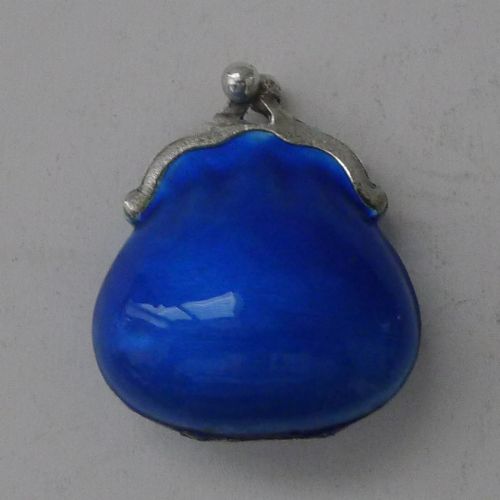
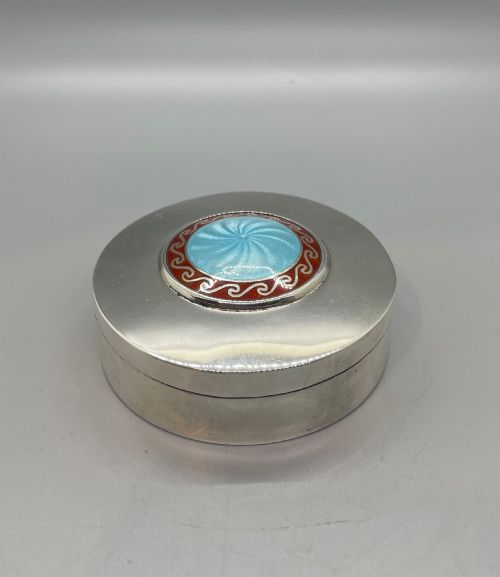
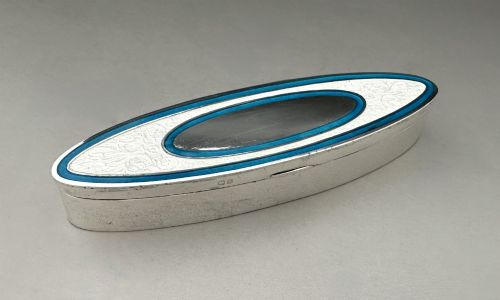


Blue Enamel Pill Box
These small containers, known as a blue enamel pill box, offer delicate colour and fine metalwork for pocket or dressing table.
Blue Enamel Pill Box
When you search for a blue enamel pill box, you encounter small handheld containers created for cosmetics, patches, snuff, or pills. The forms range from Georgian patch and snuff boxes to Edwardian and later silver pill boxes with engine-turned detail.
The pieces appearing on this page span the eighteenth century through the twentieth century. Earlier examples emerge from Staffordshire and Bilston enamels, while later pieces rely on sterling silver mounts housing vitreous enamel lids.
Makers shaped these items in rectangular, round, and oval formats. Collectors also find related forms such as vinaigrettes, rouge pots, and miniature compacts within the wider selection.
How they were made
Artisans applied powdered glass pastes onto copper, brass, or silver bases before firing the pieces in a kiln to form a hard vitreous coating. Many Edwardian and later pieces incorporate guilloche or engine-turned engraving beneath translucent enamel to create geometric patterns.
Mounts and frames utilise sterling silver, copper gilt, silver-gilt, or gold, often joined to the body with tiny hinges and bezels. Russian examples employ cloisonné wire techniques to outline distinct compartments of coloured enamel paste.
Blue Enamel Pill Box Retail Price Guide 2026
Typical asking prices for blue enamel pill box among the pieces listed under this phrase on Sellingantiques today, from the lower quarter to the upper quarter. They describe what is for sale here now, not the wider market.
Listings include items spanning the 18th century, Georgian period, Edwardian era, and the 20th century.
What varies in quality
The crispness of the engine-turning beneath translucent enamel dictates much of the visual depth in twentieth-century pieces. Finer work displays precise symmetry without blurring or pooling in the glass paste.
The handling of the hand-painted transfer scenes on eighteenth-century patch boxes separates standard items from superior examples. Early metal mounts fitted securely to the enamel body indicate careful workshop production.
The Blue Enamel Pill Box Glossary
- Guilloche
- A decorative engraving technique where a mechanical lathe cuts precise, repeating geometric patterns into a metal substrate. This underlying pattern shows clearly beneath translucent enamel.
- Vitreous enamel
- A material made by fusing powdered glass to a metallic base at high temperatures in a kiln. The resulting surface provides a glossy and durable coloured finish.
- Patch box
- A small eighteenth-century container originally used to hold small pieces of adhesive fabric placed on the face. These boxes frequently feature mirrors fitted inside the hinged lid.
- Bilston enamel
- Enamel work produced in the Staffordshire town of Bilston during the eighteenth century. These pieces typically feature copper bases covered in white or coloured enamel with hand-painted top designs.
- Silver-gilt
- Silver that has been coated with a thin layer of gold on its exterior surface. This treatment provides a warm metallic tone alongside the durability of a silver base.
Blue Enamel Pill Box: Frequently Asked Questions
What were blue enamel pill boxes used for?
These small vessels carried medicinal pills, lozenges, or breath fresheners for personal use throughout the day. Eighteenth-century precursors held beauty patches or powdered snuff.
Their compact dimensions allowed owners to slip them easily into pockets or evening bags for quick access.
How do I date a blue enamel pill box?
Silver components often bear hallmark stamps indicating the assay office and year of manufacture, particularly on twentieth-century pieces. Eighteenth-century examples rely on copper bases, painted motifs, and characteristic hinge construction.
Stylistic cues like Art Deco geometry or Georgian neoclassical borders provide further chronological markers.
How should I clean my enamel pill box?
Dust the surface gently with a soft, dry microfibre cloth to remove everyday particles. Avoid soaking the piece in water, as moisture can seep into historic hinges or compromise old adhesives.
Keep silver mounts polished with a dedicated cloth while taking care to avoid rubbing the enamel directly.
What is the difference between Bilston and Staffordshire boxes?
Bilston enamel specifically refers to items manufactured in the Staffordshire town of Bilston during the Georgian era. Staffordshire acts as the broader regional descriptor for output from multiple potteries and enamelling workshops in the same county.
Both categories typically employ copper bodies coated in opaque or coloured enamel.