




Blue Chinese Wool Carpet
A blue chinese wool carpet brings deep indigo tones and historical texture to a room, offering enduring craftsmanship from past centuries.
Blue Chinese Wool Carpet
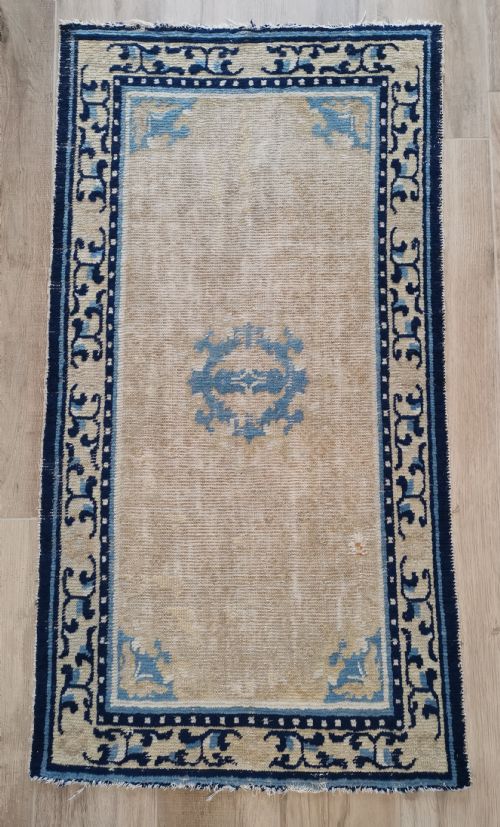
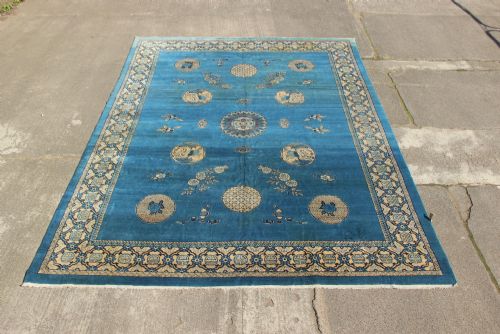
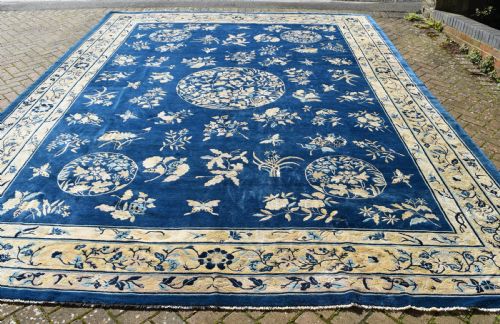
When you search for a blue chinese wool carpet, you are looking at floor coverings that span periods from the early nineteenth century through to the Art Deco era. The selection includes Ningxia rugs, Pao Tao carpets, Peking roomsize carpets, and Khotan rug fragments, representing diverse regional weaving traditions across China.
The pieces you are most likely to meet on this page date around nineteen twenty, encompassing roomsize carpets and smaller seating mats. These items range from grand carpets measuring over four metres to compact pillar rugs and fragments.
Originating from Northern China and specific production centres, these floor coverings reflect stylistic shifts from traditional Qing Dynasty motifs to the cleaner geometries of Chinese Art Deco.
How they were made
These floor coverings utilise natural wool for the pile, providing a dense and durable surface that absorbs dye deeply. Cotton foundations serve as the structural warp and weft, giving stability to the hand-knotted construction.
Weavers employed traditional hand-knotting techniques specific to regions like Ningxia, Peking, and Khotan. The textile construction incorporates durable vegetable and mineral dyes to achieve the distinctive blue coloration seen across the pieces.
The listings span materials limited entirely to wool and cotton across pieces dated from eighteen hundred to nineteen twenty.
What varies in quality
The standard of a piece depends on the density of the knotting and the crispness of the design execution. Finer examples display precise pictorial or geometric detail within the wool pile, maintaining structural integrity across large roomsize formats.
Preservation of the original pile and edges separates superior survivals from heavily worn fragments. The depth and saturation of the blue dye further distinguish the finer pieces in this category.
The Blue Chinese Wool Carpet Glossary
- Ningxia rug
- A textile originating from the Ningxia region of China, known for traditional designs and soft wool pile. These pieces often feature classical iconography and subtle colour palettes.
- Piling
- The cut or looped surface yarn of a carpet that forms the upper layer. In these antiques, the wool pile provides both texture and insulation.
- Art Deco
- A design style emerging in the early twentieth century characterised by stylised motifs and clean lines. Chinese interpretations blend modern geometry with traditional eastern symbolism.
- Warp and weft
- The foundational threads of a woven textile, where the warp runs vertically and the weft runs horizontally. Cotton is typically utilised for this structural grid.
- Peking carpet
- A floor covering produced in or around Beijing, frequently featuring open fields and central medallion designs. These roomsize carpets are recognised for their refined wool knotting.
Blue Chinese Wool Carpet: Frequently Asked Questions
How do I clean a fragile antique carpet?
Surface dust should be gently removed using a suction-limited vacuum without a beater bar, moving carefully across the wool pile.
Professional textile conservation cleaning is recommended for deeper maintenance to protect the delicate cotton foundations and historical dyes.
Where were these carpets originally placed?
Larger roomsize pieces were traditionally used to anchor formal reception spaces and halls in residences and temples.
Smaller formats such as seating mats and pillar rugs served specific architectural functions within traditional Northern Chinese interiors.
Can these carpets handle daily foot traffic?
Denser roomsize carpets with intact wool pile withstand moderate walking in low-traffic areas of a home.
Fragmentary pieces and older fragile rugs are better suited for display in low-wear environments or as wall hangings.
How do I identify a Qing Dynasty piece?
Qing period carpets typically feature traditional iconography, symbolic motifs, and specific regional colour palettes established before the twentieth century.
Examination of the knot count, wool quality, and structural materials helps differentiate these earlier pieces from later Art Deco productions.