



Blue Bakshaish Carpet
A blue bakshaish carpet brings grand northwest Persian village weaving into a room, offering large-scale geometry and soft indigo dye work.
Blue Bakshaish Carpet
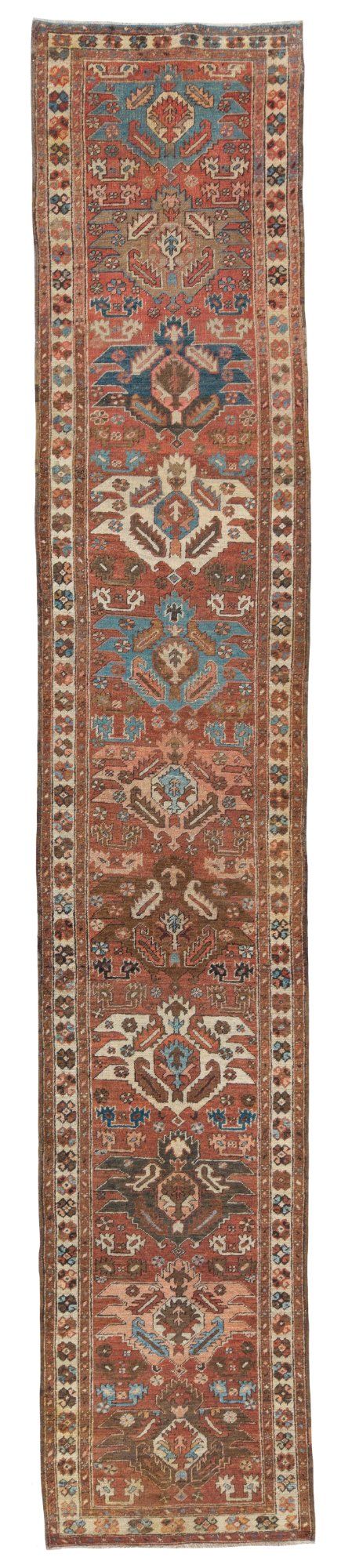
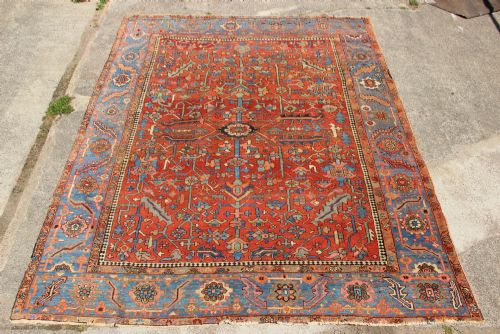
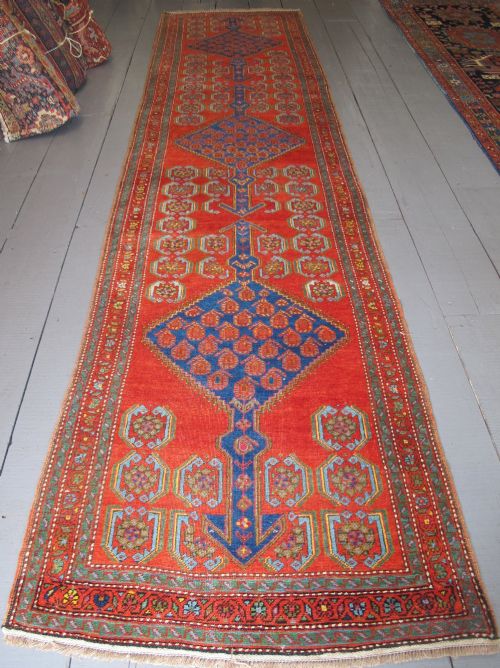
A blue bakshaish carpet belongs to the wider tradition of northwest Persian village weaving, originating from the Heriz region. These pieces appear in formats ranging from smaller village rugs and runners to large carpets spanning over four metres in length.
The aesthetic centres on large-scale geometric motifs and spacious fields rather than tight city patterns. Pieces on this page date across the latter half of the nineteenth century and the turn of the twentieth century, specifically from eighteen-fifty to nineteen-hundred.
How they were made
Weavers constructed these carpets using wool pile hand-knotted onto sturdy cotton foundations. This pairing provided the structural durability required for heavy domestic use in Persian village homes.
Natural dye traditions governed the palette, yielding the characteristic blue tones alongside contrasting earth hues. Weavers worked in domestic settings rather than large urban workshops, lending each piece an individual character.
Blue Bakshaish Carpet Retail Price Guide 2026
Typical asking prices for blue bakshaish carpet among the pieces listed under this phrase on Sellingantiques today, from the lower quarter to the upper quarter. They describe what is for sale here now, not the wider market.
Current listings exclusively feature wool and cotton construction across nineteenth and early twentieth-century dates.
What varies in quality
The distinction between tiers rests upon the handling of scale and proportion within the geometric field. Master village weavers balanced grand medallion layouts with open space, whereas lesser examples crowd the composition.
Knot density and the depth of the indigo dye work also dictate standing. Uniform wear across the wool pile and an even retention of the original outer borders separate standard room coverings from superior survivors.
The Blue Bakshaish Carpet Glossary
- Bakshaish
- A village and carpet-weaving district in northwest Persia associated with distinctive geometric rugs and carpets. Pieces from this origin often share design traits with nearby Heriz and Serapi production.
- Heriz
- A major carpet-weaving region in northwest Persia encompassing several specific village traditions. Bakshaish and Serapi carpets are frequently categorised under this broader geographical heading.
- Runner
- A long, narrow carpet format designed primarily for hallways, corridors or alongside large furniture. Surviving nineteenth-century examples often display extended repeating geometric borders.
- Pile
- The upright yarn loops forming the soft upper surface of a woven carpet. In these pieces, the wool pile absorbs natural indigo and madder dyes over decades of oxidation.
Blue Bakshaish Carpet: Frequently Asked Questions
Where were blue bakshaish carpets made?
These carpets were produced by village weavers in the northwest region of Persia, specifically around the Heriz district. Families and local workshops worked independently to create room-sized carpets and long runners.
Production relied on traditional motifs passed down through generations, distinguishing village weaving from city-based workshop output.
How do I date an antique bakshaish carpet?
Dating relies on assessing the structural materials, the depth of the wool pile, and the specific palette of natural dyes. Pieces on this page span from eighteen-fifty to nineteen-hundred.
Structural analysis of the cotton foundation and wool knotting helps confirm the nineteenth-century period of origin.
How do I care for an old carpet?
Protect the wool pile by placing a breathable rug underlay beneath the carpet to prevent slipping and friction against hard floors. Vacuum gently using suction attachment only, avoiding rotating brush bars.
Rotate the carpet periodically to ensure even exposure to natural light and foot traffic.
What is the difference between bakshaish and serapi?
Bakshaish carpets generally feature more eccentric, open geometric layouts and softer village drawing. Serapi carpets often display bolder, more structured large central medallions with a slightly more formal appearance.
Both traditions stem from the broader Heriz region of northwest Persia.