
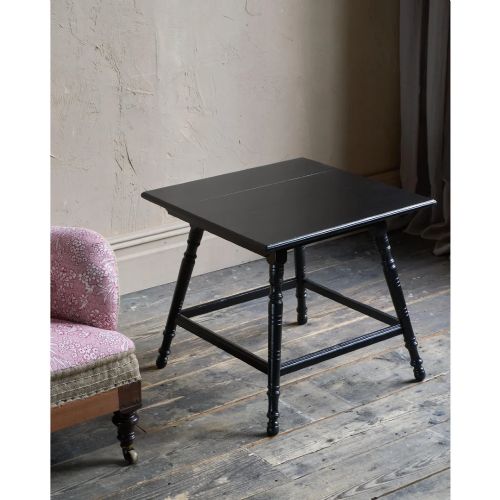
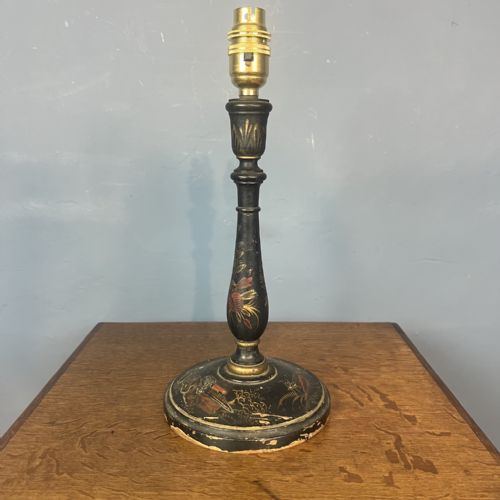


Black Turned Lamp Table
These black turned lamp table pieces deliver dark surfaces and sculptural supports to any room.
Black Turned Lamp Table
A black turned lamp table brings together dark finishes and turned supports across several historical periods, including the eighteenth century, Victorian era, and early twentieth century. Buyers encounter side tables, occasional tables, nests of tables, and table lamps designed for practical placement in living spaces.
The pieces appearing here span distinct stylistic movements such as the Aesthetic Movement, Anglo-Indian, Edwardian Chinoiserie, Georgian Revival, and English Country traditions. Makers and workshops utilise ebonised wood, lacquer, paint, and hardwood to achieve the characteristic dark surface finish.
Materials and construction
Craftsmen shape these tables using hardwood, ebonised wood, and lacquer, applying hand paint or gilt paint for decorative detail. Turned supports require precise lathe work to create the characteristic profiles seen on nineteenth and early twentieth century examples.
Surfaces receive deep black finishes through ebonising or black lacquer, sometimes paired with brass components, marble inserts, or spelter mounts. The construction relies on traditional joinery methods appropriate for side and occasional tables.
One gypsytable wears an ebonised coat, ready to pack up and tell your fortune by lamplight.
Evaluating quality and finish
Quality rests in the crispness of the turned woodwork and the depth of the ebonised or lacquered finish, where superior examples display smooth, even surfaces without crude repairs. The integration of decorative elements like hand painting or gilt details distinguishes finer pieces from simpler utility items.
Structural integrity of the turned legs and stability of the tabletop define a well-made piece, alongside the quality of secondary materials such as brass fittings or marble tops.
Hindley and Sons·Bertram and Son·Liberty·EW Godwin
The Black Turned Lamp Table Glossary
- Ebonised
- Wood treated with a stain, dye, or finish to resemble heavy, polished ebony. This process gives lighter timbers a dark, uniform appearance.
- Turned
- Wood shaped on a lathe to create cylindrical or profiled sections with circular cross-sections. This technique produces decorative legs and supports.
- Aesthetic Movement
- A late nineteenth-century design style emphasising visual beauty over narrative or moral content. It often incorporates ebonised surfaces and oriental motifs.
- Chinoiserie
- European artistic interpretation of Chinese and East Asian artistic traditions. It frequently appears on lacquered furniture and decorative objects.
- Occasional table
- A small, versatile table designed for specific, intermittent use rather than permanent placement. These pieces function easily as lamp stands or side tables.
Black Turned Lamp Table: Frequently Asked Questions
What is a black turned lamp table?
A black turned lamp table is an occasional or side table featuring a dark ebonised or lacquered finish and lathe-turned wooden supports. These pieces serve to hold lamps or small objects while adding a strong vertical and dark visual element to a room.
They appear across various historical periods, incorporating styles from the Aesthetic Movement to Edwardian Chinoiserie.
Where do I put a black turned lamp table?
These tables find natural placement beside armchairs, sofas, or in corners where a surface is needed for illumination or decorative objects. Their compact footprint as side or occasional tables suits smaller spaces as well as larger reception rooms.
Matching them with the right lamp height ensures both practical lighting and balanced proportions.
How do I clean an ebonised table?
Dust ebonised and lacquered surfaces regularly with a soft, dry cloth to prevent buildup. Avoid harsh chemical cleaners or excess moisture, which can damage historic black painted or lacquered finishes.
Gentle polishing with appropriate wood care products maintains the deep sheen of the dark timber.
Are these tables solid wood?
The listings show various materials including hardwood, ebonised timber, and lacquered wood construction. Some examples incorporate specialist finishes or painted details over the wooden base structure.
Examining the individual piece reveals whether the construction relies on solid timber or traditional veneering techniques.