

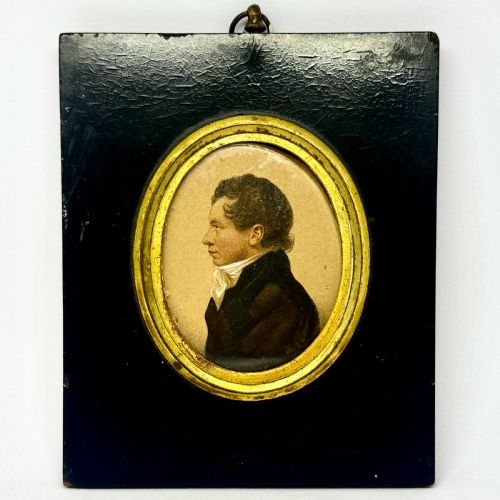


Black Profile Silhouette
A black profile silhouette captures a likeness in sharp outline, offering an intimate record of Georgian and Victorian life.
Black Profile Silhouette
A black profile silhouette is a portrait rendered in dark monochrome, focusing entirely on the contour of the sitter. These works emerge primarily from the Georgian, Regency, and Victorian periods, manifesting as portrait miniatures, framed wall art, and jewellery pieces.
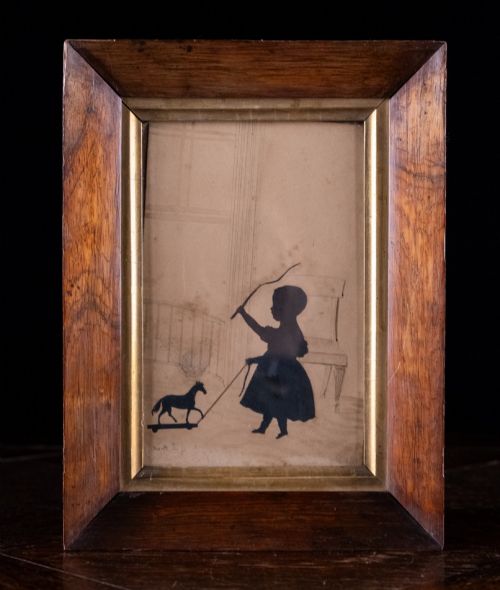
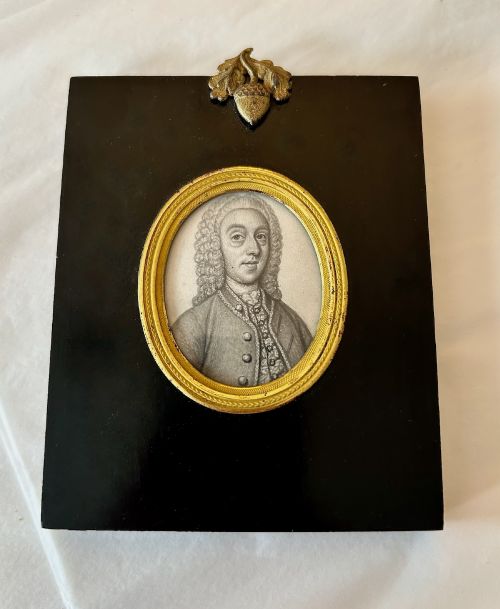
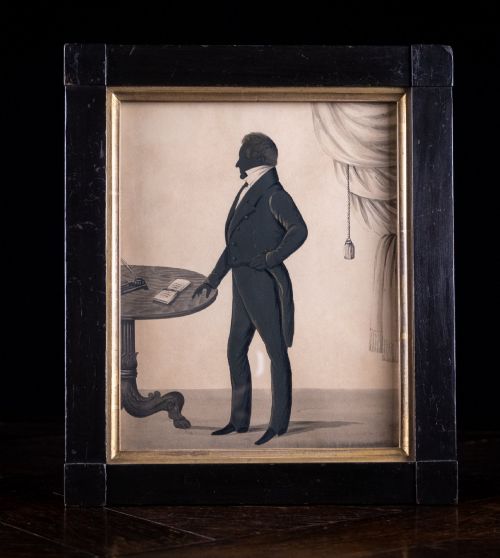
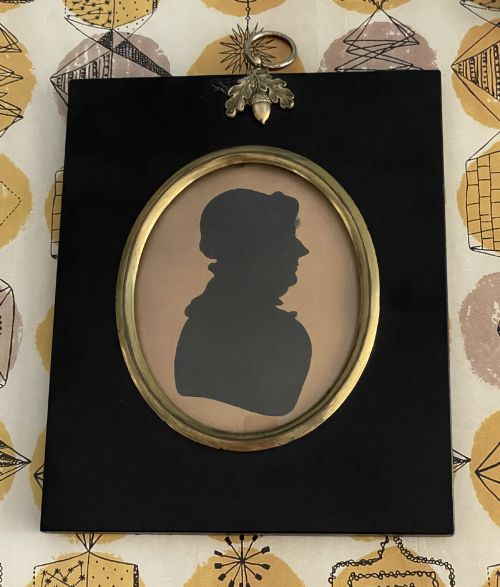
The pieces on this page span the late eighteenth century through to the late nineteenth century. Common subjects include gentlemen, ladies in turban caps, children with animals, and family conversation groups.
Makers recorded in the evidence range from notable profile artists working in London and Edinburgh to vernacular folk art pieces. Most survivors are housed in period frames made of ebonised wood or rosewood.
How they were made
Makers utilised several distinct techniques to create these likenesses, including freehand cutting from black paper, painting directly onto glass or plaster, and applying reverse painting methods. Many examples incorporate delicate gold leaf highlights to define hair ribbons, buttons, and costume details.
Support materials vary according to the method employed, with artists selecting fine paper, glass, plaster, or card housed behind protective glazing. Frames are constructed from timber such as ebonised wood and rosewood, sometimes paired with brass mounts and fittings.
Black Profile Silhouette Retail Price Guide 2026
Typical asking prices for black profile silhouette among the pieces listed under this phrase on Sellingantiques today, from the lower quarter to the upper quarter. They describe what is for sale here now, not the wider market.
Listings feature paper, glass, plaster, and ebonised wood across Georgian, Regency, and Victorian periods.
What varies in quality
Quality rests upon the precision of the cutting or brushwork, separating swift souvenir pieces from master portraits. A skilled silhouette captures immediate character and accurate proportions solely through the outer contour and minimal interior bronze or gold detailing.
The preservation of fragile materials also dictates standing. Intact glass, original backing papers, and uncracked papier-mache or wooden frames maintain the integrity of the work from its eighteenth or nineteenth-century origin.
Bateman·Frith·James Gillespie·Augustin Edouart·John Miers·Elizabeth Hudson·Frederick Frith·Thomas London·J. Deacon·George Atkinson·John Smith of Edinburgh·Alfred Darbyshire
The Black Profile Silhouette Glossary
- Profile
- A side-view portrait showing the outline of the human face or figure. This format forms the core of all silhouette work.
- Cut-paper
- A technique where the likeness is snipped from black paper using scissors before being mounted against a contrasting background. It requires immense dexterity without preparatory sketching.
- Reverse painting
- An application of black pigment and gold leaf onto the underside of glass so the final image is viewed through the transparent pane. This protects the delicate paint surface from dust and damage.
- Hollow-cut
- A method where the silhouette is cut out from a white sheet of paper, which is then laid over black fabric or paper to reveal the portrait through the negative space.
- Ebonised wood
- Timber treated with stain or polish to imitate the deep black finish of ebony. It is frequently found on Regency and Victorian frames.
Black Profile Silhouette: Frequently Asked Questions
What periods do these silhouettes come from?
The pieces span the Georgian, Regency, and Victorian eras, running from the late eighteenth century through the nineteenth century. Earlier eighteenth-century examples often appear on plaster or glass, while nineteenth-century works frequently feature detailed cut-paper or painted formats.
Stylistic shifts reflect the changing fashions of the sitters, moving from powdered hair and Georgian waistcoats to Regency turbans and Victorian children's attire.
How should I display a silhouette?
These framed works suit hanging on small wall spaces or placing within cabinet displays where light levels can be controlled. Because many rely on paper, glass, or delicate painted surfaces, they require protection from direct sunlight to prevent fading.
Keeping them away from damp environments ensures the original wooden frames and fragile internal papers remain stable over time.
How do I identify a maker?
Makers often signed their work on the reverse of the frame, directly on the backing paper, or occasionally on the portrait itself. Trade labels belonging to prominent profileists frequently provide biographical details and business addresses.
Unsigned pieces can sometimes be attributed through distinctive cutting habits, specific framing choices, or the presence of characteristic gold highlights.