


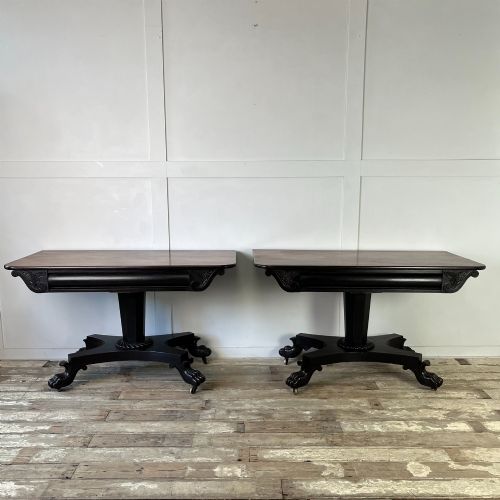


Black Hall Console Table
A black hall console table anchors an entrance with dark elegance, offering a surface for display alongside architectural presence.
Black Hall Console Table
A black hall console table brings dark surfaces into an entryway, drawing primarily on 18th-century, 19th-century, Regency, and Victorian periods. Buyers meet painted wood, ebonised wood, and lacquer finishes designed to sit flush against passage walls.
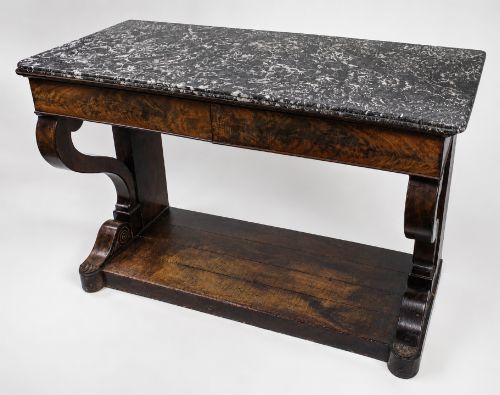
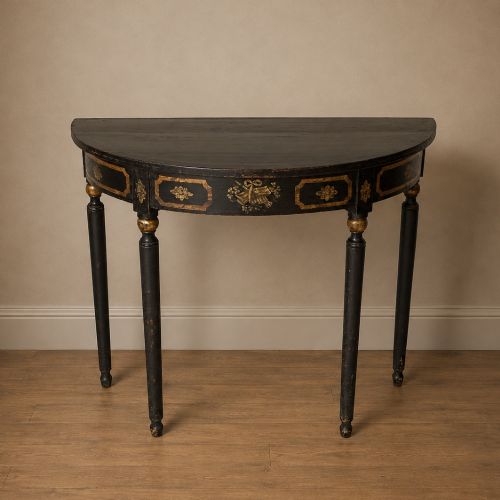
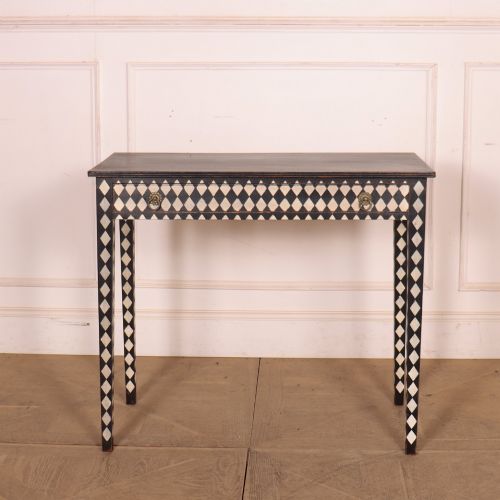
Forms span demi-lune shapes, rectangular console tables, and side tables paired with marble tops or hand-painted geometric details. Origins cross English, French, Chinese, Swedish, and Dutch workshops.
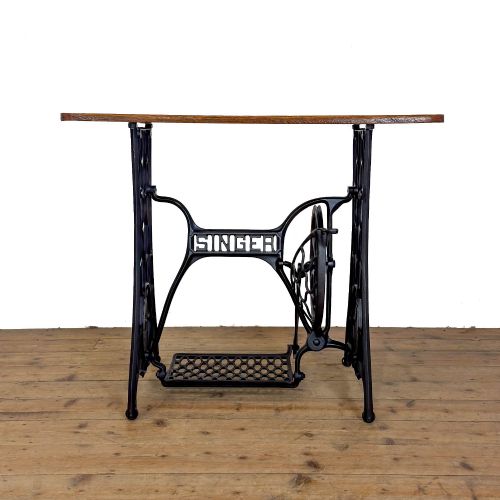
The selection ranges from large country house centre tables to small lamp tables and writing desks adapted for hall use. Many examples incorporate parcel gilding, mirrors, or drop leaves suited to narrow spaces.
How they were made
Cabinetmakers utilised mahogany, satinwood, elm, and wrought iron as structural timbers beneath black paint, lacquer, or ebonised surfaces. Flame mahogany veneers provided rich grain patterns on large French and English pieces.
Surfaces received dark paint, ebonising, or black lacquer, often accented with parcel gilt highlights or hand-painted geometric motifs. Heavy white or grey marble slabs were fitted directly to the timber frames of Regency and French console tables.
Listings feature ebonised wood, mahogany, satinwood, elm, and painted finishes paired with marble and brass.
What varies in quality
Construction standards appear in the crispness of carved parcel gilding and the depth of ebonised finishes applied to mahogany or pine. Superior pieces retain original marble tops fitted precisely to the wooden rails.
Proportion and decorative restraint separate standard utility tables from fine Regency, French Empire, or Aesthetic Movement commissions. Hand-painted geometric decoration and intact lacquer work distinguish regional or period pieces.
Gillows
The Black Hall Console Table Glossary
- Ebonised
- Wood stained or painted to imitate ebony, a dark and dense timber used extensively in Regency and Victorian cabinetmaking.
- Demi-lune
- A half-moon shape characteristic of console tables designed to stand flat against a wall.
- Parcel gilt
- Portions of an object highlighted with thin layers of gold leaf, frequently seen alongside black paint or ebonised timber.
- Console table
- A table supported by wall brackets or legs, historically built to display decorative objects in hallways and reception rooms.
Black Hall Console Table: Frequently Asked Questions
Where should a black hall console table go?
These tables fit naturally in entrance halls, corridors, and reception spaces where surface space is needed without blocking foot traffic. Their shallow depth allows them to sit against passage walls.
Pairs of demi-lune tables look balanced beneath mirrors or paintings, while single rectangular pieces work well beside doorways or staircases.
How do I identify a Regency console table?
Regency pieces often feature classical motifs, ebonised timber, parcel gilding, and architectural lines reminiscent of French Empire or English neoclassical design. They frequently incorporate marble tops and turned or carved supports.
Look for proportions and materials typical of the early 19th century, including flame mahogany and specific classical detailing.
What is the difference between a console and a side table?
Console tables are traditionally designed to stand against a wall, sometimes requiring fastening or brackets for stability due to their shallow shape. Side tables stand independently on four legs and can float within a room.
In hallway settings, both forms function similarly for display and surface storage.
How do I care for ebonised wood?
Ebonised surfaces require dusting with a soft, dry cloth to prevent micro-scratching on the dark finish. Avoid exposure to direct sunlight and moisture to protect the stain or paint.
Periodic application of appropriate wax maintains the sheen on antique polished wood without building up residue.