



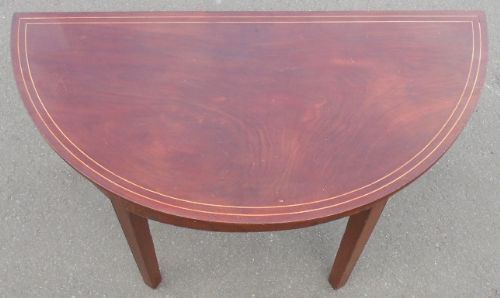


Georgian Inlay Wall Table
These georgian inlay wall table pieces bring the refined proportion and cabinet work of the eighteenth century into modern rooms.
Georgian Inlay Wall Table
When you search for a georgian inlay wall table, you encounter console, side, serving, pier, and hall tables created across the eighteenth century, the nineteenth century, and later revival periods.
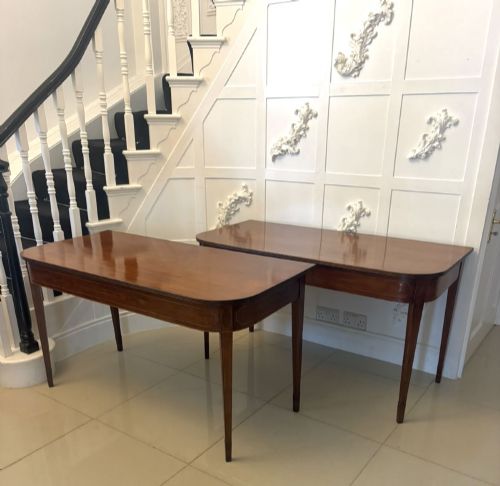
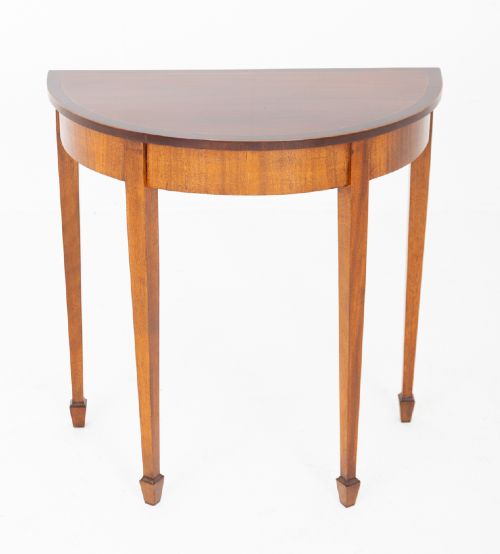
The demi-lune or half-moon form dominates the selection, frequently paired with folding tops or shaped bowfronts designed to stand flat against a wall.
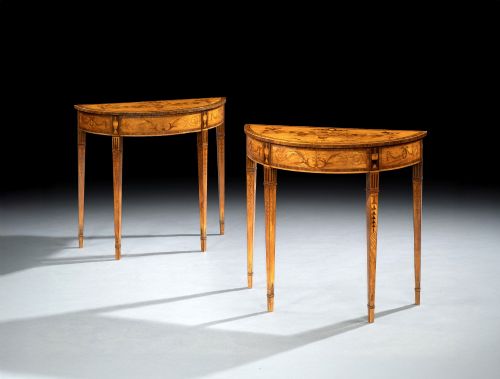
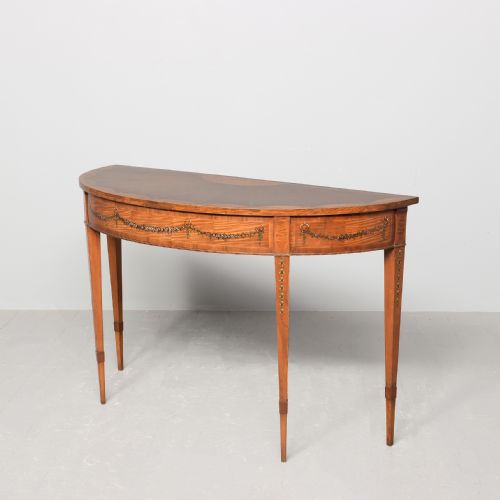
Makers shaped these surfaces in mahogany and satinwood, applying intricate wood inlay, marquetry, and painted details to suit formal domestic interiors.
How they were made
Cabinet makers built the primary carcass using solid mahogany or satinwood, often incorporating crossbanding to frame the main timber grain.
Decoration relied on precise wood inlay and marquetry, setting contrasting timbers like boxwood into the surface alongside painted elements.
Georgian Inlay Wall Table Retail Price Guide 2026
Typical asking prices for georgian inlay wall table among the pieces listed under this phrase on Sellingantiques today, from the lower quarter to the upper quarter. They describe what is for sale here now, not the wider market.
Some timepieces on display record the busy hours of London workshops centuries ago.
What varies in quality
The distinction between standard examples and superior work rests on the crispness of the marquetry and the choice of cabinet timbers.
Finer tables demonstrate a disciplined balance in the painted or inlaid motifs, where the proportions of the demi-lune top match the delicacy of the tapered legs.
Cording of London
The Georgian Inlay Wall Table Glossary
- Demi-lune
- A half-moon shape used for console and side tables designed to sit flush against a wall. This profile allows the furniture to occupy minimal depth while providing a useful display surface.
- Marquetry inlay
- Decorative patterns formed by fitting small pieces of veneer into a prepared wooden ground. Artisans utilised contrasting woods to create pictorial or geometric designs.
- Crossbanding
- A border of veneer laid around the edge of a table top so that the grain runs at right angles to the central panel. This technique frames the primary timber and protects the edges.
- Pier table
- A decorative table designed to stand against the wall between two windows, frequently positioned beneath a mirror. These pieces prioritized surface ornamentation over heavy storage.
Georgian Inlay Wall Table: Frequently Asked Questions
Where should I place a demi-lune table?
These tables suit narrow hallways, entrance spaces, or living rooms where floor depth is restricted. Their flat rear edge rests securely against the wall while the curved front softens the room layout.
Historically, they stood in formal reception rooms beneath wall mirrors or portrait paintings, serving as display surfaces for decorative objects or lighting.
How do I identify a George III period piece?
Examine the timber selection, construction methods, and the style of the inlay work. Eighteenth-century examples typically employ dense mahogany or satinwood with hand-cut marquetry rather than printed or machine-applied decoration.
Revival pieces from later centuries often copy these proportions but display different secondary woods and cleaner, more uniform internal construction.
What is the difference between a console and a pier table?
Console tables are general wall-fixing or freestanding tables with decorative front legs, while pier tables were specifically designed to occupy the wall space between windows.
Both forms share similar shallow depths and ornamental surfaces, making them interchangeable in modern interior styling.
Can I use a fold over table for dining?
Many examples feature hinged tops that open to double their surface area, originally intended for card games or occasional serving. While they provide extra space when unfolded, their delicate leg frames require careful treatment.
They function best as side tables that can expand temporarily when guests visit.