

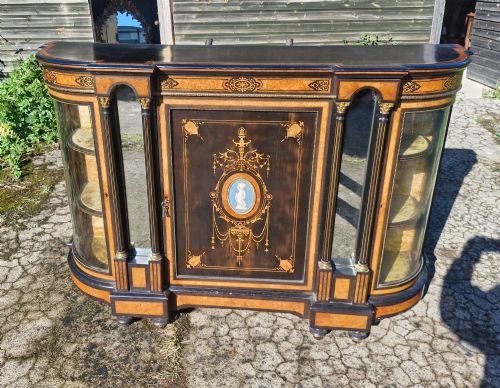


Black and Walnut Cabinet
These black and walnut cabinet pieces bring together dark ebonised finishes and rich walnut timbers to anchor a room with serious presence.

Black and Walnut Cabinet
A black and walnut cabinet brings together contrasting dark ebonised finishes and rich walnut timbers, appearing most frequently in Victorian side cabinets, credenzas, and music cabinets. These pieces span eras from the seventeenth century table cabinet through eighteenth century French examples up to late nineteenth century Aesthetic Movement designs.
The selection ranges from glazed display pier cabinets to open bookcases and fitted writing desks, each demonstrating the interplay between dark surfaces and figured wood. Buyers encounter robust Victorian constructions alongside earlier forms, all united by this distinctive timber and dark surface combination.
Construction and materials
Makers utilised solid walnut and burr walnut veneers, contrasting them against ebonised wood and ebony to create striking visual depth. Ormolu mounts, brass details, and marquetry inlay provide further enrichment to the surfaces.
Glass panels feature in display doors, while mirrored backs appear in credenzas to reflect light within interior spaces. Skilled cabinetmakers combined these fine timbers with traditional joinery methods suited to each period style.
Black and Walnut Cabinet Retail Price Guide 2026
Typical asking prices for black and walnut cabinet among the pieces listed under this phrase on Sellingantiques today, from the lower quarter to the upper quarter. They describe what is for sale here now, not the wider market.
An anatomical illustration from seventeen seventy-nine sneaks into the furniture lineup, proving someone took cabinetry very to heart.
Assessing quality
The distinction between tiers rests upon the choice of timber and the precision of the marquetry inlay. Superior examples employ highly figured burr walnut veneers alongside meticulously ebonised mouldings rather than simpler painted finishes.
Hardware such as ormolu mounts and brass fittings indicates the grade of the piece, with finer castings showing crisp detail. The integration of secondary woods and the fidelity of period details like baroque curves or aesthetic movement lines complete the assessment.
Chubb·Waring and Sons
The Black and Walnut Cabinet Glossary
- Ebonised wood
- Timber treated to imitate ebony, creating a deep black finish commonly used to frame walnut panels in Victorian furniture.
- Burr walnut
- Highly prized wood grain showing intricate swirling patterns formed from tree growths, utilised on primary display surfaces.
- Ormolu
- Gilt bronze ornamentation applied to furniture, frequently seen on French and period revival pieces.
- Marquetry inlay
- Decorative patterns formed by fitting contrasting pieces of wood veneer into a prepared surface.
- Credenza
- A low dining room or parlour cabinet, often featuring mirrored backs and glazed doors in nineteenth century iterations.
Black and Walnut Cabinet: Frequently Asked Questions
How do I style a black and walnut cabinet?
The strong dark tones and figured wood grain allow these pieces to function as focal points in traditional or mixed modern rooms. Use the interior shelving of glazed or open versions to display ceramics, books, or collections.
Position them against lighter walls to let the contrast between the ebonised frame and walnut panels stand out clearly.
How do I tell Victorian cabinets from earlier periods?
Victorian examples often employ ebonised wood alongside burr walnut with mechanical or aesthetic movement influences dating from the mid to late nineteenth century. Earlier pieces, such as seventeenth century table cabinets, rely on solid ebony and walnut construction with simpler, heavier proportions.
Examining the internal secondary timbers and construction joints helps clarify the specific era of manufacture.
Were these cabinets used for specific items?
Certain forms were designed for specific purposes, such as music cabinets intended for sheet music storage and pier cabinets built for narrow wall spaces between windows. Other variants like credenzas functioned in dining rooms for serving and display.
Their diverse interior configurations reflect the domestic habits of the eighteenth and nineteenth centuries.