

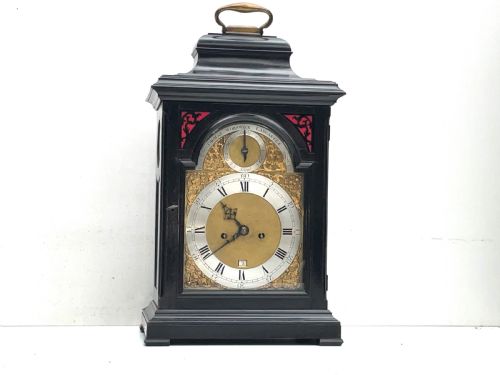
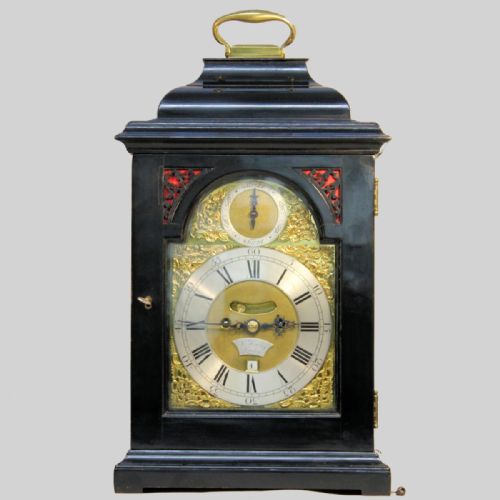


Bell Striking Bracket Clock
A bell striking bracket clock is a weighty table timepiece with an audible chime, offering both precision engineering and architectural presence for a room.

Bell Striking Bracket Clock
When you search for a bell striking bracket clock, you encounter portable mechanical timekeepers housed in architectural wooden cases designed to sit upon furniture rather than hang on a wall. The pieces listed on this page span the eighteenth century, the Georgian period, the Victorian era, and eighteen eighty, showing a strong representation of eighteenth-century London craftsmanship.
The dominant forms include ebonised bell-top cases and mahogany table clocks, alongside examples featuring Gothic Revival cathedral-arch styling or automation. Cases frequently incorporate glass panels and brass fittings, while movements utilise verge or fusee escapements designed to strike the hours or quarters upon bells.
How they were made
The makers constructed these enclosures using dense hardwoods such as mahogany and oak, often applying an ebonised finish to achieve a deep black surface. Brass, ormolu, and silvered brass form the dials, bezels, and internal plates, while glass panels protect the movement and face.
Mechanically, the workshops built intricate brass and steel gear trains incorporating verge escapements and fusee or chain mechanisms. Bells provide the audible striking capability, engineered to sound single notes or multiple tones across arrays of up to eight bells.
Bell Striking Bracket Clock Retail Price Guide 2026
Typical asking prices for bell striking bracket clock among the pieces listed under this phrase on Sellingantiques today, from the lower quarter to the upper quarter. They describe what is for sale here now, not the wider market.
What varies in quality
The distinction between ordinary and exceptional examples rests upon the sophistication of the movement and the integrity of the case. Triple fusee configurations, automation, and complex multi-bell quarter-striking arrangements elevate the internal engineering far beyond standard single-bell timepieces.
Case architecture also defines the grade of the clock, where crisp mouldings on bell-top or cathedral-arch designs and signed brass dials by established London makers demonstrate superior original commissioning.
George Wadham·Somersall London·William Withers·John Fletcher·John Taylor·Watson London·Benjamin Maud·Isaac Hurley·Joseph Lum·John Rapton
The Bell Striking Bracket Clock Glossary
- Verge escapement
- An early type of clock escapement using a crown wheel and a rod with pallets. It produces a distinctive ticking rhythm.
- Fusee
- A conical pulley used with a cord or chain to maintain equal power as the mainspring unwinds. This mechanism improves timekeeping accuracy.
- Bell-top
- A distinctively shaped clock case roof that curves upward to resemble the profile of a bell. It is typical of eighteenth-century English design.
- Ebonised
- Wood treated with a dark stain or finish to imitate ebony. This technique was popular in high-status Georgian clock cases.
- Triple fusee
- A movement with three separate fusee cones driving timekeeping, striking, and chiming trains. It allows the clock to play tunes or strike quarters on multiple bells.
Bell Striking Bracket Clock: Frequently Asked Questions
What is a bell striking bracket clock?
A bell striking bracket clock is a portable mechanical timepiece housed in a wooden table case that chimes the hours or quarters on internal bells.
These pieces were originally designed for easy movement between rooms in large houses, requiring a flat surface to rest upon rather than permanent wall mounting.
How do I wind my clock?
Winding involves inserting a key into the winding holes on the dial to tension the internal springs or pull up the fusee chains.
Care must be taken to match the correct key size and turn the mechanism smoothly without over-winding the movement.
How do I date an antique clock?
Dating relies on examining the maker's signature on the brass dial, the style of the wooden case, and the mechanical escapement type.
Eighteenth-century examples frequently feature verge escapements and ebonised bell-top cases, whereas later Victorian iterations show different architectural influences.
Where should I place a bracket clock?
These clocks require a sturdy, level surface such as a heavy sideboard, mantelpiece, or dedicated table away from direct sunlight and draughts.
A stable foundation ensures the pendulum or verge mechanism maintains an even beat and keeps accurate time.