
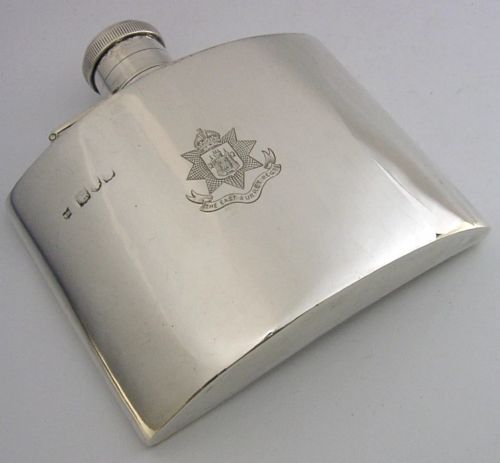
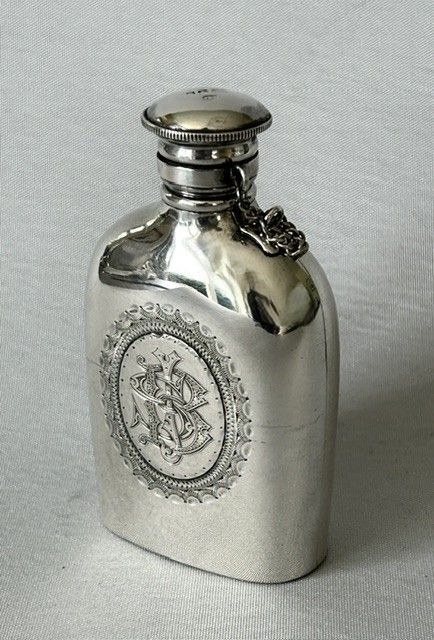


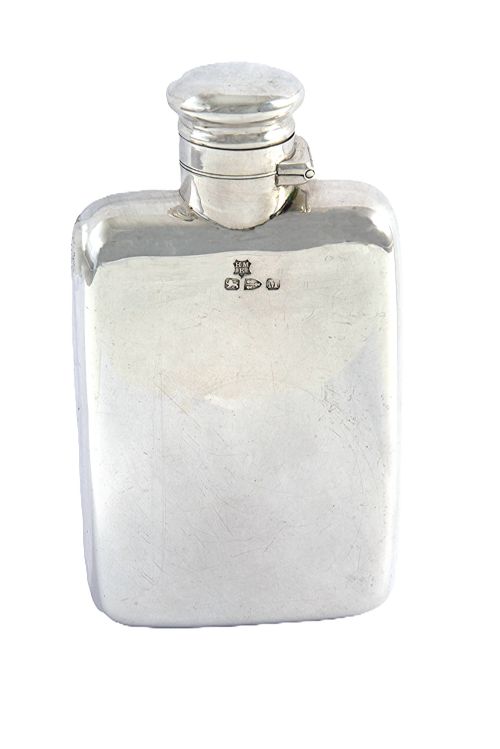


Bayonet Cap Flask
A bayonet cap flask is a pocket container designed for spirits, securing its closure with a quarter-turn mechanism rather than a traditional screw thread.
Bayonet Cap Flask
A bayonet cap flask is typically encountered in silver, silver plate, cut glass, and leather-bound forms dating from the Victorian era through the Art Deco period. These containers range from pocket-sized hip flasks to larger barware examples, often incorporating removable cups at the base for drinking.
The selection on this page spans from the late nineteenth century into the 1930s, encompassing styles such as Edwardian and Art Deco alongside military associations. Most pieces combine solid sterling silver or silver plate with glass bodies or crocodile skin sleeves.
Materials and construction
Makers utilised sterling silver and silver plate for the caps, collars, and base cups, often pairing them with heavy cut glass or wrapping the bodies in crocodile leather and crocodile skin. The bayonet mechanism requires precise metalworking to ensure the cap locks firmly onto the neck with a short twist, preventing leaks during carriage.
Many examples integrate hinged flip-top caps or removable silver cups that slip off the bottom of the glass or leather-covered body. Hallmarks stamped into the silver components record the assay office, city, and year of manufacture, pointing to silversmiths working in centres like Birmingham, Sheffield, and Chester.
Some regiments issued specific silver flasks for the Boer War, ensuring soldiers marched into battle suitably equipped for a restorative dram.
Distinctions in quality
Quality in a bayonet cap flask rests upon the weight of the metal, the clarity of the cut glass, and the tightness of the bayonet fastening. Substantial gauge silver and robust hinges separate high-grade workshop production from lighter commercial output.
The integration of materials also defines the tier of the piece, particularly the stitching on crocodile leather sleeves and the crispness of hallmarks stamped by known makers. Retaining the original removable cup and securing a snug fit on the bayonet cap preserves the integrity of the design.
Edward Smith·William Neale·JB Chatterley and Sons·Asprey·James Dixon
The Bayonet Cap Flask Glossary
- Bayonet cap
- A closure system that fastens with a push and a short twist, common on spirit flasks to prevent accidental loosening.
- Removable cup
- A silver or silver-plated cup fitting snugly over the base of the flask, sliding off for use as a drinking vessel.
- Hallmark
- A series of official marks stamped into silver indicating the maker, assay office, standard of purity, and year of manufacture.
- Cut glass
- Glass decorated by cutting patterns into the surface with a wheel, used for the bodies of many pocket flasks.
- Barware
- Utensils and containers used for the preparation and service of alcoholic drinks.
Bayonet Cap Flask: Frequently Asked Questions
How do you open a bayonet cap flask?
Push the cap down slightly against its internal spring and give it a quarter-turn to release the pins from their slots. Lifting straight up removes the cap entirely.
To close it, align the pins with the slots, push down, and twist in reverse to lock the mechanism securely in place.
Were these flasks meant for the pocket?
Pocket flasks were manufactured in slender, curved profiles designed to fit comfortably against the hip or inside a waistcoat pocket. Larger versions served as travel flasks or barware items.
The inclusion of leather sleeves and crocodile skin provided a secure grip and protected the metal or glass during transit.
How do I date my flask?
Dating relies primarily on the silver hallmarks stamped onto the cap, collar, or cup, which include a date letter corresponding to the assay office records. Stylistic markers such as Edwardian proportions or Art Deco geometric lines also indicate the period of manufacture.
Unmarked silver plate or glass-only examples require comparison of their form, lettering styles, and manufacturing techniques with dated pieces.
Can I still use an antique flask for spirits?
Many antique flasks remain functional if the internal cork or washer inside the bayonet cap is intact and creates a proper seal. Testing the cap with water first checks for leaks.
Modern users should inspect the interior for cleanliness and avoid storing spirits in silver containers for extended periods.