
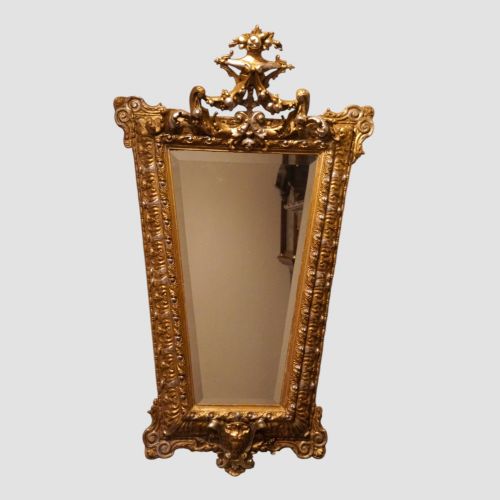


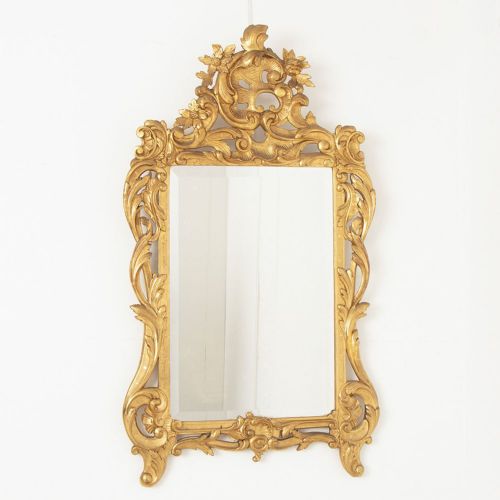

Baroque Style Crest Mirror
A baroque style crest mirror brings dramatic carved ornament and reflective depth to a room, offering the bold proportions collectors value.
Baroque Style Crest Mirror
When you search for a baroque style crest mirror, you examine wall mirrors and overmantel mirrors defined by ornate crestings and revival periods. The examples found here span the nineteenth century, Edwardian era, and early twentieth century, drawing on Italian, Dutch, and French design influences.
The most common versions on this page are nineteenth century pieces employing Italian baroque revival or rococo revival styling. These items utilise cushion frames, trapezoidal outlines, or carved crests featuring lions heads and classical motifs.
Origin and period dictate the character of each piece, ranging from grand English overmantle mirrors in carved wood and gesso to smaller wall mirrors in giltwood and silver leaf. Collectors encounter diverse regional interpretations, from Dutch brass frames to carved pine pairs.
Construction and materials
Makers constructed these mirrors using solid timber substrates such as oak or pine, which provided a stable foundation for intricate decorative schemes. Carved wood and gesso formed the raised scrollwork, foliage, and crests characteristic of the style.
Surface decoration relied on the application of gold leaf or silver leaf over gesso, creating the metallic brilliance central to baroque aesthetics. Some variants incorporate brass or painted finishes to achieve distinct tonal qualities.
Listings feature periods spanning the eighteenth century through to nineteen ten, alongside materials including gesso, giltwood, and carved pine.
Assessing quality and execution
Depth and precision in hand-carved wood separate superior examples from simpler moulded pieces, as skilled carvers achieved sharper undercut foliage and more expressive figural details like lions heads. The quality of the gesso application beneath the gilding determines the crispness of the ornamental relief.
The integrity of the original giltwood or silver leaf surface influences the overall merit of the mirror, with patination showing age authentically without crude overpainting. Frame construction joints and the retention of original glass add further distinction to a piece.
The Baroque Style Crest Mirror Glossary
- Crest
- The ornamental top flourish of a mirror frame, often heavily carved with scrolls, foliage, or heraldic motifs.
- Gesso
- A plaster-like mixture applied to wood frames to create a smooth surface for carving or gilding.
- Giltwood
- Timber coated with gold leaf or gold paint, widely utilised in baroque and revival mirror production.
- Overmantel mirror
- A large horizontal mirror designed specifically to hang above a fireplace mantel.
- Cushion frame
- A convex or rounded frame profile that slopes inward toward the glass, prominent in seventeenth and nineteenth century Dutch and English mirrors.
Baroque Style Crest Mirror: Frequently Asked Questions
How do I hang a heavy carved mirror?
Large carved wood and gesso mirrors require secure wall fixings distributed evenly across the primary timber frame rather than relying solely on the hanging wire.
Consulting a professional installer ensures the weight distributes safely into wall studs or masonry.
Are these mirrors original baroque or revival pieces?
The majority of pieces matching this style date from the nineteenth and early twentieth centuries, produced during the baroque revival movements.
True seventeenth century examples are exceptionally scarce, whereas nineteenth century interpretations offer comparable decorative presence.
How do I clean a giltwood frame?
Dust the carved surfaces gently with a soft, dry brush to prevent damage to fragile gesso and leafing.
Avoid liquid cleaners, water, and solvents, as moisture strips historic metallic leaf and softens underlying gesso.
Where should I place an overmantel mirror?
Positioning an overmantel mirror above a fireplace anchors the room's proportions and reflects natural light across the space.
Ensure the width of the mirror aligns harmoniously with the mantelpiece shelf below it.