






Barley Twist Brass Candlesticks
These barley twist brass candlesticks bring a sculptural turned column to the table, catching the light across centuries of domestic and ecclesiastical interiors.
Barley Twist Brass Candlesticks
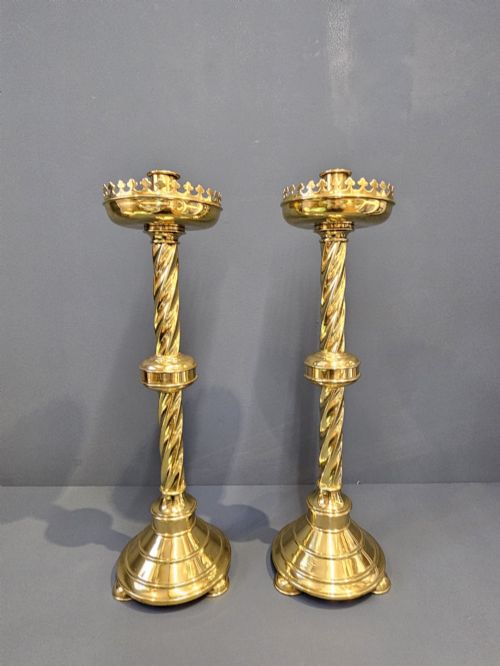
Barley twist brass candlesticks emerge across the Victorian and Edwardian periods, stretching back to church altars and forward into early twentieth-century homes. The most common iteration on this page pairs a solid brass column with a fitted base or a combined oak shaft, often surviving in matched pairs.
Makers adapted the helical form for domestic illumination, resulting in table lamps alongside traditional candleholders. Pieces span from mid-nineteenth-century ecclesiastical designs to later domestic oak hybrids.
The distinct spiral stem appears in both solid cast brass and open timber work fitted with brass sconces and bases. These objects represent a crossover between functional lighting and decorative turned woodwork.
Materials and manufacture
Foundry work relied on cast brass, shaping heavy metal components into stepped bases, sconces and double helix columns. Lathe work created the characteristic spiral profiles in both metal and hardwoods like oak and mahogany.
Assemblers joined turned wooden shafts to spun or cast brass tops and drip pans. Some examples incorporate fitted trays and handles for carriage, while others integrate enamel or glass elements.
Several charming pairs sport dedicated brass thistle tops, adding a prickly Scottish flourish to the twisted wooden columns.
Gradations in manufacture
Subtlety in the pitch and depth of the twist distinguishes standard production from finer workshop output. Crisp turning on the lathe ensures clean helical lines without tear-out in the timber or pitting in the brass casting.
Weight and gauge of metal dictate the substance of the piece, with substantial cast bases offering stability to taller columns. Superior examples display careful jointing between the brass tops and wooden or metal stems.
T Thomason & Co
The Barley Twist Brass Candlesticks Glossary
- Barley twist
- A spiral turning resembling a stalk of barley, popular in furniture and candlesticks from the seventeenth century onwards.
- Ecclesiastical
- Pertaining to the church, describing larger scale altar or church candlesticks produced for religious settings.
- Sconce
- The socket or cup at the top of a candlestick designed to hold the candle secure.
- Double helix
- A decorative form featuring two intertwined spiral threads running parallel along the column.
- Gothic Revival
- An architectural and decorative style drawing on medieval forms, frequently seen in Victorian church metalwork.
Barley Twist Brass Candlesticks: Frequently Asked Questions
How do I date my barley twist candlesticks?
Examine the weight of the brass, the assembly methods at the base, and the style of turning. Earlier Victorian ecclesiastical pieces often feature heavier castings, while nineteen-twenties examples frequently combine oak with fitted brass thistles.
Compare the proportion of the twist and any maker marks against documented periods like the Edwardian era or the nineteenth century to narrow down the decade.
Were these originally meant for church or home?
The evidence shows both large ecclesiastical altar candlesticks and domestic table versions. Church pieces tend to be taller and heavier, designed for ritual spaces.
Shorter pairs and those incorporating oak shafts served domestic interiors, often placed on mantelpieces or side tables.
Can these candlesticks be converted to lamps?
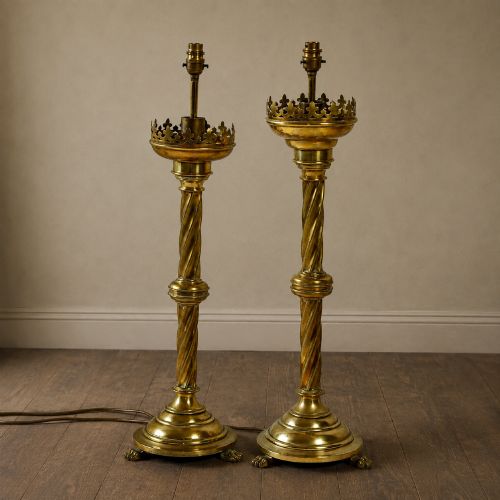
Several pieces in the archive were produced or adapted as table lamps rather than purely holding candles. Conversion depended on hollow stems or fitted bases capable of running electrical wiring safely.
Original lamp variants exist alongside candleholders from the Victorian and Edwardian periods.
Why do some have fitted trays?
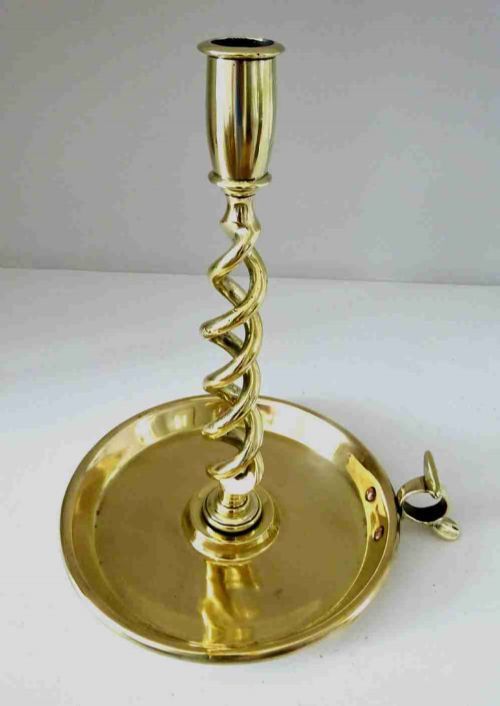
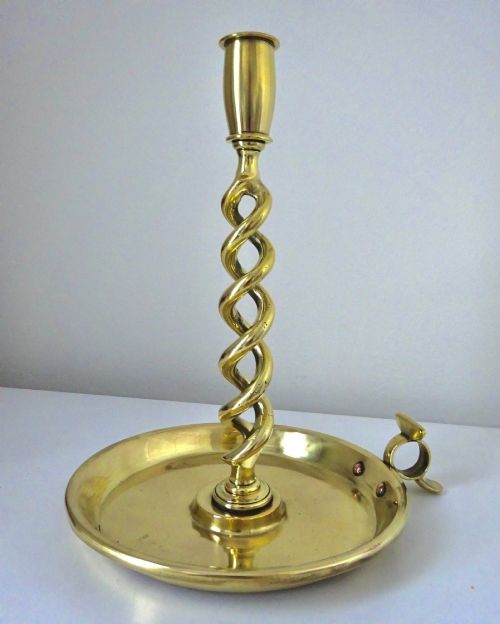
Fitted trays and handles served a practical purpose in earlier domestic settings, catching melting wax during transport from room to room. They appear on Victorian pieces designed for carrying by hand.
This utilitarian feature distinguishes chamber-style candlesticks from stationary altar or table models.