


Banded Agate Box
These banded agate boxes are small hardstone containers prized for their distinctive natural striping, offering collectors exquisite miniature craftsmanship.
What They Are
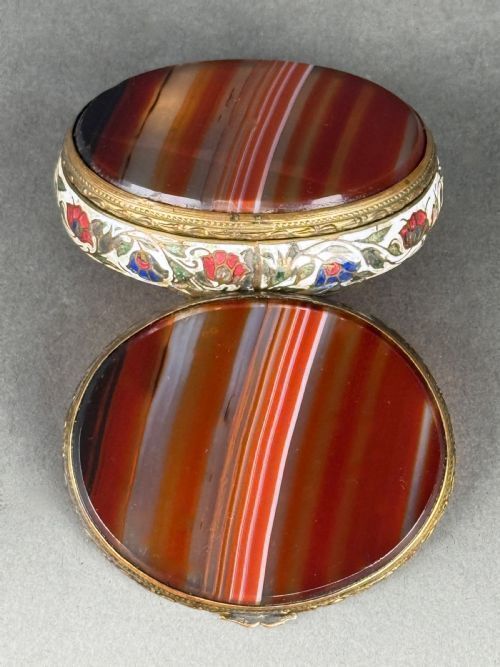
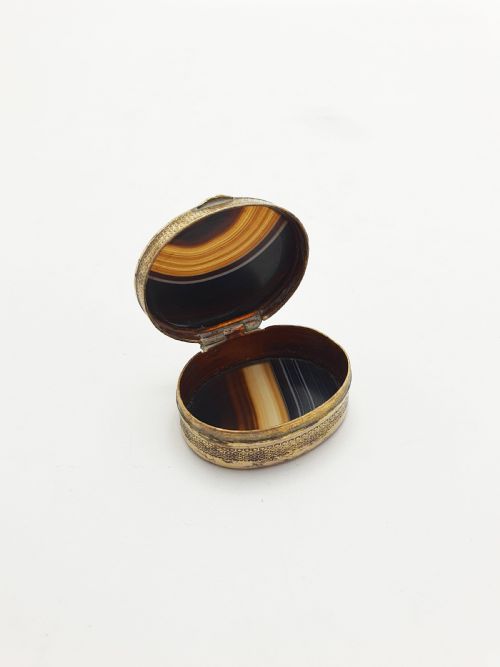
A banded agate box is a compact hardstone container designed for holding small personal items such as pills, snuff, or trinkets. These pieces predominantly date from the nineteenth century, including specific examples from around eighteen eighty and the Georgian period. Forms range from miniature pill boxes and vinaigrettes to double-sided designs and trinket boxes.
The objects frequently combine polished sections of banded agate with metal mounts, showcasing the natural striping characteristic of the stone. French nineteenth-century examples often incorporate champleve enamel alongside gilt brass, while others reflect British craftsmanship such as Scottish pieces from eighteen eighty. Collectors encounter various miniature trunk and rectangular box shapes within this category.
Originating largely from European workshops during the nineteenth century and earlier Georgian eras, these containers served portable, decorative functions for well-to-do owners. The survival of such delicate hardstone objects demonstrates their enduring appeal as functional works of art. Each piece reflects the specific design preferences of its period, balancing utility with decorative mineral specimens.
How They Were Made
Makers constructed these containers by cutting and polishing hard banded agate stones into thin panels that reveal natural mineral strata. These stone panels were then fitted into metal frames, utilising materials such as gilt brass, gilt metal, and ormolu to secure the structure.
Advanced metalworking techniques are visible in the mounts, where gilt brass and ormolu provide secure hinges and rims for the stone lids and bases. Certain pieces incorporate champleve enamel work alongside the metalwork, adding coloured decorative details that complement the natural patterns of the agate.
What Varies in Quality
The visual impact of a banded agate box depends heavily on the contrast and clarity of the natural mineral bands within the stone. Superior examples display striking, uninterrupted strata across the polished hardstone panels, whereas lesser pieces feature muted or heavily fractured mineral patterns.
Metalwork execution distinguishes finer specimens, with delicately chased gilt brass, ormolu, or champleve enamel mounts elevating the overall craftsmanship. Simpler or coarser metal mounts indicate standard production, while precise integration between the stone panels and the metal housing marks the top of the range.
The Banded Agate Box Glossary
- Banded Agate
- A form of quartz displaying distinct natural parallel stripes or bands of varying colour. This stone forms in volcanic rocks and provides the primary visual material for these boxes.
- Vinaigrette
- A small ornamental box featuring a perforated internal grille. Historically, this grille held a sponge soaked in aromatic vinegar for personal refreshment.
- Champleve Enamel
- An enamelling technique where troughs or cells are sunk into a metal surface and filled with vitreous enamel paste before firing. This method creates decorative coloured patterns alongside metal elements.
- Ormolu
- Finely ground high-carat gold applied to a bronze or brass object using a mercury amalgamation process. The technique produces a rich, durable golden finish on metal mounts.
- Hardstone
- A general term for semi-precious stones used in decorative arts, including agate and carnelian. These materials require specialised cutting and polishing techniques due to their high mineral hardness.
Frequently Asked Questions
What were banded agate boxes used for?
These small containers were carried by individuals to store medicinal pills, scented snuff, or small personal trinkets throughout the nineteenth century.
Their compact size allowed them to fit easily into pockets or small reticules for daily use.
How do I date a banded agate box?
Dating relies on examining the metal mounts, hinge construction, and associated decorative techniques like champleve enamel or Georgian metalwork styles.
Nineteenth-century examples often display specific stylistic markers that distinguish them from earlier Georgian pieces.
How should I care for a hardstone box?
Keep the piece away from direct sunlight and moisture to protect the polished agate surface and the underlying metal mounts.
Clean the stone gently with a dry microfibre cloth and avoid harsh chemical cleaners on the gilt or enamelled parts.
Are all banded agate boxes Scottish?
While certain nineteenth-century pieces originate from Scotland, many others were produced in France and across broader European workshops.
Geographic attribution depends on specific hallmarks, metalworking styles, and regional design characteristics present in the mounts.