

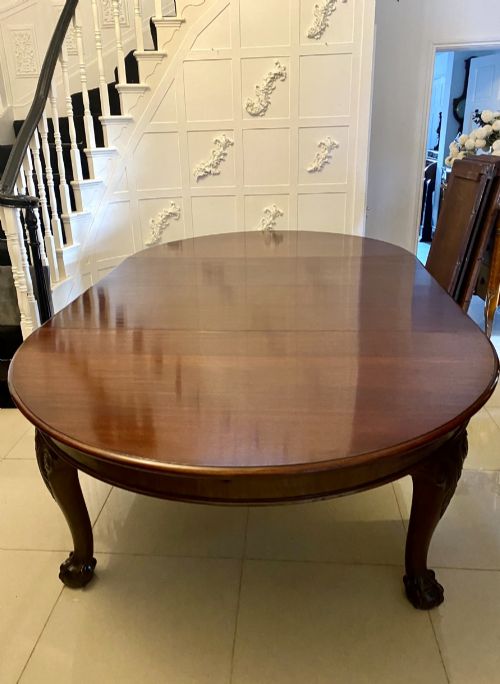
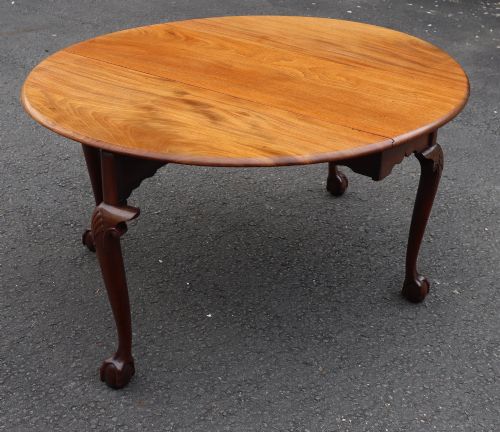
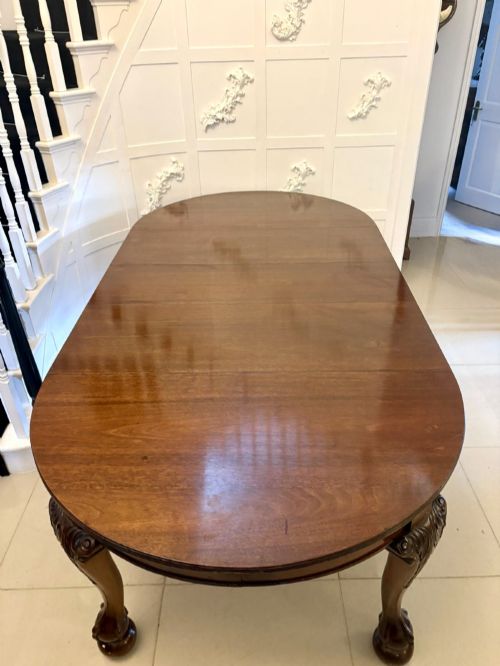
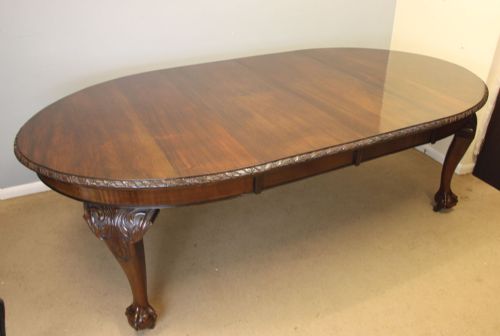



Ball and Claw Dining Table
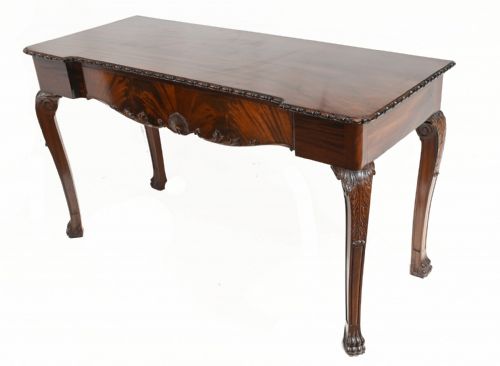
A ball and claw dining table anchors a room with carved talon-and-sphere terminals supporting sturdy timber frames.
Ball and Claw Dining Table
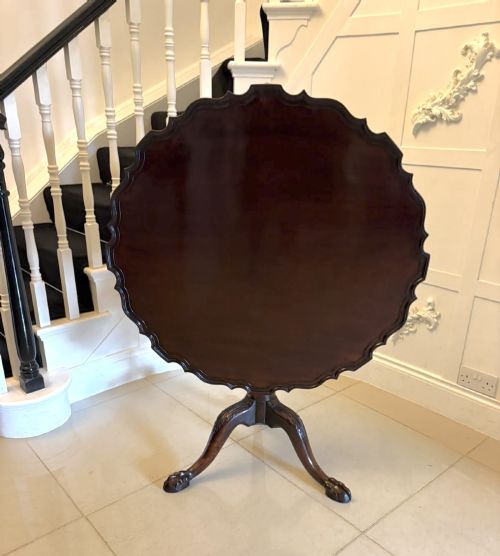
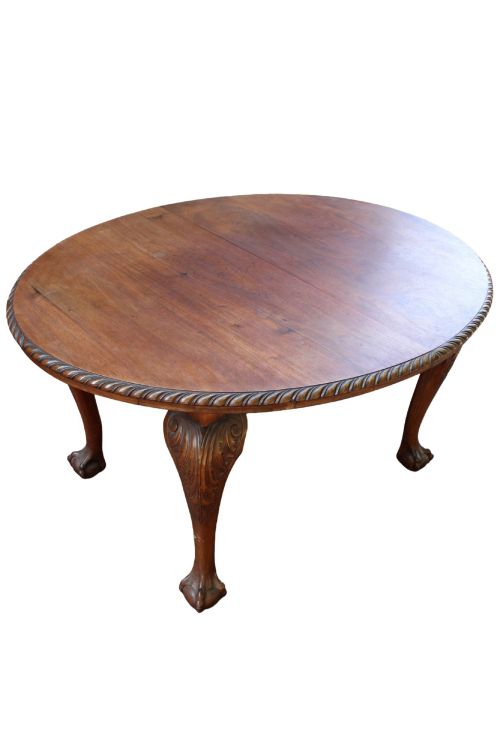
A ball and claw dining table is a dining table characterised by its distinctive carved feet, which appear across various historical periods from the eighteenth century to the twentieth century. These tables span several stylistic revivals including Chippendale, Queen Anne, and Adam, alongside original George II and Georgian pieces.
The selection here includes extending dining tables, drop-leaf tables, and centre tables constructed primarily from mahogany, walnut, and burr walnut. Buyers most frequently encounter Edwardian and nineteenth-century revival examples alongside authentic eighteenth-century iterations.
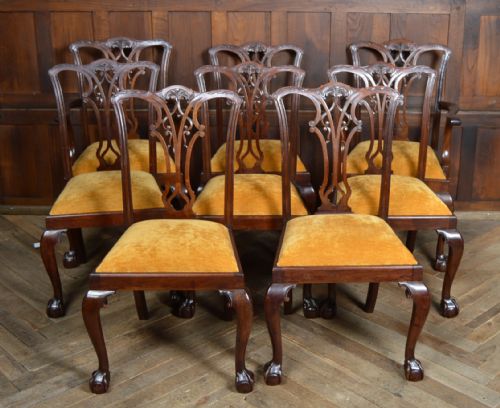
Forms range from smaller drop-leaf tables to large extending dining tables designed to seat ten or twelve guests, often accompanied by matching dining chairs or sideboards.
How they were made
Makers utilised solid timbers and selected veneers such as flame mahogany and burr walnut, applying them over sturdy construction frames. Carving is executed directly into the solid wood of the cabriole legs, shaping the distinctive ball and claw terminals by hand.
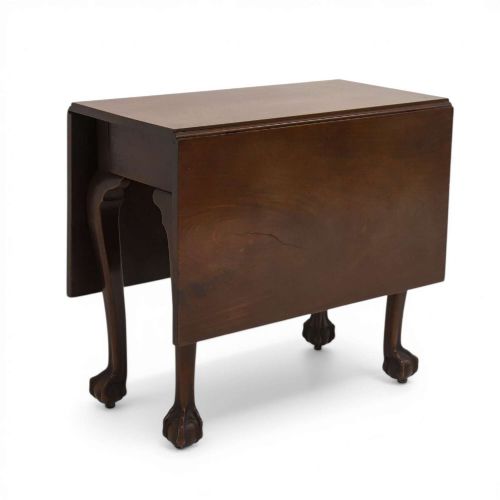
Extending mechanisms on later Victorian and Edwardian examples incorporate wind-out systems that allow the timber leaves to separate smoothly. Drop-leaf variants rely on hinged flaps supported by swing legs to alter the surface area.
Ball and Claw Dining Table Retail Price Guide 2026
Typical asking prices for ball and claw dining table among the pieces listed under this phrase on Sellingantiques today, from the lower quarter to the upper quarter. They describe what is for sale here now, not the wider market.
Materials recorded across the inventory include solid mahogany, bleached oak, burr walnut, and flame mahogany veneer.
What varies in quality
Quality reveals itself in the crispness and depth of the carved details on the claw-and-ball feet and the proportion of the cabriole legs. Finer examples display fluid, confident carving where the talons grip the sphere securely, whereas lesser pieces show shallow or mechanical execution.
The choice of primary timber and veneer figure dictates the visual depth of the surface, with richly grained mahogany and burr walnut representing the upper tier. Structural integrity, particularly in the smooth operation of extending mechanisms and the stability of drop-leaf hinges, separates utilitarian tables from superior examples.
Maple & Co·Gillows
The Ball and Claw Dining Table Glossary
- Cabriole leg
- A furniture leg that curves outward at the knee and tapers inward toward the ankle, finishing in a foot such as a claw and ball. This form originates from ancient Chinese designs and became prominent in European furniture during the eighteenth century.
- Piecrust tilt top
- A circular tabletop edged with a raised, carved moulded rim resembling pastry crust, often mounted on a pillar base that tilts horizontally for storage. This form appears on eighteenth-century centre tables.
- Wind out extending table
- A dining table that expands via an internal metal screw mechanism operated by a handle, separating the top to insert additional timber leaves. This system gained widespread use during the Victorian and Edwardian periods.
- Breakfront
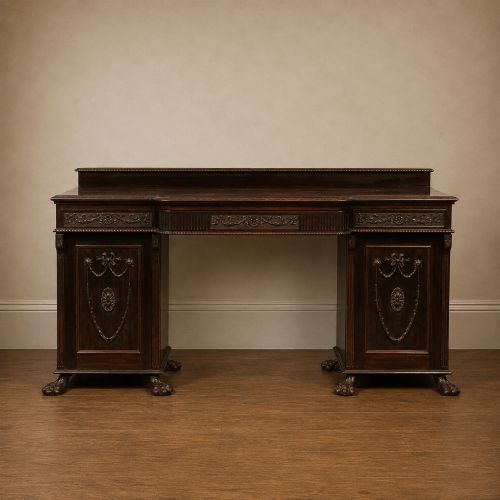
- A cabinet or sideboard whose central section projects forward from the flanking outer sections. This architectural arrangement creates varied shadow and depth on larger dining room furniture.
- Drop-leaf table
- A table featuring a fixed central section and hinged flaps on either side that fold down when not in use. These flaps raise to provide an expanded dining surface supported by swing legs.
Ball and Claw Dining Table: Frequently Asked Questions
What is a ball and claw foot?
A ball and claw foot is a carved furniture terminal depicting a bird's talon gripping a spherical ball. This motif draws inspiration from Chinese dragon designs before appearing widely in British furniture.
Craftsmen carved these feet at the base of cabriole legs on tables, chairs, and sideboards across multiple stylistic periods.
How do I date an extending table?
Dating relies on examining the timber, the construction of the frame, and the mechanical extension system. Eighteenth-century pieces use manual leaf insertion without metal wind-out gears.
Victorian and Edwardian versions often incorporate internal metal winding mechanisms alongside period-specific secondary woods and revival stylistic cues.
Are drop leaf tables stable?
Drop-leaf tables achieve stability through hinged swing legs that pivot outward to support the lowered flaps. When fully extended, these support legs bear weight securely beneath the joints.
Original eighteenth-century drop-leaf tables rely on precise timber tolerances to maintain a level dining surface.
How do I care for mahogany?
Mahogany requires stable indoor humidity away from direct heat sources and strong sunlight to prevent timber movement. Regular dusting with a soft, dry cloth preserves the polished surface.
Applying natural wax periodically nourishes the grain without building up heavy chemical residues.