






Balkan Woven Carpet
These balkan woven carpet pieces are flat-woven textiles carrying rich regional traditions, offering warmth and graphic character to any floor.
Balkan Woven Carpet
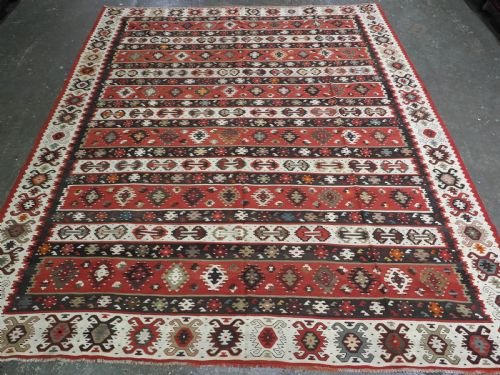
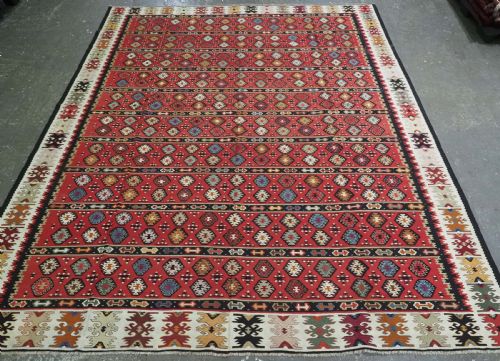
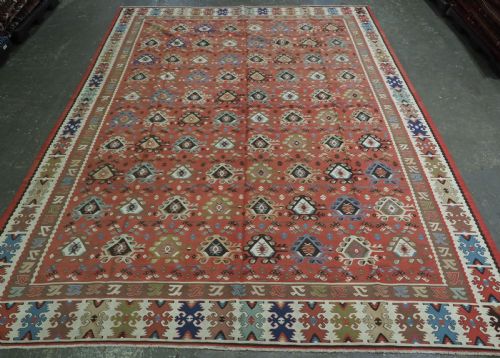
When you search for a balkan woven carpet, you are looking at flat-woven rugs and kilims originating from regions such as Pirot, Sarkoy, and Thracian territories. These textiles emerge predominantly from periods spanning the late nineteenth century through to the 1930s. The most common versions encountered on this page are antique Sarkoy and Pirot kilims featuring classic, banded, or repeat medallion designs.
The aesthetic embraces Balkan folk art, traditional motifs, and Ottoman Balkan influences. Pieces often arrive in large room sizes or as area rugs, displaying flowering trees, lattice patterns, and all-over repeat compositions. Soft reds, pastels, and warm warm colour palettes define the visual character of these particular flat-weaves.
Materials and Construction
These textiles are constructed primarily from wool and cotton, materials selected for durability and tactile quality. Weavers utilised traditional flat-weaving techniques without a pile, creating crisp graphic lines and reversible surfaces.
Natural dye traditions ensured that colours such as soft reds and gentle pastels aged gracefully over the decades. The resulting flat-woven structure provides a sturdy floor covering that maintains its geometric precision across large room formats.
Listings span periods from 1860 to 1930, utilising wool and cotton materials across rug and kilim formats.
Evaluating Quality
Quality in these flat-weaves rests upon the crispness of the woven design and the harmony of the colour palette. Pieces featuring scarce lattice layouts or intricate flowering tree motifs demonstrate superior design ambition.
The preservation of the wool and cotton fibres alongside the vibrancy of soft or warm tones distinguishes finer examples. Uniformity in the flat-weave structure and large room proportions also elevate individual pieces within the range.
The Balkan Woven Carpet Glossary
- Kilim
- A flat-woven carpet or rug produced without a pile. These textiles rely on interlocking weft threads to form geometric and floral patterns.
- Pirot
- A town renowned for its traditional flat-woven kilims. Pirot pieces typically exhibit sharp geometric motifs and double-sided designs.
- Sarkoy
- A historic weaving centre associated with flat-woven floor coverings. Sarkoy kilims often incorporate banded layouts and traditional folk art motifs.
- Flat-weave
- A textile construction method where warp and weft threads are interlaced directly. This technique yields a thin, durable rug without raised pile.
- Banded design
- A decorative layout organised into horizontal bands or stripes. This arrangement frequently structures the field of Balkan and Anatolian kilims.
Balkan Woven Carpet: Frequently Asked Questions
How were these rugs used originally?
These flat-weaves served primarily as functional floor coverings in homes across the region. Their sturdy wool construction provided insulation against cold floors.
Larger examples were designed to anchor main living spaces, while smaller formats suited utility areas or wall hanging.
How do I care for a flat-woven kilim?
Living with these textiles requires gentle maintenance such as regular light vacuuming without a rotating brush. Keeping them out of direct sunlight helps preserve the natural dyed wool colours.
Professional specialist cleaning is recommended when deeper maintenance becomes necessary.
How do I identify a Sarkoy kilim?
Sarkoy kilims are recognised by their specific banded or repeat patterns and soft colour palettes. They often feature traditional folk motifs rooted in Ottoman Balkan styling.
Examining the weave structure and wool quality assists in confirming their nineteenth or early twentieth-century origins.