
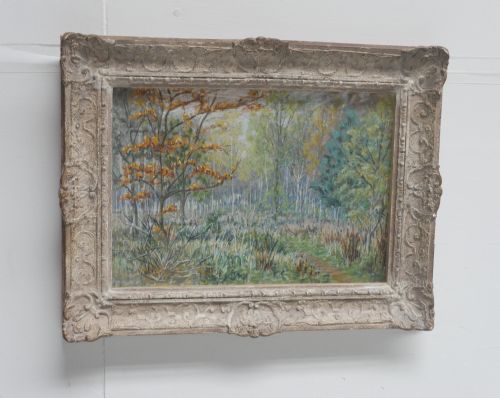


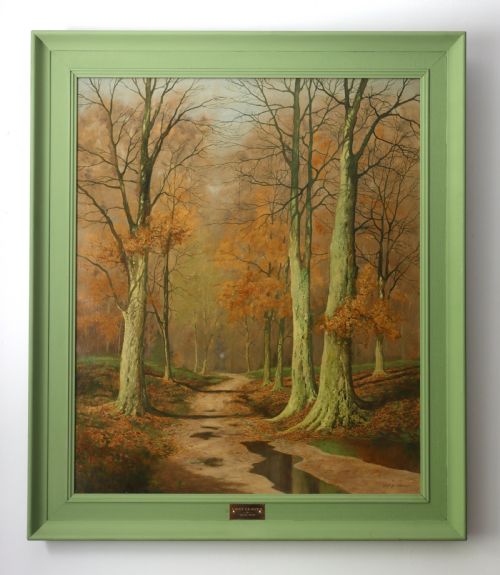

Autumn Woodland Artwork
Autumn woodland artwork captures seasonal trees and rivers in pastel, oil, and watercolour from the Victorian era to the mid-twentieth century.
Autumn Woodland Artwork
Buyers seeking autumn woodland artwork encounter landscapes executed in mediums such as oil on canvas and watercolour on paper. These pieces span periods from the nineteenth century through to nineteen sixty, capturing seasonal foliage and natural settings.
The most common examples on this page include oil paintings and watercolours framed in wood and gilded wood, often housed under glass. Works range in style from British Impressionism and Victorian Naturalism to traditional realism and English country house aesthetics.
How these pieces were made
Artists painted autumn woodland scenes using oil pigments on stretched canvas or applied watercolours and pastels onto paper surfaces. Many works are paired with wooden frames, some finished in gilded wood.
The physical construction relies on traditional painters' supports, with paper works commonly protected beneath glass and canvas works retaining their original stretchers.
Listings feature periods from the nineteenth century to nineteen sixty, utilising oil on canvas, watercolour on paper, pastel, and gilded wood.
What varies in quality
Quality differences appear in the handling of light and seasonal colour within the landscape, distinguishing accomplished brushwork from simpler renderings. The depth of composition and the fidelity of the natural scene separate standard decorative pieces from notable works.
Framing also distinguishes the tier of a piece, with period gilded wood frames offering greater historical integrity than later replacements.
Arthur Herbert Rigg·Owen Bowen·William Mellor·Walter Follen Bishop·Edmund George Warren·Charles James Adams·Ernest Higgins Rigg·J McIntyre·Everett W. Mellor
The Autumn Woodland Artwork Glossary
- Oil on Canvas
- Pigments bound in drying oil applied to a woven fabric stretched across a wooden frame. This medium allows for rich texture and deep colour layering.
- Watercolour on Paper
- Pigments suspended in a water-soluble vehicle applied to paper supports. It creates luminous washes well suited to atmospheric landscape scenes.
- Pastel
- A medium composed of powdered pigment and a binder rolled into stick form. It produces velvety colour applications on paper surfaces.
- Gilded Wood
- Wooden framing treated with a thin layer of gold leaf or metallic gilt. This finish enhances the visual weight of nineteenth-century and early twentieth-century presentations.
- British Impressionism
- A painting movement focusing on light and everyday subjects in a looser brush style. It gained prominence in the late nineteenth and early twentieth centuries.
Autumn Woodland Artwork: Frequently Asked Questions
What periods do these autumn woodland artworks cover?
The selection spans from the Victorian era and the late nineteenth century through to nineteen sixty. Examples include works dated nineteen hundred, nineteen ten, nineteen fifty, and nineteen sixty.
These dates reflect traditional realist, Victorian naturalism, and post-war vintage styles represented across the inventory.
How should I frame and display these watercolours?
Watercolours on paper require protection behind glass to prevent atmospheric damage to the pigment. Framing should include acid-free mounts to separate the paper from the glazing.
Display these pieces away from direct sunlight to preserve the delicate pastel and watercolour tones.
What is the difference between oil paintings and watercolours here?
Oil paintings utilise pigment bound in oil on canvas or wood panels, offering heavier texture and durability. Watercolours employ water-soluble pigments on paper, yielding lighter, translucent effects.
Oils are generally displayed without glass protection, whereas paper works require glazing.
Are these artworks signed by the artists?
Several pieces feature signatures from listed artists such as Arthur Herbert Rigg, Walter Follen Bishop, and Charles James Adams. Other works are attributed through traditional stylistic markers or period inscriptions.
Signatures help verify the origin within British landscape painting traditions.