
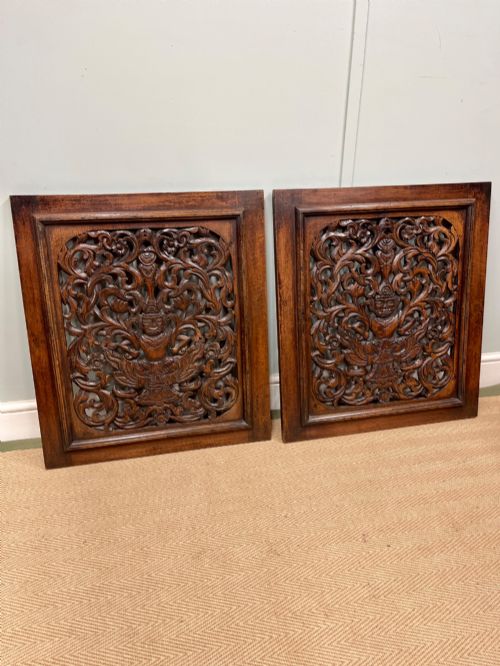


Asian Carved Plaque
An asian carved plaque brings complex depth and narrative artistry to a wall, offering rich cultural history through finely worked wood, lacquer, and jade.
Asian Carved Plaque
When you search for an asian carved plaque, you encounter a diverse range of wall-hung art spanning multiple centuries and regions across Asia. The examples available here typically take the form of wooden panels, temple carvings, wall hangings, and framed reliefs originating from China, Japan, Burma, India, and Southeast Asia.
Materials and Techniques
Carvers utilised dense timbers such as teak and general hardwoods, frequently enhancing the wooden surfaces with gold leaf, paint, or dark lacquer. Skilled artisans also incorporated shell inlay like mother-of-pearl and abalone to create contrasting details on floral and avian motifs.
Certain works employ specialist decorative techniques including cloisonne enamel and hardstone carving, particularly jade. Panels and cart doors from these periods rely on deep relief carving to build dimension and narrative complexity into the material.
Daruma stares out from a nineteenth-century plaque, reminding viewers of steady persistence through every historical shift.
Judging Quality and Execution
Quality in these pieces rests upon the crispness and depth of the carving, where master carvers achieved remarkable articulation in foliage, figures, and animal forms. The fineness of inlay work and the preservation of original gilt wood, paint, or lacquer surfaces also distinguish finer examples.
The structural integrity of the wood, the complexity of composition such as double-sided carving, and the overall coherence of the design elevate certain panels well beyond standard decorative items.
The Asian Carved Plaque Glossary
- Giltwood
- Wood that has been treated with gold leaf or a gold-coloured finish. This technique highlights carved details and adds reflective warmth to temple panels.
- Cloisonne
- An ancient technique for decorating metalwork objects with coloured glass paste separated by strips of metal wire. It appears on masterwork Japanese chargers and plaques.
- Lacquer
- A durable resin finish applied in multiple layers to wood and polished to a smooth sheen. It frequently serves as a dark background for inlaid shell or painted foliage.
- Hardstone
- A term for semi-precious stones such as jade used in intricate carving. These materials demand high skill to shape into detailed figures and dragons.
- Relief
- A sculptural technique where figures and motifs project from a flat background. Deep relief carving creates strong shadow play and three-dimensional depth on wall panels.
Asian Carved Plaque: Frequently Asked Questions
How were asian carved plaques originally used?
Many of these pieces functioned as architectural elements within temples, homes, or official buildings, often mounted as interior wall panels or architectural doors.
Others served purely as decorative wall art or displays within traditional interiors to signal status and showcase master craftsmanship.
How do I hang a heavy wooden plaque?
Due to the substantial weight of dense timbers like teak and hardwood, secure wall fixings and appropriate brackets are essential.
Consult a professional framer or installer to ensure the weight is evenly distributed without stressing the ancient wood.
How should I care for antique lacquer and wood?
Keep these pieces away from direct sunlight, high humidity, and sudden temperature fluctuations to prevent the wood from splitting and the lacquer from cracking.
Dust gently with a dry, soft cloth and avoid chemical polishes that can damage aged painted or gilded surfaces.
How do I tell different regional styles apart?
Chinese panels frequently display deep wood carving, lacquering, and motifs like dragons or detailed court figures, often tied to Qing Dynasty aesthetics.
Japanese pieces tend to emphasise refined lacquerwork, folk art traditions, or specific subjects like Daruma, while Indian and Burmese examples showcase distinct narrative reliefs and figural styles.