

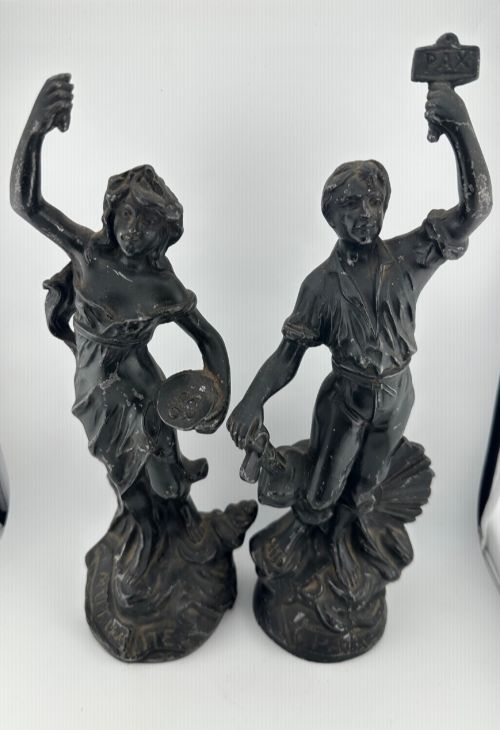





Art Nouveau Spelter
Art nouveau spelter pieces bring flowing organic lines and romantic figurative subjects directly into your home.
Art Nouveau Spelter
When you search for art nouveau spelter, you encounter decorative objects shaped by the flowing organic aesthetics of the late nineteenth and early twentieth centuries. These pieces typically take the form of table lamps, figures, statues, mantel clocks, and table mirrors created during the height of the movement. You are most likely to meet French figurative sculptures and lighting mounted on marble or onyx bases.
The objects capture the characteristic whiptail curves, floral motifs, and stylised female models associated with the turn of the century and the French Belle Epoque. Makers utilised the malleable alloy to cast intricate drapery, hair, and botanical elements that define the style. These works served primarily as decorative ornaments or functional lighting for domestic interiors.
How they were made
Foundry workers cast the zinc-based alloy into detailed moulds, frequently finishing the surface with metallic paints, silvering, or patination to emulate bronze. Artisans combined the metal with contrasting materials such as Verdi green marble, brass, and glass to create substantial bases and lamp components.
Makers often signed their casts directly on the metal or integrated signatures into the sculptural base before applying the final surface treatment. Sculptures were sometimes paired with fabric shades or integrated into complex mantel clock housings alongside brass and wood elements.
Art Nouveau Spelter Retail Price Guide 2026
Typical asking prices for art nouveau spelter among the pieces listed under this phrase on Sellingantiques today, from the lower quarter to the upper quarter. They describe what is for sale here now, not the wider market.
Some figures bear cheerful allegorical titles like Gaiete, bringing a touch of nineteenth-century optimism straight to the mantelpiece.
What varies in quality
The crispness of the cast detail separates standard production runs from superior artistic outputs, particularly in the rendering of facial expressions, hair, and botanical motifs. Finer examples retain delicate surface finishing, original patination, or silvering rather than later repainting.
The choice of supporting materials significantly impacts the overall presence of the piece, with dense marble and onyx bases indicating higher ambition than simpler metal mounts. Well-preserved original mounts and integrated lamp hardware distinguish the best-surviving domestic items.
L & F Moreau·Auguste Moreau·Moreau
The Art Nouveau Spelter Glossary
- Spelter
- A zinc-based alloy commonly used as an economical alternative to bronze for nineteenth-century decorative figures and lamps. It accepts patination and metallic paint readily.
- Art Nouveau
- An international style of art and architecture prevalent from the 1890s to the First World War, characterised by sinuous lines and motifs inspired by nature.
- Patina
- The surface appearance acquired by metal through age, wear, or chemical treatment applied during manufacture to simulate an aged bronze finish.
- Verdi green
- A mottled green coloration frequently found on marble bases or patinated metal surfaces associated with French decorative arts of the period.
- Figural lamp
- A lighting fixture incorporating a sculpted human or allegorical figure as the primary structural and aesthetic element of the design.
Art Nouveau Spelter: Frequently Asked Questions
What is spelter metal?
Spelter is a zinc alloy that found widespread use across the nineteenth and early twentieth centuries for decorative sculptures, clocks, and lamps. It allowed foundries to produce intricate castings at a lower cost than bronze.
Because the metal is relatively soft, objects made from it require careful handling to preserve delicate details and surface finishes. Manufacturers typically applied patination, silvering, or paint to give the alloy a richer appearance.
How do I date these pieces?
Dating relies on stylistic markers of the Art Nouveau movement alongside materials like Verdi green marble bases and cast-metal techniques. Most examples date from the late nineteenth century through the Edwardian era up to the 1930s.
Maker signatures inscribed on the cast figures provide a reliable anchor for dating specific works. Structural clues, such as early wiring methods or original lamp fittings, also help place an object in its correct period.
Where were they made?
The majority of these decorative figures and lamps originate from French foundries working during the Belle Epoque. French artists and makers dominated the production of stylistic domestic ornaments during this era.
Export records and stylistic evidence show these pieces were distributed widely across Europe and Britain for middle-class and elite domestic interiors.
How do I care for spelter?
Maintain the surface by dusting gently with a dry, soft cloth, avoiding commercial metal polishes that can strip original patination or paint. Keep the pieces away from moisture and direct sunlight to protect both the metal and any accompanying marble or onyx bases.
When handling figural lamps or mirrors, support the heaviest parts of the object rather than lifting solely by delicate cast extremities or arms.